Table of Contents >> Show >> Hide
- Why upper back pain happens (and why stretching helps)
- Quick safety check (please don’t stretch through red flags)
- How to stretch for maximum relief (without overdoing it)
- The 8 best stretches for upper back pain relief
- 1) Cat-Cow (thoracic + whole-spine mobility)
- 2) Thread the Needle (thoracic rotation + between-the-shoulder-blades relief)
- 3) Open Book (side-lying thoracic rotation)
- 4) Doorway Pec Stretch (opens the chest; reduces rounded-shoulder tension)
- 5) Child’s Pose with Side Reach (lats + upper back)
- 6) Seated Thoracic Rotation (desk-friendly “wring out the spine” stretch)
- 7) Foam Roller Thoracic Extension (a.k.a. “give your upper back permission to un-hunch”)
- 8) Cross-Body Shoulder Stretch (rear shoulder + upper back tension)
- A simple 10-minute routine (do this when your upper back starts complaining)
- Habits that make upper back relief last longer
- Real-life experiences: what people notice when they start stretching (about )
- Conclusion
If your upper back feels like it’s wearing a tiny, invisible backpack full of bricks, you’re not alone.
That “between-the-shoulder-blades” ache is one of the most common complaints from desk work, phone hunching,
driving, stress-clenching, and “I swear I had good posture in 2019” living.
The good news: for a lot of people, upper back pain is driven by tight muscles, stiff joints in the thoracic spine
(the mid/upper part of your spine), and shoulders that creep forward like they’re trying to read your texts.
Smart stretching can help you feel looser fastand keep you from replaying the same pain episode on loop.
Why upper back pain happens (and why stretching helps)
Your upper back (thoracic spine) is designed to moveespecially to rotate and extend (think: opening your chest,
standing tall, twisting to look behind you). But modern life rewards the opposite position: rounded shoulders,
forward head, and a mid-back that stays stuck in flexion for hours.
Over time, two things often happen:
- Your chest and front-of-shoulder tissues tighten, which encourages slumping and makes your shoulder blades work harder.
- Your thoracic spine gets stiff, so your neck and lower back compensate. (They’re helpful… until they’re cranky.)
Stretching targets both problems: it opens the front of the body, restores thoracic mobility, and reduces the “guarding”
that makes everything feel glued together. It’s not magicit’s mechanics (with a side of “finally, I can breathe fully again”).
Quick safety check (please don’t stretch through red flags)
Stretching is generally safe for mild-to-moderate muscle tension. But pause the DIY plan and get medical guidance if you have:
- pain after a fall, accident, or direct blow
- unexplained fever, swelling/redness, or feeling generally unwell
- unintended weight loss
- numbness, tingling, weakness, or symptoms spreading into an arm/leg
- pain that’s constant, severe at night, or not improving after a week of home care
Also: if a stretch causes sharp pain, dizziness, or worsening symptoms, stop. The goal is “pleasant pull,” not “auditioning for a pain documentary.”
How to stretch for maximum relief (without overdoing it)
- Warm up first: 5–10 minutes of easy movement (walk, gentle arm swings, marching in place).
- Hold steady: For most static stretches, aim for about 20–30 seconds. If you’re very tight, longer holds can helpwithout forcing it.
- Repeat: 2–4 rounds per side works well for most people.
- Breathe: Slow inhales and longer exhales help your nervous system “allow” the stretch.
- No bouncing: Smooth and controlled beats springy and chaotic.
The 8 best stretches for upper back pain relief
Pick 4–6 that feel best, or do all 8 as a short routine. You’ll get the most benefit if you do them consistently
(even 5–10 minutes a day can make a difference).
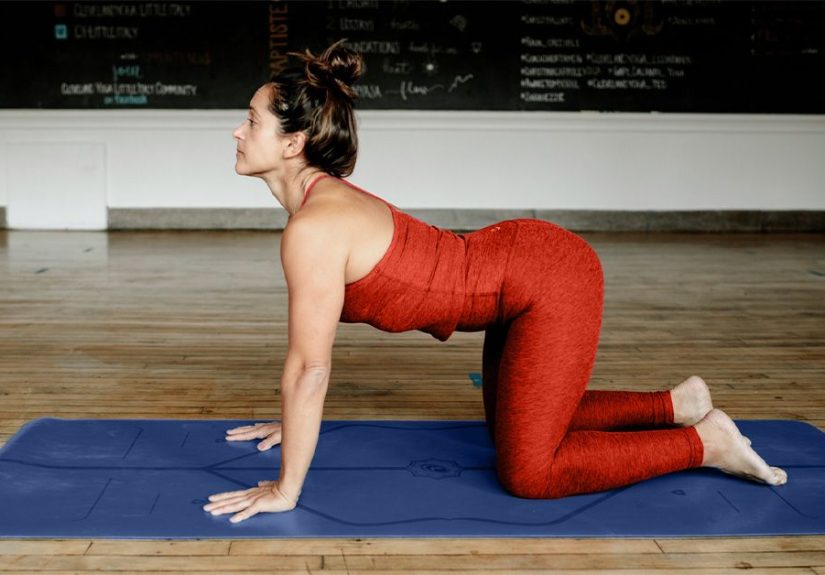
1) Cat-Cow (thoracic + whole-spine mobility)
Why it helps: Gentle motion improves spinal mobility and reduces stiffness from prolonged sitting.
- Start on hands and knees (hands under shoulders, knees under hips).
- Cow: Inhale, lift your chest and tailbone, and let your belly soften as your upper back gently extends.
- Cat: Exhale, round your upper back, gently tuck your pelvis, and let your head relax.
- Move slowly, syncing one full breath with each position.
Dosage: 5–10 slow reps.
Make it easier: Do it seatedhands on thighs, gently arch and round through the upper back.
2) Thread the Needle (thoracic rotation + between-the-shoulder-blades relief)
Why it helps: Rotates the thoracic spine and stretches the upper back and rear shoulder.
- Start on hands and knees.
- Slide your right arm under your left arm, palm facing up, letting your right shoulder move toward the floor.
- Keep your hips mostly stacked over your knees (don’t dump your weight into the low back).
- Hold where you feel a comfortable twist and stretch.
Dosage: Hold 20–30 seconds; 2–3 rounds per side.
Pro tip: Breathe into your ribsyour chest should feel like it’s gently expanding in all directions.
3) Open Book (side-lying thoracic rotation)
Why it helps: Improves mid-back rotation while keeping the low back from stealing the show.
- Lie on your left side with hips and knees bent about 90 degrees.
- Stack your knees together (you can place a pillow between them if needed).
- Reach your arms forward, palms together.
- Open your right arm across your body toward the floor behind you, rotating through the upper back.
- Let your head follow your hand if it feels comfortable.
Dosage: 6–10 slow reps per side, or hold the open position 20–30 seconds.
Common mistake: Letting the top knee liftkeep knees stacked to target the thoracic spine.
4) Doorway Pec Stretch (opens the chest; reduces rounded-shoulder tension)
Why it helps: Tight chest muscles can pull shoulders forward and overload the upper back.
- Stand in a doorway.
- Place your forearms on the doorframe with elbows around shoulder height (or slightly lower if needed).
- Step one foot forward and gently lean until you feel a stretch across the chest/front shoulders.
- Keep ribs downavoid flaring your chest like you’re posing for a superhero poster.
Dosage: Hold 20–30 seconds; repeat 2–3 times.
Make it easier: Do one arm at a time with the elbow lower than shoulder height.
5) Child’s Pose with Side Reach (lats + upper back)
Why it helps: Stretches the lats and upper back, which can feel tight from overhead work or desk posture.
- Kneel and sit back toward your heels (use a pillow between calves/thighs if needed).
- Reach arms forward and let your chest sink toward the floor.
- For a side reach: walk both hands to the right to stretch the left side of your upper back; then switch.
Dosage: Hold 20–40 seconds each direction.
If knees don’t love it: Do a “desk child’s pose”: hands on a table, sit hips back, chest drops between arms.
6) Seated Thoracic Rotation (desk-friendly “wring out the spine” stretch)
Why it helps: Restores rotation without requiring you to get on the floor at work (or in a parking lot).
- Sit tall with feet flat.
- Cross arms over your chest, or place one hand behind your head (elbow out to the side).
- Rotate your ribcage to the right while keeping hips facing forward.
- Pause at the end range and breathe.
Dosage: Hold 15–25 seconds per side; 2–3 rounds.
Pro tip: Think “rotate from the bra line,” not “yank from the neck.”
7) Foam Roller Thoracic Extension (a.k.a. “give your upper back permission to un-hunch”)
Why it helps: Encourages thoracic extensiongreat if you feel stiff, rounded, or locked up after sitting.
- Lie on your back with a foam roller across your upper back (around the shoulder blade level).
- Support your head with your hands (elbows forward).
- Gently extend your upper back over the roller as you exhalesmall, controlled movement.
- Return to neutral; shift the roller slightly up or down and repeat.
Dosage: 6–10 slow reps at 2–3 spots.
Make it easier: Use a rolled towel instead of a foam roller (softer, less intense).
Avoid: If you feel pinching in the low back, bring ribs down and keep the motion small.
8) Cross-Body Shoulder Stretch (rear shoulder + upper back tension)
Why it helps: Targets the back of the shoulder and can ease the “tight strap” feeling near the shoulder blade.
- Stand or sit tall.
- Bring your right arm across your chest.
- Use your left hand/forearm to gently pull the arm closer (without hiking your shoulder up to your ear).
- Keep your torso facing forwardno twisting to “cheat” the stretch.
Dosage: Hold 15–30 seconds; repeat 2–3 times per side.
Quick posture check: Relax your neck and let your shoulder blade stay down and back.
A simple 10-minute routine (do this when your upper back starts complaining)
- Cat-Cow: 8 reps
- Thread the Needle: 25 seconds each side
- Doorway Pec Stretch: 30 seconds
- Open Book: 6 reps each side
- Foam Roller Thoracic Extension (or towel): 6 reps at 2 spots
- Child’s Pose with Side Reach: 30 seconds each direction
- Cross-Body Shoulder Stretch: 20 seconds each side
- Seated Thoracic Rotation: 20 seconds each side
If you’re short on time, do “the big three”: Doorway Pec Stretch + Open Book + Foam Roller Thoracic Extension.
That combo hits the usual suspects: tight chest + stiff thoracic spine.
Habits that make upper back relief last longer
1) Fix the “sitting tax” with micro-breaks
Your body doesn’t hate sitting. It hates sitting without change. Stand up every 30–60 minutes, even for 30 seconds.
Do a couple shoulder rolls, a quick doorway stretch, or a seated rotation. Small resets add up.
2) Upgrade your workstation (no need for a spaceship desk)
- Screen: Bring it closer and closer to eye level so you’re not craning your neck forward.
- Keyboard/mouse: Keep them close so your shoulders can relax instead of reaching all day.
- Chair: Sit back, feet supported, and avoid perching on the edge like you’re about to flee.
3) Pair stretching with light strength
Stretching opens the door; strength keeps it from swinging shut again. A few times a week, add gentle
upper-back work (like shoulder blade squeezes, rows with a band, or wall slides). If you’re not sure where to start,
a physical therapist can tailor it to your posture and pain triggers.
4) Don’t ignore stress (your shoulders definitely don’t)
Stress commonly shows up as “shoulders in earrings” posture. Try this: exhale slowly and let your shoulders drop.
Repeat three times. Congratsyou just did a nervous-system stretch. It counts.
Real-life experiences: what people notice when they start stretching (about )
People often expect stretching to feel like flipping a switch: stretch once, pain disappears forever, credits roll.
In real life, it’s more like training a stubborn housecat to accept being held. Progress happens, but it’s usually
a mix of quick wins and slow, steady change.
A very common first-week experience is “Wow, I didn’t realize how tight I was.” The doorway pec stretch can be
especially eye-opening. Desk workers and students who spend hours on laptops often feel an immediate sense of
“front-of-the-body tightness” they didn’t know they had. After a few rounds, they’ll report that their shoulders
rest a little farther back, their neck feels less loaded, and breathing feels easierlike their ribcage has more room.
Another frequent pattern: rotation feels weird at first. With open books and thread-the-needle, many people notice
one side moves smoothly while the other side feels stuck. That asymmetry can come from sports (always swinging the
same way), one-shoulder bag habits, driving posture, or always turning to one side at a workstation. The good news is
that the “stuck side” often improves quickly when you practice gently and breathe. The reminder here is important:
if you crank into the twist, your body tightens defensively. If you ease in, the range tends to show up with less drama.
People who try the foam roller thoracic extension often describe a “posture reset” feeling afterwardlike their upper back
can finally stand upright without effort. The most useful feedback is usually not “it hurt less instantly” but
“I can sit taller without feeling stiff.” That’s a huge win, because better thoracic extension means your neck
and shoulders don’t have to overwork to keep your head up.
It’s also normal to feel mild soreness in the first week, especially if you’ve been stiff for a long time. That doesn’t mean
stretching is bad; it often means you asked tissues to move in a way they haven’t moved recently. The line in the sand
is sharp pain or worsening symptoms. Most people do best when they start with shorter holds, fewer reps, and a relaxed pace.
One of the most honest long-term experiences is this: consistency beats intensity. People who “go hard” once a week often
feel temporary relief, then rebound tightness. People who do 5–10 minutes most days tend to report fewer flare-ups,
less end-of-day stiffness, and better awareness of when their shoulders start creeping forward. They also start catching
their posture earlierbefore pain buildslike noticing, “Oh, I’m hunching,” and doing two quick stretches instead of
waiting for their upper back to file a formal complaint.
Finally, many people discover that the best stretch is the one they’ll actually do. If getting on the floor is a barrier,
seated rotations, doorway stretches, and desk child’s pose can still make a meaningful difference. The goal isn’t a perfect
routineit’s a repeatable one that helps your upper back feel calmer, looser, and more resilient.
Conclusion
Upper back pain often improves when you restore thoracic mobility, open the chest, and reduce the daily posture “tax.”
Start with the 8 stretches above, use the 10-minute routine when stiffness shows up, and combine stretching with better
workstation setup and light strengthening for longer-lasting relief. And if symptoms are severe, persistent, or paired with
red flags, get checked outsmart care beats toughing it out.