Table of Contents >> Show >> Hide
- What This 336 LED Display Actually Is
- Why Seven-Segment Displays Still Rule
- How a Build Like This Works Under the Hood
- What Makes This One More Than a Big Number Board
- The Hardware Choices That Sell the Look
- Why This Project Resonates With Makers
- Lessons You Can Steal for Your Own Display Projects
- The Experience of Watching a 336 LED Digit Display in Real Life
- Conclusion
Some hardware projects are useful. Some are clever. And some stroll into the room, glow like a haunted arcade cabinet from an alternate 1987, and make you whisper, “Okay, that is absurdly cool.” This 336 LED digit display belongs in that third category. It is the kind of build that reminds you why people still lose sleep over seven-segment displays long after phones, tablets, and OLED panels took over the planet.
At first glance, the piece looks like a wall of vintage orange numbers. Then your brain starts doing cartwheels. It is not just showing digits. It is behaving like a visual instrument. It fades, shifts, and turns a grid of segmented numeric displays into something halfway between industrial signage, retro computing, and electronic art. That tension is what makes it special. It is familiar enough to feel nostalgic, but strange enough to feel new.
And that is the real magic of a project like this: it takes one of the most limited visual formats in electronics and pushes it until it starts acting like a low-resolution cinema screen with a superiority complex.
What This 336 LED Display Actually Is
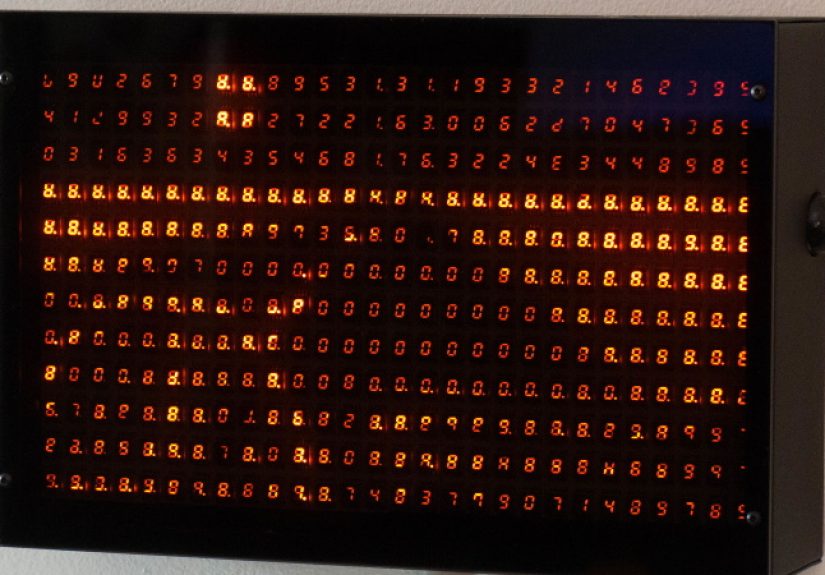
The display widely known by the wonderfully dramatic title Bask In The Glory Of This 336 LED Digit Display refers to Chris Combs’ art piece Road Ahead. The build uses 336 individual seven-segment numeric LED displays arranged across 14 custom boards. On paper, that sounds like a giant pile of digits. In practice, it becomes a dense field of controllable glowing segments that can show numbers, grayscale imagery, motion, and stylized visual effects.
That distinction matters. This is not just a bigger clock, a beefier counter, or the world’s most overqualified microwave timer. It is a purpose-built artwork that uses numeric hardware as a graphic medium. The display is driven as a contiguous visual surface, not merely as 336 independent number modules. That design choice is why it feels so hypnotic. You are not looking at isolated digits. You are looking at a segmented pixel field disguised as a number wall.
The finished piece also leans hard into its aesthetic identity. Instead of making the enclosure warm and friendly, the build embraces a colder, more machine-like presence. Smoked acrylic softens the orange light just enough to create diffusion, while a powder-coated steel enclosure gives it the stern face of old industrial equipment. The result is retro, but not cute. It feels more like a panel from a serious machine that might know something you do not.
Why Seven-Segment Displays Still Rule
Seven-segment displays are one of the most stubbornly effective interfaces in electronics. They do not do much, but what they do, they do with swagger. Each digit is built from seven LED segments, with an optional decimal point, arranged to form the numbers 0 through 9 and a handful of letters if you are willing to accept some alphabet-related compromises. Nobody looks at a seven-segment display and says, “Ah yes, excellent typography.” But everybody understands it instantly.
That is why this format has lasted so long in calculators, meters, test equipment, timers, and industrial controls. It is bright, legible, and brutally direct. There is no mystery. No decorative nonsense. Just glowing segments telling you what is happening right now. In a world packed with soft, polished interfaces, seven-segment displays still hit like a wrench on a metal workbench.
They are also wonderfully modular. A single digit is simple. A four-digit cluster is useful. A wall of 336 digits is what happens when restraint takes the day off.
How a Build Like This Works Under the Hood
Each digit is simple. The system is not.
At the component level, a seven-segment display is straightforward. Each segment is an LED, and each LED needs the right polarity, current limiting, and control logic. Common-anode and common-cathode arrangements determine how segments are turned on, and even a single basic display can eat through microcontroller pins faster than free pizza disappears at a hackerspace.
Scale that up to 336 digits and the wiring problem becomes delightfully rude. You are no longer dealing with a beginner electronics exercise. You are managing thousands of luminous elements, synchronization, timing, brightness control, and data movement without turning the project into a nest of sadness.
Why driver chips matter
This is where LED driver ICs earn their paycheck. Instead of asking a microcontroller to directly babysit every segment, modern display drivers handle scanning, multiplexing, and brightness control more efficiently. In smaller projects, chips such as the MAX7219 are popular because they can drive up to eight digits while handling decoding, scan circuitry, and current control. In more flexible matrix-style builds, constant-current drivers make it possible to treat the display more like a programmable lighting surface.
For Road Ahead, the build uses IS31FL3733 matrix controllers, one per display board. That matters because these drivers support individual PWM control, which opens the door to grayscale effects instead of simple on/off segment behavior. Once you have that level of control, a seven-segment display stops being just a digit engine and starts becoming a very weird graphics card.
Multiplexing: the old trick that still works
Large LED systems usually depend on multiplexing, which is the polite engineering term for “turn things on and off so quickly that human eyes happily believe the lie.” Rather than powering every segment continuously through dedicated control lines, multiplexed systems scan rows, columns, or digits in rapid succession. Done well, the result looks steady and bright. Done badly, it looks like a haunted elevator panel.
That is one reason large segmented displays are so interesting. They sit at the intersection of hardware limitations and perceptual psychology. The display does not have to be driven in the most literal way. It only has to be driven in a way that appears continuous, stable, and expressive to the viewer.
What Makes This One More Than a Big Number Board
The killer idea in this project is that the software treats the hardware as a single graphical surface. That is a very different mindset from the usual “digit one shows this, digit two shows that” approach. Chris Combs’ software maps a pixel grid onto the physical locations of the LED segments, samples the relevant image data, and translates it into brightness values for each segment. In other words, the software is not merely writing characters. It is rendering.
That is why grayscale imagery becomes possible. Because each segment can be driven at varying brightness levels through PWM, the display can create motion and shading instead of just numerals. The resolution is comically low compared with modern screens, but that is part of the charm. Low resolution forces style. You stop chasing realism and start embracing suggestion, silhouette, and visual rhythm.
There is also something deliciously rebellious about turning seven-segment digits into pseudo-pixels. These components were designed to be obedient little number machines. Here, they are cast in an art role they were never supposed to get, and they absolutely run with it.
The Hardware Choices That Sell the Look
The electronics are impressive, but the physical presentation is what seals the deal. Big segmented displays often fail visually because they reveal too much. You can see the individual emitters too clearly, the panel lacks depth, or the frame feels like an afterthought. This build avoids that trap.
Smoked acrylic is a huge part of the effect. Diffusion and spacing matter in LED work because the human eye is fast to notice hotspots, separated points of light, and uneven brightness. A well-chosen front panel softens the segments without killing their crispness. That makes the numbers and graphics feel more unified, more deliberate, and more cinematic.
The steel enclosure helps too. A wooden case can make electronics feel handcrafted and cozy. That is great for some projects. This one wanted menace. The colder enclosure gives the display authority. It feels like something recovered from a mainframe room, a control console, or a science-fiction prop department that was suspiciously overqualified.
Even the orange glow matters. Orange seven-segment LEDs hit a sweet spot between visibility and nostalgia. Red can feel clinical. Blue often looks modern but harsh. White can feel sterile. Orange says, “I was built to display numbers, but I also know where the secrets are buried.”
Why This Project Resonates With Makers
Makers love projects like this because they sit in the sweet spot between technical rigor and emotional payoff. The build is full of real engineering concerns: signal routing, controller selection, frame rate optimization, segment mapping, enclosure tolerance, sensor integration, and software architecture. But the output is not just functional. It is expressive.
That combination is rare. Plenty of electronics projects work beautifully and still leave viewers emotionally unchanged. This one gets a reaction. You can imagine it hanging in a gallery, a studio, a retro-tech collection, or a very intense hallway where guests immediately start asking questions.
It also proves a broader point: constraints are not the enemy of creativity. A seven-segment display is a highly constrained medium. It was born to show digits, maybe a couple of letters, and not much else. Yet by scaling it up, using PWM, adding diffusion, and thinking of segments as a visual field rather than isolated numerals, the project turns those constraints into style.
Lessons You Can Steal for Your Own Display Projects
If you are building anything with segmented LEDs, there are some excellent takeaways here. First, decide early whether your display is only functional or whether it also needs mood. That choice affects everything from LED color to enclosure material to diffusion strategy. Second, offload work wherever possible. Driver ICs, matrix controllers, and smarter communication schemes save you from reinventing misery at scale.
Third, think visually, not just electrically. A display is not finished when it lights up. It is finished when it looks right in a room, from a distance, behind a panel, under real viewing conditions. Fourth, do not underestimate software architecture. Once a display grows past hobby-demo size, good rendering logic and efficient updates matter as much as solder joints.
And finally, never apologize for making something gloriously impractical if it is genuinely beautiful. Not every circuit needs to solve a productivity problem. Sometimes the mission is simply to make people stare.
The Experience of Watching a 336 LED Digit Display in Real Life
Now for the part that spec sheets and block diagrams never quite capture: what it actually feels like to stand in front of a display like this. Not the engineering. Not the bill of materials. The feeling.
Imagine walking into a dim room and seeing a broad rectangle of orange segmented light floating behind smoked acrylic. From across the room, it does not immediately read as hundreds of individual digits. It reads as a presence. Your eyes catch the glow first, then the rhythm of the segments, then the realization that the whole surface is built from tiny numeric modules. It is one of those rare hardware moments where your brain shifts gears in real time.
Up close, the display becomes even stranger and better. You recognize the familiar grammar of seven-segment numerals, but the arrangement is so dense that it starts to feel architectural, almost like illuminated brickwork. Numbers appear, fade, and reorganize themselves. Then the system begins behaving less like signage and more like a living graphic texture. That transition is the hook. It turns a nostalgic hardware format into a visual event.
There is also a tactile quality to the way segmented light feels, even though you are only looking at it. Modern screens are so smooth that they almost erase their own physicality. A build like this does the opposite. You are constantly aware that there is real hardware behind every illuminated shape: real segments, real boards, real drivers, real timing. It feels mechanical in the best possible way.
The orange glow helps sell the illusion. It feels older, warmer, and somehow more trustworthy than many modern display colors. The smoked acrylic adds depth, which prevents the piece from looking like bare components bolted to a panel. Instead, the light seems to emerge from inside the object. That gives it a cinematic mood, like an instrument panel in a machine that was built for a task too dramatic to be explained casually.
There is a psychological trick happening too. Seven-segment displays are associated with clocks, counters, voltmeters, alarm radios, microwaves, calculators, and industrial equipment. Your brain brings all of that baggage to the viewing experience. So when the display starts showing grayscale motion or abstract imagery, it feels slightly illegal, like a toaster giving a TED Talk. The format is so tied to pure utility that expressive behavior becomes surprisingly powerful.
If you spent any time around older computers, arcade hardware, or electronic equipment with amber or orange displays, the nostalgia factor lands hard. But this is not cheap nostalgia. It is not trying to imitate the past with a fake vintage filter. It is using real display logic and real segmented hardware to make something that feels historically aware while still being artistically fresh.
That is why a project like this sticks in your memory. You do not just remember the number 336. You remember the mood: the glow, the machine-ness, the improbable elegance of turning rigid numeric displays into something expressive. You walk away thinking about segments, brightness, enclosure design, and why some pieces of hardware have more charisma than entire smart homes.
Conclusion
Road Ahead earns its reputation because it understands both engineering and theater. The 336-digit array is technically impressive, yes, but plenty of technically impressive builds are forgettable. What elevates this one is the way it turns old-school display language into a visual performance. It uses PWM, custom control boards, motion-triggered behavior, smart software, diffusion, and industrial styling to make a wall of digits feel alive.
That is the real glory here. Not just the quantity of LEDs, but the quality of the idea. A medium designed for plain numbers becomes a moody, grayscale, retro-futurist art object. That is the kind of project makers remember, viewers talk about, and search engines love because it delivers what the best hardware stories always do: real substance, real craft, and just enough madness to be unforgettable.