Table of Contents >> Show >> Hide
- The Tiny Computer With Big Budget Intentions
- Why RadioShack Built It in the First Place
- What Made the MC-10 So Cheap
- The Real Problem: Cheap Arrived at the Wrong Time
- Why It Never Became a Hit
- What the MC-10 Actually Got Right
- The Experience of Living With RadioShack’s Cheapest Computer
- Legacy: A Flop With Character
In the early 1980s, buying a home computer felt a little like shopping for a spaceship at a yard sale. Every month brought a new machine, a new promise, and a new reason to annoy your family by taking over the television. Into that noisy, plastic-fantastic battlefield marched one of the strangest little entries in RadioShack history: the TRS-80 MC-10 Micro Color Computer.
If the name sounds like it was generated by a committee trapped in a beige conference room, that is part of the charm. The MC-10 was RadioShack’s bargain answer to the low end of the home computer market, a machine aimed at beginners, hobbyists, and families who wanted color computing without paying full Color Computer money. In theory, it was a clever move. In practice, it became a perfect example of how being cheap is not always the same as being a good value.
This is the story behind RadioShack’s cheapest computer in its mainstream home-computer lineup: why it existed, what Tandy was trying to pull off, why the MC-10 looked promising on paper, and why the market basically looked at it and said, “Cute, but no thanks.”
The Tiny Computer With Big Budget Intentions
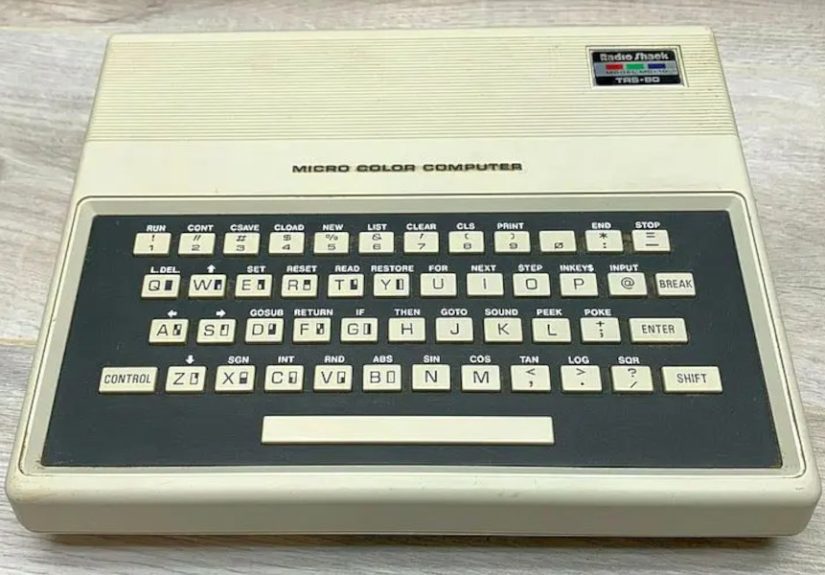
The machine at the center of this story is the TRS-80 MC-10, introduced in 1983 as a low-cost member of RadioShack’s broader computer family. It was marketed as a compact, beginner-friendly system that plugged into a color television and gave new users a relatively affordable way to learn programming, play simple games, and join the growing home computer craze.
At first glance, the MC-10 had a decent sales pitch. It was small, light, and much less intimidating than the larger TRS-80 Color Computer. It offered 4K of RAM, used Micro Color BASIC in ROM, and ran on a Motorola 6803 processor. It could display color graphics, save programs to cassette, and even connect to serial devices like printers. For someone who had never owned a computer before, that was enough to sound futuristic.
Better yet, the price looked friendly. The MC-10 debuted at roughly $119.95, with a 16K expansion module sold separately for about $49.95. That made it one of the cheapest color-capable home computers available through a major American retail chain. RadioShack clearly wanted a machine that could sit near the bottom of the price ladder and whisper to shoppers, “Come on, you can afford this one.”
And that whisper mattered. RadioShack had already built a reputation around mass-market computing. The original TRS-80 line helped normalize the idea that ordinary people could buy a fully assembled computer at a neighborhood electronics store. The MC-10 was supposed to continue that mission, only with a smaller footprint and a lower price tag. Think of it as the budget motel version of the computer revolution: not luxurious, but technically you were still on the trip.
Why RadioShack Built It in the First Place
To understand the MC-10, you have to understand the era. By 1983, the home computer market had become brutally competitive. Earlier low-cost machines like the Timex/Sinclair 1000 had proven there was real consumer appetite for inexpensive computers. At the same time, larger players such as Commodore, Atari, and Texas Instruments were cutting prices so aggressively that the entire market started to feel like a clearance aisle with microprocessors.
RadioShack did not want to surrender the entry-level segment. It already had the better-known Color Computer, but that machine sat higher in the lineup. The MC-10 was designed to act as a lower-cost doorway into the RadioShack ecosystem. In theory, a family might buy the MC-10 as a first machine, learn BASIC, maybe buy some software, and later move up to a bigger Tandy system. It was not just a product. It was a funnel.
That explains the computer’s marketing tone. RadioShack positioned it as an ideal first computer, emphasizing ease of use, size, affordability, and educational value. The included manual reportedly aimed to teach beginners how to operate the system and write their own programs. The message was simple: this was not a machine for corporate spreadsheets or elite hackers in dim basements. This was a friendly starter computer for normal people with normal budgets and, perhaps, one family TV nobody else was allowed to use after dinner.
What Made the MC-10 So Cheap
Here is where the plot gets interesting. The MC-10 was not cheap by accident. It was cheap because Tandy made a series of very deliberate compromises.
1. The keyboard was economical, and your fingers could tell
The MC-10 used a compact 48-key chiclet-style keyboard. It looked modern in the way that many early-1980s things looked modern: sleek, minimal, and slightly suspicious. Reviewers noted that it was usable, but not comfortable for serious typing. In other words, it was fine for pecking in a BASIC line or two, but less ideal if you planned to become the next great bedroom coder.
2. Memory was kept to the bare minimum
With just 4K of RAM out of the box, the MC-10 was clearly built to hit a price point first and impress power users second. Four kilobytes was enough for learning and small programs, but not enough to make the computer feel roomy. Once you started dreaming bigger, the optional memory expansion became less of an upgrade and more of a necessity.
3. Storage was still cassette-based
Like many budget machines of the period, the MC-10 relied on a cassette recorder for program storage. Cassette storage was cheap, widely available, and slow enough to make modern users question every life choice that led them there. It worked, but it was hardly glamorous, and by 1983 it already felt less impressive than disk-based options appearing elsewhere in the market.
4. The display leaned on the household TV
Another cost-saving move was the use of a standard color television as the display. That was smart from a pricing standpoint because it avoided bundling a dedicated monitor. It also made setup approachable for families. But it reinforced the MC-10’s identity as a lightweight consumer machine, not a system built for long, comfortable work sessions.
5. Expansion existed, but not much of an ecosystem
The machine did include useful touches, including a serial port and an expansion connector. On paper, that sounds better than some rival ultra-budget systems. But the broader platform never developed into a rich hardware or software ecosystem. A feature list is only as powerful as the world around it, and the MC-10’s world stayed very small.
The Real Problem: Cheap Arrived at the Wrong Time
If the MC-10 had arrived earlier, it might have looked sharper. That is the cruel twist. By the time it appeared in 1983, the market had moved fast. Consumers were no longer comparing it only to ultra-basic beginner machines. They were comparing it to discounted systems with stronger software libraries, better keyboards, more memory, and more established reputations.
That was the machine’s core problem. At $119.95, the MC-10 was affordable, but not so affordable that shoppers could ignore its limits. Contemporary reviewers pointed out the uncomfortable truth: more capable computers were often available for not much more money, and sometimes for less during price wars. When a buyer could find an Atari 400, a TI-99/4A, or another stronger system hovering around similar price territory, the MC-10’s appeal started to wobble.
RadioShack later cut the MC-10’s price even further, reportedly down to $79.95, which tells you everything you need to know about how the launch was going. That lower price made the machine more tempting, but it also made the original strategy look shaky. By then, the MC-10 had already gained a reputation as a cut-down, awkward cousin rather than a breakthrough bargain.
Why It Never Became a Hit
The MC-10 failed for a few overlapping reasons, and none of them were especially mysterious.
It was too limited for ambitious users
Yes, it had color. Yes, it had BASIC. Yes, it fit on a desk without requiring new furniture. But many buyers wanted room to grow. The MC-10’s limited memory, small keyboard, cassette dependence, and modest graphics made it feel like a starter kit rather than a long-term home computer.
It was not cleanly compatible with the better-known Color Computer
This was a big one. The MC-10 borrowed ideas from the Color Computer family and shared some accessory logic, but it was not truly software-compatible with the Color Computer in the way buyers might have hoped. Even BASIC differences created friction. That meant the MC-10 did not fully benefit from the broader CoCo software identity. In a market where software availability could make or break a platform, that was not a minor inconvenience. It was a flashing warning sign.
Its official software support looked thin
RadioShack sold a handful of MC-10-branded titles and accessories, but the catalog support did not explode into a deep must-have library. For budget buyers, software mattered as much as hardware. A cheap computer with too little compelling software quickly becomes an expensive conversation piece.
It was squeezed by a brutal market
The early 1980s computer market did not reward “pretty good for the price” for very long. It rewarded clear wins. Machines either had to be cheap enough to feel irresistible, or powerful enough to justify the spend. The MC-10 lived in the uncomfortable middle. It was inexpensive, but not unbeatable. Capable, but not exciting. Educational, but not exactly irresistible.
What the MC-10 Actually Got Right
Now for the part where we stop dunking on the poor thing for a minute.
The MC-10 was not worthless. It was compact, approachable, and perfectly capable of teaching programming fundamentals. For a beginner learning BASIC, the machine did what it was supposed to do. It also offered color output in a category where some ultra-budget rivals still looked and felt stripped down. Reviewers noted that the display could be crisp, and the machine itself was easy to connect and understand.
There is also something undeniably admirable about its design goal. RadioShack wanted to make computing feel ordinary, affordable, and available to people who were not yet “computer people.” The MC-10 embodied that democratic impulse, even if the end product fell short of greatness. Not every important machine is a blockbuster. Some are important because they reveal what companies thought the public wanted, feared, and could afford at a specific moment in tech history.
The Experience of Living With RadioShack’s Cheapest Computer
To really appreciate the MC-10, you have to imagine the everyday experience of using it in 1983 rather than judging it from the luxury penthouse of modern computing. This was not a machine you carried into a coffee shop to write a screenplay or used to edit 4K video while pretending to enjoy a turmeric latte. This was a computer that turned the family television into a command center and made you feel vaguely brilliant for typing 10 PRINT "HELLO".
The first experience was physical. The MC-10 was tiny, almost toy-like, which made it feel approachable instead of intimidating. That mattered. Big computers looked serious, expensive, and maybe slightly angry. The MC-10 looked like something a curious kid, a hobbyist, or a budget-conscious parent might actually dare to bring home. It fit into everyday life. It did not demand a special desk, a dedicated room, or a second mortgage.
Then came the ritual. You connected it to a television, powered it up, and entered a world where every tiny action felt meaningful. There was no ocean of apps. There was no infinite scroll. There was just you, the keyboard, BASIC, and the thrilling possibility that the machine might do exactly what you told it to do. Or, more likely, refuse because you forgot a quotation mark somewhere around line 40.
Programming on the MC-10 was probably equal parts empowerment and negotiation. The small keyboard slowed you down. The limited memory forced discipline. The cassette system demanded patience. But those limitations also made the machine strangely educational. You learned to think carefully. You learned to keep programs short. You learned that saving your work was not optional unless you enjoyed reliving grief in real time.
For beginners, that mattered more than raw power. The MC-10 encouraged active computing instead of passive consumption. You did not just buy software and zone out. Often, you typed things in. You experimented. You debugged. You learned what a command did because you had to, not because a tutorial badge popped up and congratulated you with confetti.
There was also a social side to the experience. In many homes, a computer like the MC-10 was a shared object. One person typed, another watched, somebody else complained about losing the TV, and eventually the whole room got involved in deciding whether a blocky on-screen shape was “a car,” “a spaceship,” or “honestly just a square.” Early home computing was deeply communal in that way. It happened in living rooms, not hidden behind passwords and earbuds.
So while the MC-10 was commercially limited, the experience of using it could still be memorable. It offered a first taste of coding, problem-solving, and computer ownership to people who might otherwise have been priced out. That is not nothing. In fact, for some users, that is everything. A machine does not have to win the market to change a person’s life. Sometimes it just has to be the first one that lets them in.
Legacy: A Flop With Character
Today, the MC-10 survives as an odd but fascinating footnote in RadioShack computer history. It was not the company’s biggest hit. It was not its most capable machine. It was not even the best budget buy of its own moment. But it remains memorable because it captured a very specific idea: that there should be a truly inexpensive on-ramp to color home computing.
In that sense, the MC-10 is more than a failed low-cost computer. It is a snapshot of the early 1980s, when manufacturers were racing to figure out how cheap a computer could become before it stopped feeling worth owning. RadioShack’s answer was bold, compact, slightly awkward, and a little too compromised for the market it entered.
Still, there is something lovable about the machine. Maybe it is the tiny case. Maybe it is the stubborn little keyboard. Maybe it is the sheer optimism of a company looking at a fast-changing market and saying, “What if we made computing cheaper?” Even when the answer was imperfect, the question itself helped shape personal computing history.
And that is the real story behind RadioShack’s cheapest computer. The MC-10 was not a legend because it dominated the market. It mattered because it showed how hard it was to build an affordable computer that was cheap enough, useful enough, and timely enough all at once. In the early home computer era, missing even one of those targets could turn a product from gateway machine into retro curiosity almost overnight.