Table of Contents >> Show >> Hide
- What Makes the Mill Valley Look Work
- The Layout: Design It Like a Workflow (Not a Closet With Appliances)
- Steal the Materials Palette
- Steal the Storage Strategy (So the Room Stays Pretty in Real Life)
- Make It Safe and Efficient (Because Style Shouldn’t Start Fires)
- Steal This Look: The “Recipe” (With Smart Swaps)
- Design Mistakes to Avoid (So You Don’t “Steal” Regret)
- Conclusion: A Laundry Room You’ll Actually Want to Use
- Experience Notes: What It’s Like to Live With a “Modern Mill Valley” Laundry Room (500+ Words)
- You stop fighting your room’s workflow
- Deep counters feel “extra”… until you use one
- A good sink becomes your problem-solving station
- Open shelving only works when you commit to containment
- Lighting changes your mood more than you expect
- You become more aware of maintenanceand that’s a good thing
- The best surprise: the room stays tidy with less effort
Laundry rooms usually get the same design energy as the junk drawer: “close it fast and pretend it’s fine.”
But in Mill Valley, Californiawhere modern homes love clean lines, practical details, and a little quiet flexthis
small utility space became downright glamorous. The inspiration laundry room (featured by Remodelista) proves a
simple truth: when the basics are beautiful, you’ll actually want to do the basics. (Or at least you’ll hate them
12% less, which is basically joy.)
In this guide, you’ll learn how to recreate the Modern Mill Valley laundry room vibe: graphic Moroccan cement tile,
a sculptural pendant, stainless-steel work surface, a hardworking sink, and storage that keeps the chaos corralled.
We’ll break down the “why” behind every choice, offer smart swaps for different budgets, and add the real-world
lessons people discover after living with a stylish laundry setup.
What Makes the Mill Valley Look Work
The magic here isn’t “fancy.” It’s considered. The room is basically a compact work zonewash, dry, treat stains,
fold, hangyet it feels elevated because every surface and fixture earns its keep.
1) A bold floor that does the decorating for you
The inspiration room uses graphic cement tile from Marrakech-based Popham Designan energetic pattern with crisp,
modern geometry. The effect is part art, part “I have my life together,” even if the dryer is currently eating a sock.
Patterned tile is especially powerful in small laundry rooms because it adds personality without stealing storage space.
2) One iconic light fixture = instant upgrade
A sculptural pendant changes the whole mood. In the featured space, a Cecilie Manz–designed Caravaggio pendant adds a
sleek, modern silhouettelike jewelry for a utility nook. It’s not just pretty; it makes the room feel intentional, not accidental.
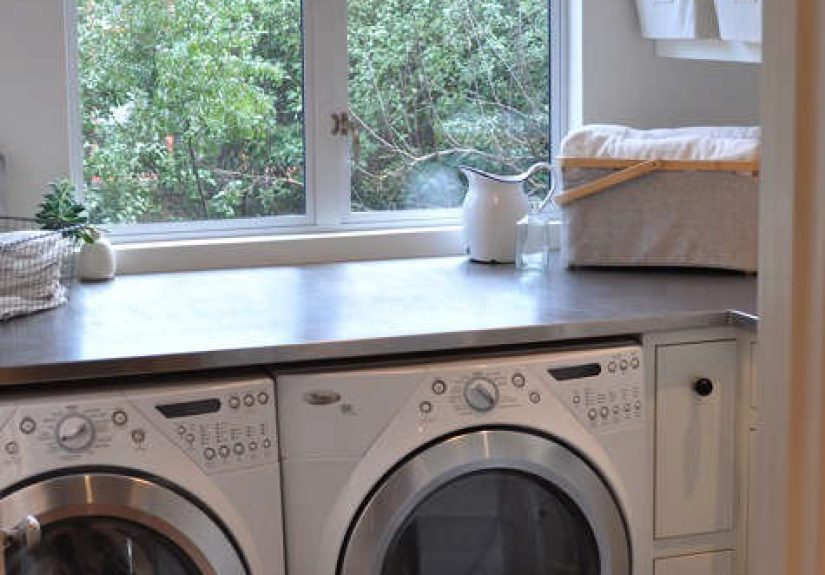
3) Stainless steel for a “professional” work surface
Stainless-steel countertops bring that subtle commercial-kitchen confidence: durable, wipeable, and unfussy. The original
design even used a deeper-than-standard countertop (about 35 inches) to create a true folding/ironing zonebecause laundry
is annoying enough without balancing a basket on a 12-inch sliver of counter.
4) A real sink (not a sad little bar sink)
A utility sink is the MVP of stain treatment, hand-wash items, soaking, and general “what is this mystery goo?” moments.
The inspiration uses a simple, hardworking sink and a classic-looking faucetproof that practical can still look sharp.
The Layout: Design It Like a Workflow (Not a Closet With Appliances)
The best laundry rooms move in a logical sequence: sort → wash → dry → fold/hang. Better Homes & Gardens
emphasizes designing around those tasks so you’re not doing laundry like an obstacle course. A countertop directly beside
your washer/dryer creates a natural landing zone for baskets and folded stacks.
Key measurements to steal (and why they matter)
-
Cabinet depth basics: Standard base cabinets are often around 24 inches deep, with uppers around 12 inches deep.
This is a great baseline for planning storage without crowding the room. -
Counter depth for folding: If you can go deeper than standard (as the Mill Valley room did), you get a true work surface
that can handle baskets, a folding pile, and an ironing board without everything sliding off like it’s auditioning for a slapstick film. -
Don’t ignore clearance: Good Housekeeping warns that door and appliance clearances are a top regretespecially when washer
doors swing into walkways or cabinets.
Best “Mill Valley” layout options
- Laundry nook (compact wall run): Washer/dryer + countertop + sink + uppers. Great for hallways, kitchens, or mudroom edges.
-
Galley laundry: Opposing runs of storage and work zones. Fantastic if you want extra utility functions (broom closet, pet wash,
recycling station), but keep walkways comfortable. -
Laundry + mudroom hybrid: Hooks, bench, baskets, and a counter for foldingHGTV highlights how this combo can be both stylish
and functional when the storage is planned.
Steal the Materials Palette
Graphic Moroccan cement tile (or a convincing alternative)
The inspiration floor uses Popham Design tile with a high-contrast, geometric lookmodern, playful, and precise. If you can’t spring for
artisanal cement tile, look for porcelain look-alikes with similar crisp patterning. Your goal: graphic + clean-lined, not “Tuscan vineyard.”
Stainless-steel countertop: the underrated laundry-room hero
Stainless is heat-resistant and tough, but it can scratchso it’s ideal if you like a surface that ages with character rather than staying
showroom-perfect forever. This Old House notes stainless has a sleek modern look and strong heat resistance, while Better Homes & Gardens
points out it’s easy to sanitize even if it isn’t inherently antimicrobial. Translation: it cleans up fast, which is the whole point of a laundry room.
White or light cabinetry (with a few open moments)
Open shelving looks great in photos… right up until it becomes a museum exhibit called “Fifteen Half-Empty Bottles of Random Cleaning Stuff.”
Good Housekeeping recommends balancing closed storage (to hide the visual clutter) with selective open storage (for baskets and frequently used items).
Hardware and fixtures: simple shapes, quality feel
The Mill Valley look sticks to clean forms: a straightforward sink, classic faucet, and a pendant that reads modern. If you want the same vibe,
choose fixtures with strong silhouettes and minimal fussmatte finishes, solid metal, and timeless lines.
Steal the Storage Strategy (So the Room Stays Pretty in Real Life)
The featured room uses simple, honest organization: bins for supplies and a good tote for hauling linens and cleaning gear. That’s the secret:
storage that matches how you actually live, not how you wish you lived after watching one motivational organizing video.
Closed storage: hide the chaos
- Keep detergents and stain removers behind doors to reduce visual clutter.
- Use one “backstock” bin so extra supplies don’t spread like glitter.
- Store pet-related laundry tools (lint rollers, hair catchers) in a dedicated spot.
Open storage: make it intentional
- Use matching bins or baskets so open shelves look calm, not chaotic.
- Limit open shelves to daily-use items: clothespins, dryer balls, a small brush for lint.
- Add one small “nice” object (a plant, a framed print) so the room feels designed.
Don’t forget vertical storage
Designers frequently recommend using walls for tall tools: brooms, mops, a fold-down drying rack, or a slim cabinet for an ironing board.
This keeps the floor clear and the room easier to cleanbecause yes, laundry rooms also get dusty. (They’re basically lint nurseries.)
Make It Safe and Efficient (Because Style Shouldn’t Start Fires)
A beautiful laundry room should also be a smart one. Dryer-related fire risk is real: NFPA research has found that dryers are involved in the vast
majority of laundry-equipment fires, and lint is a leading first item ignited. The good news is that the biggest prevention steps are simple and cheap.
Dryer airflow and lint: the boring stuff that matters most
- Clean the lint filter every load: ENERGY STAR notes this improves airflow and efficiency and is an important safety measure.
- Scrub the lint screen monthly if you use dryer sheets: ENERGY STAR warns dryer sheets can leave a film that reduces airflow over time.
- Watch for warning signs: Better Homes & Gardens highlights clues like longer dry times, musty odors, and excess lint around the dryer.
- Vent material matters: Fire and loss-control guidance commonly recommends all-metal venting for better airflow and less lint trapping.
Water damage prevention: the quiet budget-saver
Washing machines are great at washing clothes and also, occasionally, your floor. Practical protections include braided hoses, a drip pan where appropriate,
and a shutoff plan if you travel often. These small choices can prevent the kind of “surprise indoor pool” nobody asked for.
Steal This Look: The “Recipe” (With Smart Swaps)
Here’s the core formula behind the Modern Mill Valley laundry room. Think of it like a capsule wardrobe, but for detergent.
The essential elements
- Floor: Graphic geometric tile (cement tile or porcelain look-alike).
- Lighting: One sculptural pendant over the work zone.
- Counter: A durable folding surface (stainless steel if you want the original vibe).
- Sink: A real utility sink for stains, soaking, and general cleanup.
- Storage: Closed cabinets + a few bins/baskets for easy access.
High/low swaps that keep the look
- Tile: Keep the pattern bold and modern; if budget is tight, use patterned porcelain and put your money into lighting.
- Counter: Stainless is amazing, but you can get a similar clean look with a solid-surface top in a light neutral.
- Light: Choose a pendant with a strong silhouette and simple finishshape matters more than brand name.
- Storage: Matching bins create instant calm, even in a tiny laundry closet.
Design Mistakes to Avoid (So You Don’t “Steal” Regret)
A stylish laundry room is wonderfuluntil it’s annoying to use. Pros consistently point to a few pitfalls:
- No folding space: One of the most common regrets is skipping a countertop or landing zone.
- Poor lighting: Laundry rooms often need layered lighting so you can actually see stains and sort colors.
- Too much open shelving: Open shelves can look cluttered fast unless you commit to bins and editing.
- No drying area: Not everything belongs in the dryer; plan a rack, rod, or retractable line.
- Skipping a sink: A utility sink makes stain treatment and handwashing dramatically easier.
Conclusion: A Laundry Room You’ll Actually Want to Use
The Modern Mill Valley laundry room works because it treats utility like it deserves good design. Graphic tile delivers personality. A statement pendant
brings polish. Stainless steel and a real sink make the work easier. And smart storage keeps the room looking calm, even when life is… not calm.
Steal the formula, adapt it to your space, and focus on what you’ll feel every day: a better workflow, fewer messes, and a room that doesn’t make you
sigh the moment you walk in. Laundry will never be your favorite hobby (unless you’re secretly a detergent influencer), but it can absolutely be less painful.
Experience Notes: What It’s Like to Live With a “Modern Mill Valley” Laundry Room (500+ Words)
A photo-perfect laundry room is easy to love on the internet. Living with one is where the real story shows upusually with a hamper full of gym clothes
and a single red sock that absolutely should not be in that load. Here are the most common “day two through month six” experiences homeowners and designers
talk about when they upgrade a laundry space to something like the Modern Mill Valley look.
You stop fighting your room’s workflow
The biggest lifestyle upgrade isn’t the tile (though yes, it’s fabulous). It’s the feeling that the room finally supports the way laundry actually happens.
When the counter is right where you need it, you don’t do that awkward shufflebalancing a basket on one hip while trying to fold a fitted sheet with the
other hand like you’re auditioning for a circus. A dedicated landing zone beside the machines changes everything: wet items have a spot, clean stacks have
a spot, and you’re not using the top of the dryer as a fragile tower of towels.
Deep counters feel “extra”… until you use one
The featured room’s deeper stainless surface is a small luxury that pays off fast. In everyday use, extra depth means you can fold without knocking
things off the edge, set down a laundry basket without blocking your hands, and even handle awkward tasks like steaming a shirt or pre-sorting loads.
It’s the difference between “I can do laundry here” and “I can do laundry here without getting mad.”
A good sink becomes your problem-solving station
People underestimate how often a laundry sink saves the day. It’s not just for delicates; it’s for muddy shoes, hand-washing a stained sleeve, rinsing a
mop head, soaking a mystery-smelling towel, or cleaning paintbrushes after a weekend project. If your sink is deep and accessible, you use it constantly.
If it’s tiny or blocked by clutter, it becomes decorative (and not in a good way). The “Mill Valley” approachsimple sink, straightforward faucet,
clear countertopkeeps it ready for real life.
Open shelving only works when you commit to containment
Open shelves look airy and modern, but they have a personality: they will publicly display your habits. If your habits include buying three kinds of stain
remover and never finishing any of them, open shelves will snitch. The fix is easy: use matching bins, limit what lives out in the open, and give yourself
one closed cabinet where the “random extras” can hide without shame. Many households find that a hybrid systemclosed storage for supplies, open storage for
baskets and daily toolsfeels both functional and visually calm.
Lighting changes your mood more than you expect
A pendant light isn’t only about style; it changes how the space feels. Instead of “basement utility corner,” you get “small, intentional room.” That shift
matters because laundry is repetitive. When the room is pleasantbright enough to see stains, warm enough to feel welcomingyou’re less likely to procrastinate.
The room stops being a place you avoid and becomes a place you can actually use without grumbling. (You might still grumble. But it’s softer grumbling.)
You become more aware of maintenanceand that’s a good thing
The most “grown-up” experience that comes with a nicer laundry room is caring a little more about safety and efficiency. When everything is thoughtfully
designed, it’s easier to keep the area around the dryer clear, clean the lint filter regularly, and notice when drying times change. That awareness matters:
lint buildup and poor airflow are major safety concerns, and regular maintenance helps performance too. The room doesn’t just look better; it supports better
habits. And honestly, few design upgrades can claim that without sounding like a lecture.
The best surprise: the room stays tidy with less effort
When storage is planned and surfaces are easy to wipe down, “resetting” the room takes minutes. Baskets go back under the counter. Detergent lives in one bin.
Towels fold on a real surface. And the stainless top cleans up quickly when (not if) detergent drips or someone sets down a dusty shoe. Over time, the room
becomes self-maintainingless because you’re suddenly a different person, and more because the space is designed to support the person you already are.
That’s the heart of the Modern Mill Valley laundry room: it’s not pretending laundry is glamorous. It’s making the everyday tasks smoother, safer, andyesmore
visually satisfying. Because if you’re going to do laundry forever (and you are), you might as well do it in a room that feels like it’s on your side.