Table of Contents >> Show >> Hide
- What Makes a Gumbo “Cajun” (and Why That Matters for a Vegetarian Version)
- The Flavor Blueprint
- Cajun Vegetarian Gumbo Recipe (Step-by-Step)
- Tips for a Truly Great Vegetarian Gumbo
- Variations You’ll Actually Want to Make
- Troubleshooting (Because Gumbo Is Bold, Not Perfect)
- Make-Ahead, Storage, and Reheating
- FAQ: Quick Answers for Busy Cooks
- of Gumbo Experience: What Cooking This Feels Like (and Why You’ll Want to Do It Again)
- SEO Tags
Gumbo has a reputation: bold, smoky, deeply savory… and occasionally capable of making grown adults argue about okra like it’s a constitutional issue.
The good news? You can absolutely make a Cajun-style vegetarian gumbo that tastes like Louisiana comfort in a bowlwithout chicken,
sausage, or seafood staging a takeover in your pot.
The not-so-secret secret is this: gumbo isn’t “meat flavor with soup around it.” Gumbo is a process. A dark roux. The holy trinity.
Layered seasoning. A slow simmer that gives everything time to become friends. Once you nail the technique, the plants show up and show off.
What Makes a Gumbo “Cajun” (and Why That Matters for a Vegetarian Version)
Gumbo lives at the crossroads of cultures and history, but your bowl usually lands in one of two neighborhoods: Cajun or Creole.
In very broad strokes, Cajun gumbo tends to be darker (thanks to a deep, toasted roux) and often skips tomatoes,
while Creole gumbo is more likely to include tomatoes and seafood. Either can use okra, filé powder, or both for thickening,
but Cajun-style commonly leans hard on that dark roux backbone.
For a vegetarian Cajun gumbo, we keep that hallmark: a roux cooked to a deep peanut-butter-to-chocolate color, then built up with the
trinity (onion, celery, bell pepper). From there, we add “smoky, savory, meaty” vibes using mushrooms, beans, and optional plant-based
sausage or smoked tofu/tempehplus a couple of chef-y pantry tricks that are still totally weeknight-friendly.
The Flavor Blueprint
1) The Dark Roux: Your Gumbo’s Backbone
Roux is flour cooked in fat. In gumbo, you cook it long enough to turn nutty and darklike toasted hazelnuts decided to become a sauce.
The deeper the color, the deeper the flavor (and the less thickening power), which is exactly why gumbo feels hearty without turning into
gravy wallpaper.
If you’ve never made a dark roux, here’s your pep talk: you can do it. Just stay nearby, stir patiently, and don’t answer a “quick call.”
Roux has a sixth sense for distraction.
2) The Holy Trinity: Onion + Celery + Green Bell Pepper
This trio is the Cajun/Creole flavor baselike mirepoix, but with bell pepper stepping in for carrots. It’s the starting point for gumbo,
étouffée, jambalaya… basically half the reason your kitchen suddenly smells like you know what you’re doing.
3) Thickening the Right Way: Okra and/or Filé Powder
Gumbo traditionally thickens with one (or more) of three methods: roux, okra, and filé powder (ground sassafras leaves).
Okra thickens naturally and adds a distinctive texture; filé adds earthy flavor and can thicken beautifullybut it’s added off the heat
at the end so it doesn’t get stringy or bitter.
4) How Vegetarian Gumbo Gets That “Smoky” Depth
Meat gumbos often get smokiness from andouille or other smoked proteins. For vegetarian gumbo, we build that depth with:
- Mushrooms (especially cremini/portobello) for savory, browned flavor
- Smoked paprika and a well-balanced Cajun seasoning blend
- Bean power (kidney beans or black-eyed peas) for hearty body
- Optional plant-based sausage or smoked tofu/tempeh for a “gumbo shop” vibe
- A tiny umami boost (miso or soy sauce) to make the broth taste “long-simmered” faster
Cajun Vegetarian Gumbo Recipe (Step-by-Step)
Serves: 6–8
Total time: About 1 hour 20 minutes (mostly stirring and simmering)
Skill level: Cozy confidence (if you can stir, you can gumbo)
Ingredients
For the roux
- 1/2 cup neutral oil (avocado, grapeseed, canola) or vegan butter
- 1/2 cup all-purpose flour
The gumbo
- 1 large yellow onion, diced
- 1 green bell pepper, diced
- 2 celery stalks, diced
- 4–5 garlic cloves, minced
- 8 oz cremini mushrooms, sliced (or chopped for a “meatier” bite)
- 2 cups okra, sliced (fresh or frozen; if frozen, thaw and pat dry)
- 1 (15 oz) can kidney beans, drained and rinsed (or black-eyed peas)
- 6 cups vegetable stock (low-sodium preferred)
- 2 bay leaves
- 1–2 tsp dried thyme (or 1 tbsp fresh)
- 2 tsp smoked paprika
- 1–2 tsp Cajun seasoning (start small; you can add more)
- 1/2 tsp cayenne (optional, to taste)
- Freshly ground black pepper
- Salt, to taste
- 1 tbsp soy sauce or 2 tsp white miso (optional but highly recommended)
- 8–10 oz plant-based sausage, sliced and browned (optional)
- 1–2 tsp filé powder, for serving (optional but traditional)
To serve
- Cooked white rice (or brown rice)
- Sliced scallions
- Chopped parsley
- Hot sauce
- Lemon wedges (surprisingly great with a smoky veggie gumbo)
Instructions
-
Brown your “smoky add-ins” (optional, but worth it).
If using plant-based sausage, brown it in your gumbo pot (or a skillet) until it has real color. Remove and set aside.
In the same pot, quickly sauté mushrooms until browned around the edges. Remove and set aside.
Browning first makes the final gumbo taste like it simmered all dayeven if it didn’t. -
Make the dark roux.
Reduce heat to medium-low. Add oil and flour to the pot and stir until smooth. Cook, stirring constantly,
as the roux moves through tan → peanut butter → milk chocolate. This usually takes 20–40 minutes depending on heat and pan.
If you see black specks or smell “burnt popcorn,” the roux is burnedsadly, you’ll want to start over.
(The good news is flour and oil are cheaper than heartbreak.) -
Add the holy trinity.
Once the roux reaches a deep brown (think: toasted pecans), add onion, bell pepper, and celery immediately.
Stir wellthis cools the roux and stops it from racing toward “burnt.” Cook 6–8 minutes until softened.
Add garlic and cook 1 minute more. -
Add okra and build flavor.
Stir in okra and cook 3–5 minutes. Add bay leaves, thyme, smoked paprika, Cajun seasoning, cayenne (if using),
black pepper, and the optional soy sauce/miso. Stir until everything smells like a parade should be happening nearby. -
Slowly add stock (avoid lumps).
Add stock about 1 cup at a time, stirring until smooth between additions. Once incorporated, add the browned mushrooms,
beans, and optional sausage. -
Simmer for body and balance.
Bring to a gentle simmer, then reduce heat to low. Simmer uncovered 25–40 minutes, stirring occasionally.
The gumbo will thicken slightly and taste more “together.” If it gets too thick, add a splash of stock. -
Taste and tune.
Remove bay leaves. Add salt as needed. Want more smoke? Add a pinch more smoked paprika. Want more kick?
Add Cajun seasoning or hot sauce. Gumbo is personalmake it yours. -
Finish with filé (optional, but do it right).
Turn off heat. Stir in 1–2 teaspoons filé powder off the heat, or let each person add it to their bowl.
Let the pot rest 5–10 minutes before serving for best texture. -
Serve like you mean it.
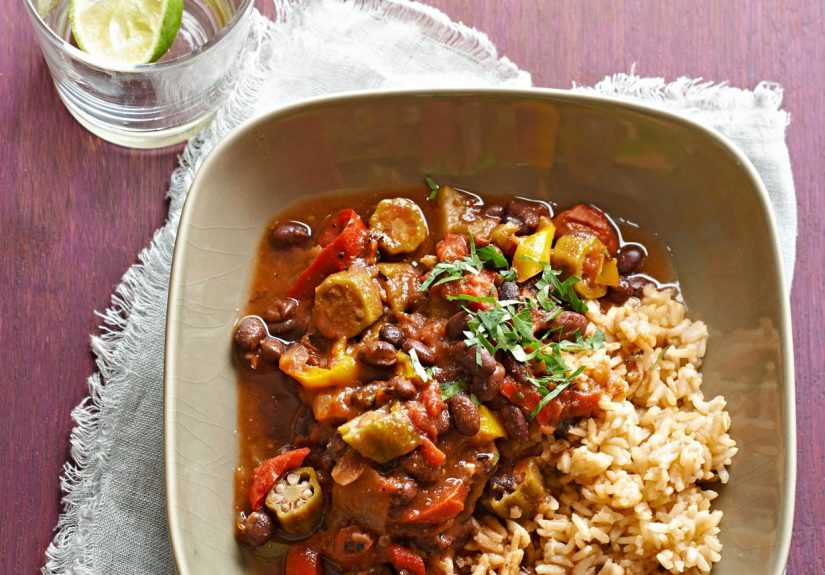
Spoon rice into bowls, ladle gumbo over, then top with scallions, parsley, and hot sauce.
Tips for a Truly Great Vegetarian Gumbo
Roux tips (a.k.a. how not to summon the smoke alarm)
- Use a heavy pot (Dutch oven = excellent) for steady heat.
- Keep heat medium-low. Faster isn’t better if “faster” tastes like burnt toast.
- Consider an oven roux if you hate constant stirringslower, steadier, less drama.
- Remember: darker roux = more flavor, less thickening. That’s normal.
Okra tips (team “not slimy,” please stand up)
- Frozen okra works. Thaw and pat dry so it browns a bit and doesn’t waterlog your pot.
- Sauté first if you’re texture-sensitive. A few minutes in the roux/trinity base helps.
- Don’t panic. As gumbo simmers, okra’s texture mellows.
Seasoning tips (Cajun flavor without salt bombs)
Cajun seasoning blends vary wildlysome are mostly salt, others are mostly spice. Start with a small amount,
taste later, then adjust. Your tongue is the real recipe card.
Variations You’ll Actually Want to Make
Vegan “Andouille” Vibes
Add plant-based sausage, smoked tofu, or smoked tempeh. Brown it well first.
Color = flavor, and flavor = joy.
Gluten-Free Roux (Yes, Really)
Swap all-purpose flour for rice flour (or a trusted gluten-free flour blend that browns well). Cook it the same wayslow and steady.
The texture may be slightly different, but you’ll still get that roasty depth.
Gumbo Z’Herbes Energy (A Greens-Forward Option)
Want something that feels like a “green gumbo” cousin? Add a few handfuls of chopped collards, kale, or mustard greens
during the simmer. It turns your gumbo into a wintery, soulful bowl that tastes like it has stories.
Tomato or No Tomato?
Traditional Cajun gumbo often skips tomatoes. If you love a subtle tang, add a small spoon of tomato paste when you add garlic,
or stir in a handful of diced tomatoes during the simmer. Keep it modestthis is gumbo, not marinara with aspirations.
Troubleshooting (Because Gumbo Is Bold, Not Perfect)
“My roux burned.”
If it smells acrid or looks speckled black, it’s burned. Starting over hurts, but burnt roux ruins the whole pot.
Next time: lower heat, stir more consistently, and keep a beverage nearby (for you, not the roux).
“My gumbo is too thin.”
Simmer uncovered longer. Remember: dark roux thickens less, so patience matters.
You can also add a little more okra, or use filé properly off-heat near the end.
“My gumbo is too thick.”
Add a splash of stock, stir, and re-simmer gently. Gumbo should be spoonable, not spreadable.
“It tastes flat.”
Usually it needs one (or more) of these: salt, acid (lemon or a dash of vinegar), heat (cayenne/hot sauce),
or smoke (smoked paprika). Add in small steps and taste as you go.
Make-Ahead, Storage, and Reheating
Gumbo is famously better the next day. Cool it, refrigerate in an airtight container, and reheat gently on the stove.
If you used filé powder, it’s best to add it per bowl at serving time (especially if you plan on reheating later).
Store leftovers up to 4 days in the fridge, or freeze up to 3 months.
FAQ: Quick Answers for Busy Cooks
Do I have to use okra?
No, but it’s traditional and helpful. If you skip okra, consider using filé (off-heat) or let the roux + simmer do more work.
You can also add more mushrooms/beans for body.
Is filé powder required?
Not required, but it’s a classic gumbo move. If you try it, remember: off-heat at the end, or added to bowlsnever boiled.
What’s the best rice for gumbo?
Plain white rice is the classic. Long-grain works great. Brown rice is fine too, especially if you like a nuttier base.
of Gumbo Experience: What Cooking This Feels Like (and Why You’ll Want to Do It Again)
The first time you decide to make Cajun vegetarian gumbo, there’s a momentusually around minute eight of stirring the rouxwhen you think,
“I could have made a salad.” That moment is normal. Gumbo is a slow-food mindset disguised as dinner.
Then the magic starts. The flour and oil shift from pale and innocent to toasted and confident, and your kitchen smells like popcorn’s
sophisticated older cousin. You’ll notice the color changes in tiny steps: tan, then caramel, then something that looks like it belongs
in a chocolate commercial. This is the part where gumbo teaches patience. Not the inspirational-quote kindmore like the practical kind
that keeps you from scorching dinner and inventing new curse words.
When you add the trinity, the pot audibly relaxes. The sizzle is immediate, and the aromatics bloom like they’ve been waiting backstage
for their cue. This is the part where vegetarian gumbo stops feeling like a “substitution recipe” and starts feeling like the real thing:
layered, fragrant, and unapologetically savory. The mushrooms do their thing tooespecially if you browned them firstbringing that deep,
roasty flavor that makes people squint suspiciously and ask, “Are you sure there’s no meat in here?”
Okra is its own personality. Some folks treat it like a beloved family member; others treat it like a prank ingredient. In gumbo, it’s
usually the hero you didn’t realize you wanted. As it simmers, it thickens the broth and softens into the background, and suddenly the
pot has bodylike it’s wearing a warm sweater. If you’re okra-cautious, sautéing it a bit first can make the texture friendlier.
If you’re okra-confident, you’ll probably add an extra handful just to watch your gumbo turn glossy and rich.
The best part is the “tuning” phase. Gumbo invites you to taste and adjust like a musician finding the right key.
A pinch more Cajun seasoning, a nudge of smoked paprika, a little acid at the endeach tweak makes the flavor snap into focus.
And once you serve it over rice with scallions and hot sauce, it becomes the kind of meal that slows everyone down.
Conversations get quieter. Bowls get refilled. Someone says, “Okay, this is going in the rotation.”
That’s the gumbo effect: it’s cozy, communal, and oddly empowering. You didn’t just make soupyou built flavor in layers,
like a delicious little architecture project. And the next day? Leftovers taste even better, which is gumbo’s way of saying,
“See? Patience pays. Also, please invite me back for lunch.”