Table of Contents >> Show >> Hide
- Why James Webb Space Telescope Images Feel So Different
- The First Five Webb Images That Changed Everything
- The Images That Turned Webb Into a Household Name
- Webb’s Second Wave: Big Personality, Bigger Detail
- What These Webb Images Are Actually Teaching Us
- Why People Cannot Stop Looking at Webb Telescope Images
- Conclusion
- A 500-Word Reflection on the Experience of Seeing Webb’s Universe
- SEO Metadata
The James Webb Space Telescope did not arrive quietly. It showed up like the universe’s most overqualified photographer, kicked open the cosmic studio door, and started dropping images that made scientists, teachers, space nerds, and random people on lunch break all say the same thing: “Well, that is ridiculous.” Since NASA released Webb’s first full-color images in 2022, the telescope has built a gallery that feels less like a normal archive and more like a highlight reel from the universe’s greatest hits album.
Webb’s growing collection includes deep fields packed with ancient galaxies, star-forming nurseries that look like fantasy landscapes, dying stars wrapped in glowing shells, giant planets flashing auroras, and spiral galaxies so detailed they seem hand-painted. Some of these images became instant icons, like the Cosmic Cliffs and the Pillars of Creation. Others slipped in more quietly and then lodged themselves in your brain for days, like the eerie Cranium Nebula or the almost too-perfect silhouette of the Penguin and the Egg.
And here is the best part: these pictures are not just gorgeous wallpaper for your desktop. Every one of them is also data. Webb is showing astronomers how stars form, how planets behave, how dust hides and reveals cosmic history, and how galaxies looked when the universe was much younger. So yes, this is a tour of stunning imagery. But it is also a tour of how beauty and science keep crashing into each other in the best possible way.
Why James Webb Space Telescope Images Feel So Different
The short answer is infrared light. Webb sees wavelengths that human eyes cannot, which lets it peer through dust and detect heat and structure that visible-light telescopes often miss. That is why Webb images feel deeper, moodier, and more revealing than many classic space photos. Hubble gave us elegant portraits. Webb walks into the same room, turns on a new set of lights, and suddenly you notice the hidden walls, the dust in the corners, and the drama behind the curtain.
That also explains the color. Webb does not snap “natural color” vacation photos of space. Scientists and imaging specialists translate infrared data into visible colors so humans can interpret the information. The result is not fake. It is representative. Shorter infrared wavelengths are often mapped toward bluer tones and longer wavelengths toward redder ones. In other words, the colors are chosen to communicate real structure, temperature, chemistry, and depth. Webb images are honest, just not literal in the everyday camera-phone sense.
The First Five Webb Images That Changed Everything
1. Webb’s First Deep Field: SMACS 0723
This was the mic drop. NASA’s first public Webb image revealed galaxy cluster SMACS 0723 and thousands of background galaxies in a patch of sky so tiny it could be compared to a speck of sand held at arm’s length. The cluster itself acts like a gravitational lens, bending and magnifying light from more distant galaxies behind it. That is why the image is full of warped arcs, glowing smudges, and tiny ancient structures that look like they have been stretched by the universe itself.
What made the deep field so thrilling was not just the beauty. It was the feeling of scale. You were looking at a crowded image, but also at time travel. Some of that light began its journey billions of years ago. Webb did not just take a pretty picture; it made the early universe feel suddenly crowded, textured, and busy. It was the kind of image that makes a person stare longer than intended and then forget why they picked up their phone in the first place.
2. The Southern Ring Nebula
The Southern Ring Nebula proved that Webb could do tenderness as well as spectacle. This planetary nebula is the result of a dying Sun-like star shedding its outer layers. In visible light, it was already beautiful. In Webb’s hands, it became a layered, glowing shell with far more depth and structure. The telescope even helped reveal the dusty cloak around the hidden companion at the center, including the hot white dwarf responsible for much of the system’s drama.
It is one of those Webb images that sneaks up on you. At first, it looks like a delicately lit cosmic bubble. Then you realize you are watching stellar death in high resolution, complete with concentric shells of expelled material. It is gorgeous, yes, but also a preview of our own star’s distant future. Nothing spices up a beautiful picture like a gentle reminder of mortality.
3. Stephan’s Quintet
If Webb’s deep field was a demonstration of reach, Stephan’s Quintet was a demonstration of scale and power. This enormous mosaic combined nearly a thousand image files into a scene with more than 150 million pixels. It captured a famous grouping of galaxies with incredible detail, revealing gravitational interactions, bursts of star formation, and activity around a supermassive black hole.
The picture feels cinematic. Galaxies appear to tug at each other, distort each other, and shape each other over immense spans of time. It is the kind of image that reminds you the universe is not static. It is a crowded neighborhood full of motion, collisions, feeding black holes, and long-running cosmic arguments.
4. The Cosmic Cliffs in the Carina Nebula
This one became a superstar for a reason. Nicknamed the Cosmic Cliffs, the image shows the edge of a star-forming region in NGC 3324 within the Carina Nebula. It looks like a jagged mountain range at sunset, complete with luminous fog and dramatic ridgelines. In reality, those “cliffs” are vast walls of gas and dust sculpted by radiation and stellar winds from massive young stars nearby.
Webb’s infrared vision exposed areas of star birth that had been hidden before. Tiny jets, embedded stars, and intricate dusty structures gave the image an almost impossibly detailed texture. It was the photo that convinced a lot of people Webb was not merely a better telescope. It was a different way of seeing.
5. WASP-96 b: The Graph That Deserved to Be in the Gallery
Yes, technically this was a spectrum, not a postcard. But it mattered too much to ignore. Webb’s observation of the hot gas giant exoplanet WASP-96 b showed that the telescope could analyze a distant planet’s atmosphere with startling precision. The data revealed atmospheric features consistent with water vapor and cloudiness, and it did so right out of the gate.
Why count it among Webb’s glorious images? Because it changed the public conversation. Suddenly, the telescope was not just delivering jaw-dropping nebulae. It was also showing that beautiful science can come in plot form. Webb arrived with galaxies, cliffs, and dying stars, then casually reminded everyone that a graph can also ruin your afternoon in the best way by making alien weather feel real.
The Images That Turned Webb Into a Household Name
Cartwheel Galaxy
Webb’s portrait of the Cartwheel Galaxy looked like a cosmic splash frozen mid-impact. This unusual galaxy was shaped by a past collision, leaving ring-like structure, bursts of star formation, and a chaotic interior that Webb explored in tremendous detail. The infrared view also gave astronomers a fresh look at activity near the galaxy’s center, including clues about its black hole and how the system has evolved over time.
The image is one of Webb’s best examples of motion without motion. Nothing in the frame is actually happening in human time, yet the whole scene feels like an explosion still unfolding.
Jupiter’s Auroras and Atmosphere
Webb’s early look at Jupiter was a useful reminder that the telescope is not only for distant galaxies and ancient light. It can also turn its gaze closer to home and absolutely show off. In infrared, Jupiter’s auroras blaze near the poles, high-altitude hazes become more visible, and storm systems stand out in striking ways. Later Webb observations pushed even further, revealing fresh detail in Jupiter’s auroral activity and the giant planet’s magnetospheric complexity.
The image works because it takes a familiar planet and makes it weird again. We all know Jupiter. Then Webb shows up and says, “Actually, here is the part you were not seeing.”
Neptune and Uranus, Now With Rings You Can Actually Stare At
Webb’s image of Neptune delivered the clearest look at the planet’s rings in more than three decades. Suddenly the distant ice giant looked crisp, sharp, and almost elegant in a way that felt new. Uranus received a similar glow-up, with Webb revealing its rings in fine detail, including the faint and elusive Zeta ring, along with its bright north polar cap.
These pictures mattered scientifically, but they also landed emotionally. The outer planets had often felt a little neglected in pop-space culture compared with Mars, Jupiter, or Saturn. Webb gave Neptune and Uranus a visual comeback tour, and honestly, it was overdue.
Pillars of Creation
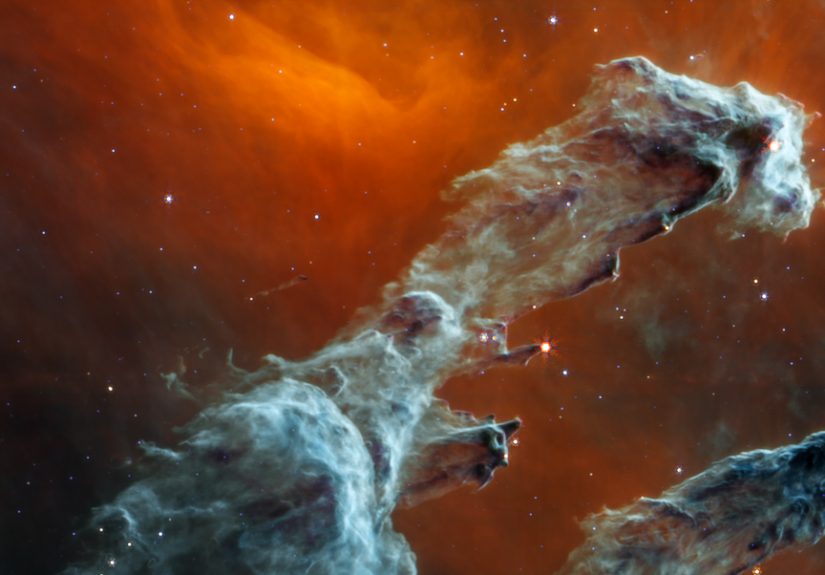
Hubble made the Pillars of Creation legendary. Webb made them eerie, textured, and newly alive. In near-infrared light, the dusty columns became semi-transparent enough to reveal more stars forming within and around them. In mid-infrared views, the mood changed again, with cooler dust and dense material taking center stage.
This is one of Webb’s most fascinating side-by-side lessons. Same iconic region. Different wavelengths. Different story. Hubble showed the monument. Webb showed the machinery inside it.
Cassiopeia A
Webb’s views of the supernova remnant Cassiopeia A turned a stellar corpse into abstract art with scientific consequences. The remnant’s filaments, knots, and expanding shell became sharply defined in infrared, letting astronomers trace different materials and structures produced by the explosion. The NIRCam and MIRI images did not just look different from older portraits; they made the aftermath look physically richer and more layered.
It is one of those scenes where the beauty almost feels rude. You know you are looking at destruction, but the details are so intricate that the picture feels embroidered rather than exploded.
Rho Ophiuchi
For Webb’s first anniversary, NASA released an image of the Rho Ophiuchi cloud complex, the closest star-forming region to Earth. It looked painterly, packed with glowing red jets, dusty folds, and baby stars still pushing through their natal material. The image offered a more intimate portrait of star formation than the large, theatrical nebulae that usually dominate public space galleries.
That intimacy is what makes Rho Ophiuchi special. It does not shout. It crackles. It feels close, busy, and personal, like the universe is building stars in a workshop just down the hall.
Webb’s Second Wave: Big Personality, Bigger Detail
The Phantom Galaxy and the 19 Spiral Galaxies
When Webb released its detailed observations of 19 nearby face-on spiral galaxies through the PHANGS program, it felt like a master class in galactic structure. Suddenly astronomers and ordinary viewers alike could see bubbles, filaments, dusty lanes, and star-forming regions with incredible clarity. The Phantom Galaxy, also known as NGC 628, became one of the standouts, its graceful spiral arms looking almost handcrafted.
These images also helped drive home a big truth about Webb: its best work is not always one single famous frame. Sometimes the real story is a set. A collection. A new standard of detail repeated across multiple galaxies until the viewer starts realizing just how much had been hidden in plain sight.
The Penguin and the Egg
Released for Webb’s second science anniversary, Arp 142 quickly earned one of the best nicknames in astronomy. The interacting galaxies resemble a penguin protecting an egg, which is charming enough on its own. But the scientific value is just as strong. Webb’s near- and mid-infrared observations show how the galaxies have been distorted by their encounter, with dust, star formation, and tidal structure all standing out beautifully.
Great astronomy images usually deliver one of two things: drama or delight. This one pulled off both. It looked whimsical from a distance and violent up close, which is a very efficient use of a galaxy pair.
Orion Bar and Other Chemistry-Rich Scenes
Some Webb images became famous not because they looked like screensavers, but because they combined strong visuals with major scientific payoff. The Orion Bar is a good example. Webb’s observations of this small region in the Orion Nebula helped detect the methyl cation, a crucial carbon-bearing molecule, while also producing a layered, luminous image of gas, dust, and a young star system with a protoplanetary disk.
Webb excels at this kind of thing: a picture that looks like molten clouds from a fantasy map, while quietly telling chemists and astronomers something profound about how planetary systems get their ingredients.
The Exposed Cranium Nebula
By 2026, Webb was still finding new ways to be unsettling and gorgeous at the same time. The Exposed Cranium Nebula, surrounding a dying star, earned its nickname because it resembles a brain inside a transparent skull. That is not the sort of phrase one expects to type in a serious astronomy article, yet here we are, and the image absolutely delivers.
Webb’s near- and mid-infrared views brought out structures that made the nebula’s anatomy-like appearance even more striking. It is a perfect modern Webb image: visually unforgettable, scientifically rich, and just odd enough to dominate your brain for the rest of the day.
Saturn in Infrared
Webb’s latest Saturn releases added another jewel to the collection. In infrared, Saturn’s icy rings shine brilliantly, while the planet’s atmosphere reveals features that are not obvious in visible light. Paired with Hubble observations, the result becomes even more powerful: visible and infrared views working together to show a more complete portrait of the ringed giant.
If you grew up thinking Saturn had already maxed out its visual charisma, Webb politely disagrees.
What These Webb Images Are Actually Teaching Us
The obvious answer is “a lot,” but let’s narrow it down. Webb is helping astronomers study the early universe, the birth and death of stars, the structure of galaxies, the chemistry of planetary systems, and the atmospheres of distant worlds. The images matter because they make hidden structure visible. Dust stops being an obstacle and becomes part of the story. Planetary rings stop being thin lines and become textured systems. Nebulae stop being decorative clouds and become active environments shaped by radiation, outflows, shocks, and chemistry.
The other lesson is that imagery is not a bonus feature of astronomy. It is central to how discovery happens. A Webb picture can be emotionally moving and scientifically productive at the same time. That double identity is why these releases keep resonating. They are beautiful enough to go viral and detailed enough to keep researchers busy for years.
Why People Cannot Stop Looking at Webb Telescope Images
Part of it is scale. Webb images make the universe feel huge without making it feel empty. Part of it is texture. Dust lanes, glowing arcs, shells, jets, and ring systems suddenly have depth. And part of it is storytelling. The best Webb image is never just “a thing in space.” It is a scene with conflict: stars being born, stars dying, galaxies colliding, planets glowing, dust hiding secrets, gravity warping light.
There is also something quietly reassuring about them. In a time when most of us spend our days looking at small screens full of urgent nonsense, Webb keeps handing us evidence that the universe is still out there being absurdly grand. Not helpful for your deadlines, maybe, but excellent for perspective.
Conclusion
So far, the James Webb Space Telescope has given us a gallery that ranges from historic to haunting, from scientifically essential to flat-out jaw-dropping. The first deep field changed expectations overnight. The Southern Ring Nebula added elegance. The Cosmic Cliffs and Pillars of Creation became modern classics. Jupiter, Neptune, Uranus, the Cartwheel Galaxy, Rho Ophiuchi, the Phantom Galaxy, the Penguin and the Egg, Saturn, and the Exposed Cranium Nebula kept the momentum going.
And that “so far” matters. Webb’s gallery is still growing. More science releases, more surprise favorites, and more cosmic images that make humans look up from their day for a moment and remember that the universe is not just bigger than we imagined. It is prettier, stranger, and more alive than we imagined too.
A 500-Word Reflection on the Experience of Seeing Webb’s Universe
Looking at James Webb Space Telescope images feels different from looking at most other kinds of photography, and I do not mean only because the subjects are galaxies, nebulae, and planets. It feels different because the pictures arrive with two emotional speeds at once. First comes the instant reaction: the color, the scale, the shape, the involuntary “wow.” Then comes the slower realization that you are not just looking at scenery. You are looking at evidence. You are looking at time, physics, chemistry, distance, and history compressed into a frame that your brain can barely process before your emotions get there first.
A lot of people describe Webb images as humbling, and that is true, but that word is almost too serious for the full experience. Sometimes the reaction is not humble at all. Sometimes it is joyful. Sometimes it is weirdly funny. The universe has a surprising sense of visual comedy. One day Webb gives us a galaxy pair that looks like a penguin with an egg. Another day it offers a nebula that resembles a glowing brain. Then it turns around and releases a deep field so densely packed with galaxies that you start to feel like the cosmos might be showing off a little.
What I find most memorable is the way Webb changes your sense of familiarity. People think they already know the sky. They know the Pillars of Creation from posters. They know Jupiter from textbooks. They know Saturn from childhood science fairs and Neptune from grainy old spacecraft images. Then Webb revisits those same objects in infrared and suddenly they do not feel old anymore. They feel unresolved. Unfinished. Still capable of surprise. That is a rare thing in public science communication: not just teaching people something new, but restoring their capacity to be surprised by something they thought they already understood.
There is also a strangely personal side to these images. Not because the universe revolves around us, obviously it does not, but because the act of looking becomes intimate. You can scroll past headlines all day and forget them by dinner. A strong Webb image lingers. You remember the dusty red folds of a stellar nursery, the glowing arcs of a lensed galaxy, the ghostly shell of a dead star. These pictures tend to stay in memory because they feel both vast and specific. They are cosmic, but they are also textured enough to feel touchable, almost like you could reach into the frame and feel the ridges of dust or the softness of a glowing cloud.
Maybe that is the deepest experience Webb offers. It makes the universe feel less like an abstract idea and more like a place. A wild place, an old place, a violent place, but still a place. You do not leave a Webb gallery thinking only about astronomy. You leave thinking about scale, time, fragility, curiosity, and how wonderful it is that a species living on one small planet learned how to build a telescope capable of turning invisible light into shared human awe.