Table of Contents >> Show >> Hide
- What Is Gamma Knife Surgery?
- How Gamma Knife Works
- Gamma Knife Procedure: Step by Step
- Benefits of Gamma Knife Radiosurgery
- Gamma Knife Surgery Risks and Side Effects
- Gamma Knife Outcomes: What Results Can You Expect?
- Who Is a Good Candidate for Gamma Knife?
- Patient Experience: What Gamma Knife Feels Like in Real Life
- Final Thoughts
Let’s clear up the first big misunderstanding right away: Gamma Knife surgery is not surgery in the old-school, scalpel-meets-scrubs sense. No incision. No actual knife. No dramatic operating-room scene where someone says, “Scalpel,” and the music swells. Instead, Gamma Knife is a form of stereotactic radiosurgery that uses many highly focused beams of radiation to target a problem area in the brain with impressive precision.
That precision is the whole point. By concentrating radiation where it is needed most, doctors can treat certain tumors, blood vessel abnormalities, and nerve disorders while limiting damage to nearby healthy tissue. For many patients, that means same-day treatment, short recovery, and no open-skull procedure. Not bad for something with such an alarming name.
If you are researching Gamma Knife radiosurgery for yourself, a family member, or a piece of medical content you want to publish, here is the practical, no-fluff guide: what Gamma Knife is, how the procedure works, the risks to know, and what outcomes usually look like over time.
What Is Gamma Knife Surgery?
Gamma Knife surgery is a noninvasive radiation treatment used mainly for abnormalities in the brain and nearby cranial structures. It delivers a high dose of radiation to a precisely mapped target using multiple beams that converge at one point. Each individual beam is relatively low impact on the tissue it passes through, but together they deliver a powerful treatment dose exactly where doctors want it.
This is why Gamma Knife is often described as being as precise as surgery without actually being surgery. It does not remove tissue in the moment. Instead, it damages the DNA of the targeted cells so they stop growing, shrink over time, or lose their ability to keep causing trouble.
What conditions can Gamma Knife treat?
Gamma Knife is commonly used for:
- Brain metastases
- Meningiomas
- Acoustic neuromas (also called vestibular schwannomas)
- Pituitary adenomas
- Arteriovenous malformations (AVMs)
- Trigeminal neuralgia
- Certain other small or hard-to-reach brain lesions
Doctors may recommend it when a lesion is deep in the brain, close to important nerves or blood vessels, too risky for open surgery, or better treated with a focused radiation approach. It can also be used after conventional surgery to target leftover tumor cells or reduce the risk of regrowth.
How Gamma Knife Works
The best way to picture Gamma Knife treatment is to imagine a crowd of tiny flashlights all pointed at the same dot on the wall. One flashlight alone is not very dramatic. But when all of them converge on the exact same point, that point gets the full intensity. Gamma Knife uses that same principle with radiation.
The treatment depends on three things:
- Immobilization so the head stays in the exact right position
- Imaging to identify the target with millimeter-level accuracy
- Computerized dose planning to shape the radiation safely around the lesion
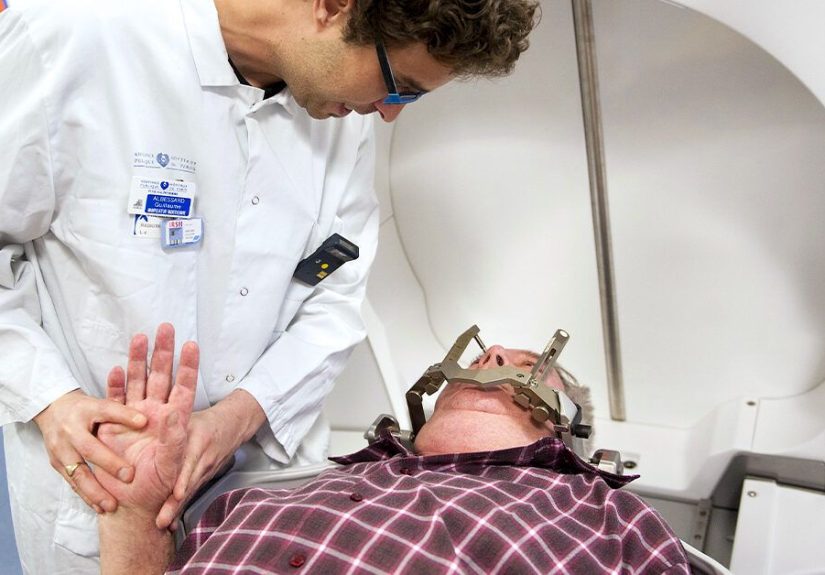
Some patients receive a rigid head frame attached with pins after the skin is numbed. Others use a frameless thermoplastic mask. Both methods are designed to prevent movement and keep the treatment coordinates exact. It sounds intimidating, and yes, the frame is the least glamorous accessory ever invented, but it is there for accuracy, not torture.
Gamma Knife Procedure: Step by Step
1) Evaluation and preparation
Before treatment day, the care team reviews your diagnosis, general health, prior treatments, scans, and the size and location of the target. You may be told not to eat or drink after midnight, and your doctors will review medications, implants, contrast allergies, and anything that could affect imaging or treatment planning.
This stage matters because not every brain lesion is best treated with Gamma Knife. The method is often ideal for small, well-defined targets, but it is not the right answer for every tumor type or every patient.
2) Head frame or mask placement
On treatment day, the team secures your head using either a frame or a custom-fitted mask. If a frame is used, local anesthetic is applied first, so patients usually feel pressure more than sharp pain. Sedation may be offered to help you relax.
In plain English: your care team wants your head to stay still enough that the radiation lands exactly where intended, not one millimeter to the left because you suddenly decided to channel your inner bobblehead.
3) Imaging
After immobilization, imaging begins. This often includes MRI, CT, or sometimes angiography for blood vessel problems such as AVMs. These scans create a three-dimensional map of the brain and the lesion.
The images are then used to define the target and nearby critical structures, such as the optic nerves, brainstem, or hearing-related nerves. This is where Gamma Knife earns its reputation: the treatment is only as smart as the planning behind it.
4) Treatment planning
Once the scans are done, the neurosurgeon, radiation oncologist, physicist, and other team members work together to build the treatment plan. They decide how much radiation to give, how many beam angles to use, and how to protect surrounding tissue as much as possible.
Patients usually wait during this stage. It can take less than an hour in some cases, but the full day at the treatment center may stretch several hours depending on complexity.
5) Radiation delivery
During treatment, you lie on a table that moves into the Gamma Knife unit. The machine delivers the radiation according to the computer-generated plan. You do not feel the radiation. It does not burn, buzz, or deliver a dramatic cinematic zap. Most patients feel nothing during the treatment itself.
The actual treatment may take roughly 30 minutes to a few hours, depending on the size, shape, and number of targets. The medical team watches from outside the room and can communicate with you the entire time.
6) After the procedure
When treatment is complete, the frame or mask is removed, the team observes you for a while, and most patients go home the same day. Mild grogginess, a headache, or nausea can happen, especially if sedation or a frame was used. Many people return to normal activity the next day, though strenuous activity may be limited briefly.
Then comes the part nobody loves: waiting for the biology to catch up with the technology. Gamma Knife works quickly as a treatment delivery system, but the visible effects on the lesion usually happen gradually.
Benefits of Gamma Knife Radiosurgery
There is a reason Gamma Knife has remained a well-established option in modern brain care. Its main advantages include:
- No incision and no open-skull surgery
- High precision for deep or delicate areas of the brain
- Outpatient treatment in many cases
- Short recovery time
- Ability to treat multiple lesions in a single session in selected cases
- Lower risk of some complications associated with open brain surgery, such as infection or spinal fluid leak
For patients who are older, medically fragile, or simply not good candidates for conventional surgery, that combination can make Gamma Knife especially appealing.
Gamma Knife Surgery Risks and Side Effects
Gamma Knife is generally considered safe and effective, but “noninvasive” does not mean “risk-free.” Radiation is still a serious treatment, and side effects can appear early or later.
Common short-term side effects
- Mild headache
- Nausea or occasional vomiting
- Fatigue
- Scalp tenderness, bruising, or numbness at frame pin sites
- Localized hair loss if the treated area is near the scalp
These effects are often temporary and manageable with medication or simple supportive care.
More serious but less common risks
- Brain swelling (edema), which may occur soon after treatment or months later
- Seizures
- Bleeding in rare situations
- Radiation necrosis, a delayed injury in treated tissue
- Nerve damage causing issues such as hearing changes, vision changes, or facial numbness, depending on the target location
Swelling is one of the most important complications to understand because it can temporarily make symptoms feel worse before things improve. That is one reason doctors sometimes prescribe steroids or other medications before or after treatment. Follow-up imaging is also crucial, because changes on a scan may reflect treatment effect, swelling, necrosis, or continued disease activity. In other words, the first scan after Gamma Knife does not always tell the whole story.
Gamma Knife Outcomes: What Results Can You Expect?
Outcome after Gamma Knife surgery depends heavily on the condition being treated. There is no single timeline that fits every diagnosis, and this is where a lot of confusion starts. Patients often assume radiation works like flipping a switch. In reality, it often behaves more like a dimmer with a very deliberate hand on it.
For malignant brain tumors or metastases
Cancerous lesions may become stable or start shrinking over weeks to months. In some cases, the main goal is local control rather than dramatic disappearance. A lesion that stops growing can represent a successful result.
For benign tumors
Benign tumors such as meningiomas or acoustic neuromas often stop growing first. Shrinkage may happen slowly over months or even years. That slower timeline does not mean the treatment failed; it often means the biology is just moving on its own schedule.
For AVMs
Arteriovenous malformations usually do not vanish overnight. The blood vessels may gradually thicken and close off over one to three years, and sometimes longer. During that waiting period, doctors continue monitoring with imaging.
For trigeminal neuralgia
Pain relief may begin within days for some patients, but it can also take weeks to months. Some people improve quickly; others wait longer for the nerve to calm down. And yes, that waiting period can feel approximately three years long even when it is only six weeks.
What affects success?
Several factors influence Gamma Knife outcome:
- Size of the lesion
- Location in relation to sensitive brain structures
- Type of tumor or disorder
- Whether it is a first treatment or retreatment
- Your overall health and prior therapies
That is why outcome discussions are individualized. A doctor is not being vague when they say, “It depends.” In Gamma Knife care, it genuinely does.
Who Is a Good Candidate for Gamma Knife?
A good candidate is usually someone with a relatively small, clearly defined lesion in or around the brain, especially when open surgery would be risky, unnecessary, or less desirable. Gamma Knife may also be recommended when preserving surrounding brain tissue is especially important, or when multiple small lesions can be treated efficiently in one visit.
Still, eligibility is not based on the machine alone. It depends on the tumor type, imaging findings, symptoms, previous treatments, and goals of care. Sometimes the best plan is Gamma Knife alone. Sometimes it is Gamma Knife after surgery. Sometimes it is not Gamma Knife at all.
Patient Experience: What Gamma Knife Feels Like in Real Life
Here is the part medical brochures often polish until it no longer sounds human: the experience of Gamma Knife is as emotional as it is technical. Many patients arrive feeling oddly confused by the name. “Knife” sounds terrifying. Then they learn it is radiation, not cutting, and the fear shifts from “Will they operate on my brain?” to “How does radiation work inside my head without wrecking everything around it?” That mental pivot is common.
The day itself often starts early and feels longer than the treatment makes it sound on paper. There is registration, vital signs, medication review, frame or mask placement, scans, waiting while the team builds the plan, then the actual treatment. Patients often describe the frame as more strange than painful: pressure, tightness, awkwardness, and the slightly surreal feeling of becoming very aware that your head has become the star of a precision engineering project.
During the treatment, many people are surprised by how uneventful it feels. No dramatic sensation. No internal fireworks. Some listen to music. Some doze. Some stare into the middle distance and start mentally reorganizing their entire life, which is a very human side effect not usually listed on consent forms.
Afterward, the most common reactions are relief and exhaustion. A mild headache is not unusual. Some patients go home, take a nap, and feel decent by evening. Others need a day or two to shake off fatigue, scalp soreness, or nausea. For people treated near hearing and balance structures, recovery may include a frustrating period of dizziness, imbalance, or ongoing symptoms while inflammation settles down.
The emotional challenge usually comes later. Gamma Knife rarely provides instant visual proof that everything is fixed. Instead, patients enter a follow-up season filled with MRIs, clinic visits, and a lot of interpretation. A scan may show stability rather than shrinkage. It may show swelling before improvement. Symptoms may improve fast, slowly, or in annoying little waves. That waiting game can be harder than the treatment day itself.
Families often go through their own version of the process. They want a clean before-and-after story. Medicine, being medicine, frequently offers a more nuanced one: the tumor is controlled, the lesion is smaller, the AVM is closing, the pain is improving, the swelling is treatable, the next scan matters. It is progress, but not always the dramatic movie ending people expect.
What many patients remember most positively is not the machine. It is the sense that a highly specialized team studied their scans in detail and built a plan around a target measured in millimeters. For a person facing a brain lesion, that precision can feel deeply reassuring. Gamma Knife is not magic, and it is not the right treatment for every case. But when it is the right fit, many patients experience it as something rare in modern medicine: serious treatment delivered with remarkable precision, minimal disruption, and a real chance at meaningful control.
Final Thoughts
Gamma Knife surgery sits at the intersection of neurosurgery, radiation oncology, and very serious geometry. It is not a cure-all, and it is not literally surgery despite the name. But for the right patient and the right diagnosis, it can offer a powerful way to treat brain lesions and neurologic conditions without an incision, a long hospital stay, or the risks of open brain surgery.
The key takeaway is simple: Gamma Knife outcome depends on the diagnosis, the target, and time. If the lesion stabilizes, shrinks, closes off, or stops causing trouble, that may be the success story. Sometimes the win is dramatic. Sometimes it is quiet. Both still count.
If you are evaluating Gamma Knife treatment, ask about the goal in your specific case: shrinkage, long-term control, symptom relief, or prevention of future growth. Once you know the goal, the rest of the conversation makes a lot more sense.