Table of Contents >> Show >> Hide
- What “Singing Like a Professional” Actually Means
- Step 1: Build the Engine Posture, Breath, and Support
- Step 2: Shape the Sound Resonance, Registers, and Vowels
- Step 3: Warm Up Like You Mean It (Not Like You’re Speed-Running It)
- Step 4: Practice Like a Pro Structure Beats Random Effort
- Step 5: Sing in Tune Ear Training and Intonation Tricks
- Step 6: Sound Professional Live Microphone Technique and Stage Control
- Step 7: Protect Your Voice Like It Pays Your Rent (Because It Might)
- Step 8: Consider a Vocal Coach (Even Pros Do)
- A Simple 7-Day Starter Plan
- Experiences: What It Feels Like to Learn How to Sing Like a Professional (About )
- Wrap-Up: Your Professional Sound Is Built, Not Found
“Sing like a professional” doesn’t mean you have to wake up sounding like a Grammy winner who was raised by a choir of angels.
It means you can do the unglamorous things pros do: sing in tune consistently, control your breath, stay relaxed under pressure,
and protect your voice so you can show up tomorrow (and the next day) without sounding like a broken kazoo.
The good news: professional-level singing is mostly skill, not magic. The even better news: skill is trainable.
Below is an in-depth, practical guide to vocal technique, vocal warm-ups, breath support, resonance, practice habits,
microphone technique, and vocal healthplus a real-world “what it feels like” experience section at the end.
What “Singing Like a Professional” Actually Means
Pros aren’t perfect. They’re reliable. Professional singing usually includes:
- Consistent pitch (not “mostly close,” but repeatably accurate across a song).
- Controlled tone (clear sound without constant throat tension).
- Stamina (finishing the set without vocal fatigue taking the wheel).
- Style (pop, rock, musical theater, jazz, classicaleach has its own “right” choices).
- Communication (your voice tells a story, not just notes).
- Vocal health (you don’t “power through” painbecause you like having vocal cords).
Step 1: Build the Engine Posture, Breath, and Support
Start with alignment (your body is the instrument case)
Good posture isn’t about standing like a statue in a museum. It’s about letting your ribs, spine, and neck line up so air flows
and your throat doesn’t do a job it wasn’t hired for.
- Feet hip-width apart, knees soft (locked knees are the fast track to wobbly breath and wobbly pitch).
- Head balanced over the spine (avoid “turtle neck” reaching toward the mic).
- Shoulders relaxed and wide (if your shoulders climb on every inhale, your breath is going to the wrong neighborhood).
Breathing for singing: “low and wide” beats “big and high”
For singing, you want an inhale that expands the lower ribs and belly areaquiet, efficient, and not dramatic.
Then you manage the exhale so the airflow is steady (not a burst, not a slow leak).
Exercise: The “Hiss Timer” (simple, effective, slightly humbling)
- Inhale silently for 4 counts. Feel the lower ribs expand.
- Exhale on a gentle “ssss” for 8 counts.
- Repeat and gradually increase to 12–16 counts while keeping the hiss smooth.
The goal isn’t to squeeze every molecule of air out like you’re wringing a towel.
The goal is control: steady airflow that can support a long phrase without neck tension.
What “support” really is (and what it isn’t)
Breath support is not “push harder.” Pushing usually makes pitch sharp, tone tight, and your face look like you’re trying to open a stubborn pickle jar.
Support is coordinated airflow plus stable body engagementoften felt around the lower ribs and coreso the throat stays free.
Step 2: Shape the Sound Resonance, Registers, and Vowels
Resonance: the shortcut to “bigger” sound without yelling
Many singers try to get louder by muscling the throat. Pros get louder by shaping resonanceusing the vocal tract (throat, mouth, and nasal spaces)
to amplify sound efficiently. Think “ring” and “clarity,” not “strain.”
Exercise: “NG” hum into a vowel
- Hum “ng” (like the end of “sing”) on a comfortable pitch.
- Keep the buzz sensation steady, then open to “ah” or “oo” without losing that easy vibration.
- Repeat on a simple 5-note scale.
If the buzz disappears the moment you open your mouth, you likely changed the shape too abruptlytry smaller mouth movement and a calmer airflow.
Registers: chest, head, and the mythical “mix”
Professional singers navigate register shifts smoothly. Beginners often “hit a wall” where chest voice can’t go higher comfortably,
and head voice feels too light. The bridge is coordinationoften called mixwhere resonance, vowels, and breath management help you transition
without cracking or forcing.
Exercise: Sirens (for smoothing the “break”)
- Use a lip trill (“brrrr”) or a gentle “woo.”
- Slide from low to high and back down, like a quiet ambulance siren.
- Keep it easy. If it gets tight, go softer and slower.
Vowels are your steering wheel
Pros subtly adjust vowels as they move through the range to keep tone consistent and avoid strain. This isn’t “changing the lyric”
it’s micro-adjusting the shape so high notes don’t turn into a squeezed squeak.
- On higher notes, slightly narrow wide vowels (e.g., “ah” can become a bit more “uh”).
- Keep consonants crisp but shortdon’t park on them.
- Use clear diction without jaw clenching (your jaw should not feel like it’s doing leg day).
Step 3: Warm Up Like You Mean It (Not Like You’re Speed-Running It)
A professional warm-up is more like slowly turning on a high-performance car than slamming the gas.
You want to wake up breath, resonance, range, and articulationwithout fatigue.
A 10–12 minute pro-style warm-up
- Body release (2 minutes): neck rolls, shoulder circles, gentle side bends.
- Breath activation (2 minutes): hiss timer or slow “sss/zzz” pulses.
- Semi-occluded exercises (2–3 minutes): lip trills, straw phonation, or gentle “vvv.”
- Resonance (2 minutes): hums, “ng,” easy “mm.”
- Light scales (2–3 minutes): 5-tone patterns on “gee,” “noo,” or “mum.”
Cool-down (yes, singers need one too)
After intense singing, cool down with gentle humming, lip trills, or soft slides.
It helps you reset coordination and reduce that “tight throat” feeling after belting.
Step 4: Practice Like a Pro Structure Beats Random Effort
“I sing a lot” is not the same as “I improve.” Professionals use feedback loops and targeted drills.
Here’s a practice structure that works for most styles.
The 45-minute “progress session”
- 10 minutes: warm-up (as above).
- 10 minutes: technique focus (breath steadiness, register bridge, resonance drill).
- 15 minutes: repertoire (song workphrasing, vowels, dynamics, lyric clarity).
- 5 minutes: performance pass (sing it like it’s liveno stopping).
- 5 minutes: review (listen back, take notes, choose tomorrow’s target).
Record yourself (because mirrors don’t record audio)
You don’t need a fancy studio. A phone recording reveals pitch drift, swallowed consonants, rushed rhythm, and breath noise.
Pros review recordings like athletes review game tape: not to cringe, but to learn.
Spot-fix the hardest 10 seconds
Professionals don’t just sing the song top to bottom 20 times. They isolate the trouble spot:
the high note, the fast lyric, the breathless phrasethen solve it with a specific tool
(vowel adjustment, breath plan, softer onset, different resonance).
Step 5: Sing in Tune Ear Training and Intonation Tricks
Pitch accuracy is part ear, part coordination
If you’re consistently flat or sharp, it’s rarely because you’re “tone deaf.”
More often, your breath, vowel shape, or tension is pulling pitch off center.
Three practical ways to improve intonation
-
Drone practice: Play a single note (a keyboard, guitar, or app drone) and sing scales against it.
Your ear learns what “locked in” feels like. -
Interval drills: Practice singing simple intervals (2nds, 3rds, 4ths, 5ths) slowly, then in musical patterns.
This builds repeatable pitch memory. -
“Checkpoints” in songs: Identify 2–3 anchor notes you can always find.
If you drift, you can recalibrate without panicking mid-chorus.
Quick fix if you go sharp: reduce push, soften volume, and open space in the mouth (often the jaw or tongue is tightening).
Quick fix if you go flat: add a touch more breath energy and aim resonance forward (flatness often comes with under-energized airflow).
Step 6: Sound Professional Live Microphone Technique and Stage Control
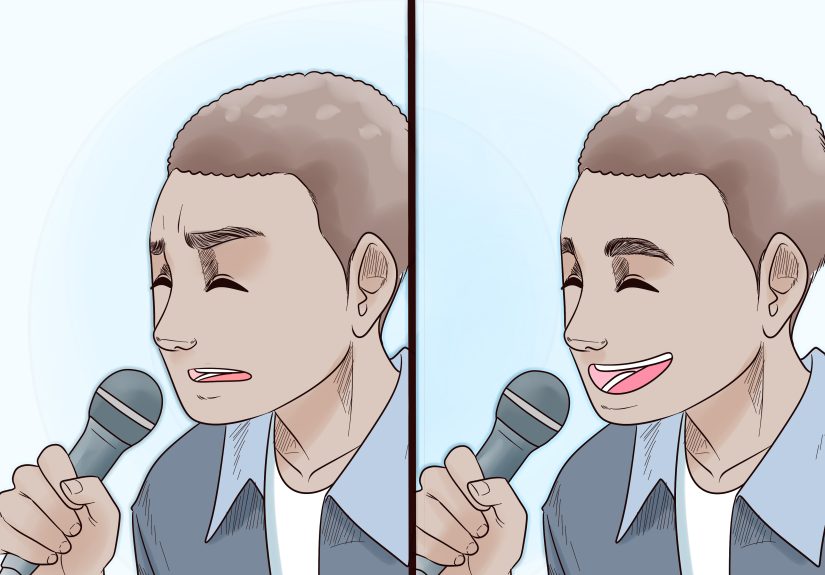
Microphone distance is tone control
Singing into a mic isn’t “singing, but closer.” Mic technique changes everything:
distance affects bass (proximity effect), loudness, clarity, and plosives (“p” pops).
- Start point: about 6–12 inches away for many live/recording situations.
- Angle: aim the mic slightly off-center to reduce popping and harsh consonants.
- Dynamics: move closer for softer lines, back off slightly for big belts.
Professional stage habits (the unsexy secrets)
- Know your breath map: mark where you inhale so you’re not gasping like a goldfish on a jog.
- Own the silence: pauses look intentional when you don’t fidget.
- Deliver the lyric: pros don’t just sing words; they communicate choiceswho, what, why, right now.
Step 7: Protect Your Voice Like It Pays Your Rent (Because It Might)
Vocal health is part of singing like a professional. The voice is tissue, not a guitar string you can replace in 30 seconds.
Treat it like an athlete treats joints and muscles.
Vocal hygiene that actually matters
- Hydration: drink water consistently. Vocal folds work best when the body is well hydrated.
- Humidity: if you live in dry air, a humidifier can help keep your throat comfortableespecially in winter.
- Avoid smoking: it irritates and dries tissues and raises long-term risk.
- Manage reflux: acid irritation can inflame the throat and affect tone and stamina.
- Don’t sing through hoarseness: hoarse + more singing often equals more inflammation.
Red flags: when to get checked
See a medical professional (often an ENT) if hoarseness lasts more than a couple of weeks,
or if you have serious symptoms like trouble breathing or swallowing, coughing blood,
or a sudden major voice change that doesn’t improve. Professionals take voice issues seriously early,
not after six months of “I thought it would go away.”
Step 8: Consider a Vocal Coach (Even Pros Do)
A good vocal coach accelerates progress by diagnosing what you can’t feel yet:
tongue tension, inconsistent airflow, vowel shapes, register strategy, style choices, and performance habits.
Think of it like having a trainer at the gymtechnique improves faster when someone can see what you’re actually doing.
A Simple 7-Day Starter Plan
If you want a clear launch pad, try this one-week plan (30–45 minutes per day).
- Day 1: posture + hiss timer + lip trills + record a verse/chorus baseline.
- Day 2: resonance drills (“ng,” hum) + gentle sirens + sing softly in tune.
- Day 3: vowel clarity + diction (slow lyrics) + one song phrase map (breaths marked).
- Day 4: register bridge (sirens + “mum” scales) + fix the hardest 10 seconds.
- Day 5: intonation day (drone + intervals) + record and compare to Day 1.
- Day 6: mic technique practice (distance/angle) + perform the song without stopping.
- Day 7: light warm-up + “mini set” (2 songs) + cool-down + write next-week targets.
Experiences: What It Feels Like to Learn How to Sing Like a Professional (About )
Most people expect the “pro” moment to arrive like a lightning bolt: one day you wake up, open your mouth, and boomyour voice is suddenly huge,
flawless, and emotionally devastating in the way that makes strangers throw flowers at you in grocery store aisles.
In real life, progress feels much more like upgrading your phone: the improvements are obvious when you compare versions,
but on any single day you’re mostly thinking, “Wait… is this better, or am I just hydrated?”
Early on, the biggest surprise is how physical singing is. You might think you need “more power,” so you push harder
and your throat immediately files a complaint with HR. Then you discover breath support isn’t force; it’s coordination.
The first time the hiss exercise clicks, it feels oddly calming, like your body finally got the memo that singing
is not a sprint away from a bear.
Warm-ups also change from “random noises” to a genuine routine. At first, lip trills are comedyair everywhere, sound nowhere.
But then one day you do a siren on a lip trill and the top notes show up without the usual strain.
That moment is a tiny miracle. It’s also annoying, because it proves the problem wasn’t that you “can’t sing high”
it was that your technique was trying to lift heavy boxes with a bent back.
The next “pro” feeling often comes from resonance. You stop trying to get louder by squeezing the throat,
and you aim for clarity and ring instead. Suddenly, the sound carries. Friends say, “Your voice is so much stronger!”
and you’re thinking, “I’m actually using less effort.” That’s the professional trick in a nutshell:
better results with less strain.
Recording yourself is where bravery is built. The first playback can be… educational. Maybe your pitch drifts on long notes.
Maybe the chorus rushes like it’s late for a meeting. Maybe your “emotional delivery” sounds like you’re reading a shopping list.
But if you can treat recordings like feedbacknot self-worthyou improve fast. You learn to spot patterns:
you go sharp when you push volume, you go flat when you under-breathe, you mumble when you’re nervous,
and your best takes happen when you commit to the lyric instead of “playing it safe.”
Live singing adds a whole new layer: microphones and adrenaline. Mic technique feels awkward until it doesn’t.
You learn that the mic is part of the instrumentmove in for intimacy, back off for big moments, angle to avoid pops.
Eventually, you stop fighting the sound system and start partnering with it.
The most “professional” experience, though, is learning to protect your voice. You stop bragging about singing through sickness.
You rest when you’re hoarse. You hydrate like it’s your job. You warm up before demanding songs.
That shiftchoosing long-term consistency over short-term egois when you genuinely start singing like a pro,
even if you’re still practicing in your bedroom with a laundry basket audience.
Wrap-Up: Your Professional Sound Is Built, Not Found
If you want to sing like a professional, focus on professional behaviors: breath control, resonance, smart practice,
ear training, performance skills, and vocal health. Keep it consistent, keep it calm, and keep it honest.
The “pro” sound isn’t a secret clubit’s the result of doing the right basics for long enough that your voice trusts you.