Table of Contents >> Show >> Hide
- Safety first: what not to do
- What you’re really testing (hint: it’s not just the injector)
- Common symptoms of injector trouble
- Before you blame the injectors: the “look-alikes”
- The safest “first tests”: scan data that points toward (or away from) injectors
- How professionals test fuel injectors (and what each test proves)
- Electrical checks: is the injector circuit healthy?
- Power balance / cylinder contribution tests: which cylinder isn’t pulling its weight?
- Injector balance / relative flow tests: is one injector under-delivering?
- Leak testing: is an injector dribbling when it should be sealed?
- Bench testing and cleaning: spray pattern, flow rate, and “real life” performance
- Port injection vs. direct injection vs. diesel: why “injector testing” isn’t one-size-fits-all
- How to interpret results without guessing
- Cleaning vs. replacing: what actually works
- FAQ: quick answers to common injector-testing questions
- Real-world experiences and scenarios (the 500-word “what it looks like in real life” section)
Fuel injectors are the engine’s tiny, fast, very dramatic bartenders: they spray fuel in precise amounts so your cylinders
get the right “cocktail” at the right time. When an injector goes off-scriptclogged, leaking, electrically cranky, or just
plain tiredyou can end up with rough idle, misfires, bad mileage, or a Check Engine light that won’t stop judging you.
This guide breaks down how fuel injectors are tested (the safe, sensible way) and how to interpret the clues
without immediately blaming the injector for every engine complaint since the invention of gasoline.
Safety first: what not to do
Fuel systems can be hazardous. Gasoline vapors are flammable, and some engines (especially direct injection gasoline and
modern diesel common-rail) can involve extremely high fuel pressures. If you smell strong raw fuel, see visible leaking,
or suspect a fuel leak, stop driving and have the vehicle inspected.
This article focuses on diagnostic concepts and non-invasive checks you can understand without opening fuel lines.
Anything involving fuel rails, pressurized lines, or specialized test gear is best left to a qualified shop.
What you’re really testing (hint: it’s not just the injector)
“Testing fuel injectors” is usually shorthand for answering four separate questions:
- Is the engine getting enough fuel overall? (pump, filter, regulator, pressure/volume)
- Is each cylinder getting its fair share? (clogged injector, restricted flow, imbalance)
- Is the injector being commanded correctly? (wiring, connector, ECU driver signal)
- Is the injector mechanically healthy? (leaking, poor spray pattern, sticking)
The smartest diagnosis follows the path of least regret: rule out the big, common stuff first, then zoom in.
Common symptoms of injector trouble
Fuel injector issues often mimic other problems, but these signs tend to show up frequently:
- Rough idle (especially when warm), stumble, or hesitation
- Misfire codes (like P0300 random misfire or P0301–P0308 for specific cylinders)
- Lean codes (often P0171/P0174) or rich codes (often P0172/P0175)
- Fuel smell in exhaust (possible leaking injector or rich running)
- Reduced fuel economy and sluggish acceleration
Two injector failures that act totally different
Not all “bad injectors” behave the same:
-
Clogged/restricted injector: Cylinder runs lean, may misfire under load, and oxygen in the exhaust can make sensors
“think” the engine is lean. -
Leaking/stuck-open injector: Cylinder runs rich, can foul a spark plug, cause a rough idle, and may trigger rich codes or
catalyst-related complaints if ignored.
Before you blame the injectors: the “look-alikes”
A lot of injector “diagnoses” are really the automotive version of blaming your Wi-Fi router for a power outage.
Here are the usual suspects that can create the same symptoms:
Ignition problems (spark plugs, coils, wiring)
A weak spark causes misfires that feel exactly like fuel problems. A shop will typically confirm the ignition side before
calling an injector guilty.
Vacuum leaks and unmetered air
A vacuum leak can create a lean condition and misfiresespecially at idlewithout any injector being at fault.
Low fuel pressure or low fuel volume
If fuel pressure is low, even perfectly healthy injectors can’t atomize fuel correctly. Diagnosis often starts by verifying
that the fuel system can deliver adequate pressure/volume to the rail. Think of it like a garden hose: the nozzle isn’t the
issue if the faucet is barely on.
Mechanical engine issues (compression, timing, valve problems)
One weak cylinder from low compression can trigger misfire counts and fuel trim chaos. Good techs rule this out before
condemning expensive parts.
The safest “first tests”: scan data that points toward (or away from) injectors
If you can safely access an OBD-II scan tool (no tools under the hood required), you can gather clues that help you
understand what a shop is looking for.
1) Pull codes and freeze-frame data
Codes don’t “declare the winner,” but they narrow the search:
- P030X suggests a misfire on a specific cylinder.
- P0300 suggests random/multiple misfires.
- P0171/P0174 suggests a lean condition (often too much air or not enough fuel).
- P0172/P0175 suggests a rich condition (too much fuel or not enough air).
Freeze-frame data shows the conditions when the code set (cold start, cruise, hard acceleration, etc.). That context matters.
2) Look at fuel trims (STFT and LTFT)
Fuel trims are the engine computer’s way of saying, “I’m adjusting fuel because reality isn’t matching the plan.”
In general:
- Big positive trims mean the computer is adding fuel (often chasing a lean condition).
- Big negative trims mean it’s subtracting fuel (often chasing a rich condition).
The pattern is the clue:
- Lean only at idle often points to vacuum leaks.
- Lean under load can suggest restricted fuel delivery (fuel pressure/volume) or restricted injectors.
- One-cylinder misfire counts plus trim weirdness can hint at an individual injector problemafter ignition and compression are verified.
3) Check misfire counters (Mode 6 or live misfire data)
Many scan tools can show which cylinder is racking up misfires. If one cylinder is dramatically worse than the others,
that’s a strong direction for targeted testing (spark, compression, injector).
How professionals test fuel injectors (and what each test proves)
Shops don’t rely on one magic test. They stack evidence until the conclusion is boringly obvious.
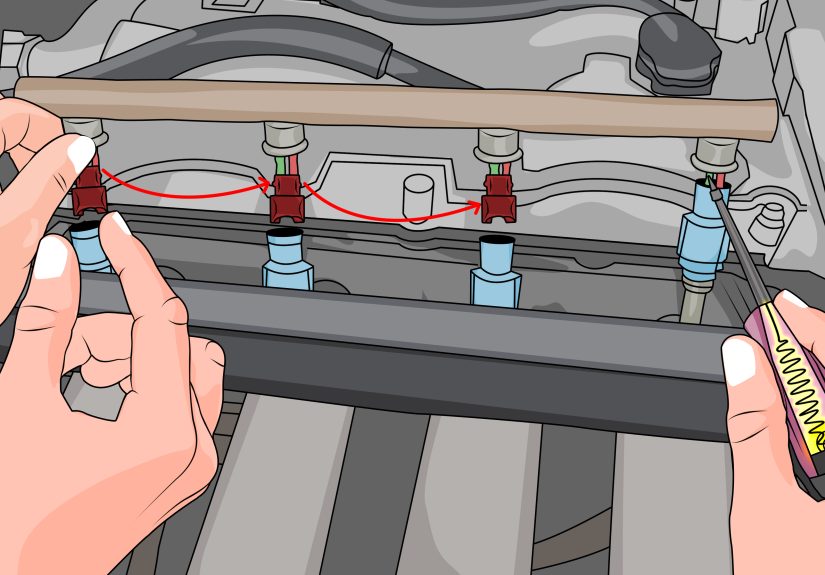
Electrical checks: is the injector circuit healthy?
A technician may verify:
- Injector coil resistance (and whether one injector reads noticeably different from the others)
- Injector command signal (whether the computer is pulsing the injector as expected)
- Connector and wiring integrity (corrosion, damaged pins, broken wires)
Many port fuel injectors are “high impedance,” often measuring in the teens of ohms, while some systems use “low impedance”
injectors with much lower resistance. Exact specs depend on the vehicleso pros compare against the service information and
against the other injectors on the same engine.
Power balance / cylinder contribution tests: which cylinder isn’t pulling its weight?
Some scan tools can run a cylinder contribution or power balance test, temporarily reducing contribution from each cylinder
and watching RPM change. A “dead” cylinder shows little change compared to healthy cylindershelpful for confirming where to focus next.
Injector balance / relative flow tests: is one injector under-delivering?
An injector balance test looks for uneven fuel delivery. Depending on the system, a shop may compare pressure changes, injector
response, or relative flow indications. The goal isn’t “perfect numbers,” it’s identifying one injector that’s the odd one out.
Leak testing: is an injector dribbling when it should be sealed?
A leaking injector can flood a cylinder, foul a plug, and create rough idle and rich symptoms. Some diagnostics look for
clues like rapid pressure drop after shutdown (again, measured with proper equipment and safety procedures).
Bench testing and cleaning: spray pattern, flow rate, and “real life” performance
For clogged injectorsespecially when contamination has made it past the main filterprofessional cleaning or replacement can be
more effective than over-the-counter tank additives. Bench testing can measure injector flow and confirm whether cleaning
restores performance or if replacement is the smarter move.
Port injection vs. direct injection vs. diesel: why “injector testing” isn’t one-size-fits-all
Injector testing changes a lot depending on the system:
Port fuel injection (PFI)
These injectors spray into the intake port. Common issues include deposits and electrical faults. Diagnostics often include
trims/misfires plus electrical checks and balance-style testing.
Gasoline direct injection (GDI)
These injectors operate under higher pressures and are more sensitive to deposits and fuel quality. Specialized tools and
procedures are commonespecially if the suspected fault involves leakage or mechanical wear.
Diesel common-rail
Diesel injectors can be solenoid or piezo style, and the system pressures can be extreme. Testing often involves specialized
equipment designed for diesel components. In plain English: this is not the system to “wing it” on in a driveway.
How to interpret results without guessing
Here are a few “if you see this, think that” patterns technicians commonly use:
Pattern A: One cylinder misfires a lot, trims look lean
After verifying spark and compression, a restricted injector becomes a strong suspect. A modest restriction can be enough to
trigger a misfire, and the extra oxygen from incomplete combustion can fool sensors into reading lean.
Pattern B: One cylinder has a dark, fuel-fouled plug and rich behavior
A leaking injector (or one stuck partially open) becomes likelyespecially if the plug in that cylinder looks different from the rest.
Pattern C: Lean codes on both banks and multiple cylinders
This often points to a “global” problem (vacuum leak, MAF issue, low fuel pressure/volume) rather than one injector.
Cleaning vs. replacing: what actually works
“Injector cleaner” in a bottle isn’t magic, but it also isn’t worthless. The key is matching the solution to the problem:
- Mild deposits: A quality fuel system cleaner may help, especially if symptoms are early and not severe.
- Significant restriction or contamination: Professional cleaning (with verification on a bench) or replacement is often more effective.
- Electrical failure or mechanical leakage: Cleaning won’t fix a broken coil or worn internal sealing surfacesreplacement is usually the answer.
If you’re paying for parts, prioritize correct fit and quality. Fuel injectors are precision components; “close enough” is how you end up paying twice.
FAQ: quick answers to common injector-testing questions
Can a bad injector cause a flashing Check Engine light?
Yes. A flashing light commonly indicates a severe misfire that can damage the catalytic converter. Misfires can be caused by
ignition, fuel delivery (including injectors), or mechanical issuesso the next step is diagnosis, not roulette.
Is a lean code always a bad injector?
Nope. Lean codes can be caused by unmetered air (vacuum leaks), MAF issues, low fuel pressure, exhaust leaks upstream of sensors,
or injector problems. The scan-data pattern and targeted testing matter.
Can one bad injector cause “system lean” codes?
Sometimes. A severe enough single-cylinder fuel restriction can create misfires that introduce extra oxygen into the exhaust,
which can influence sensor feedback. But it’s less common than global air/fuel problemsso it should be proven, not assumed.
What’s the “best” test?
The best test is the one that answers the question you actually have. If the question is “which cylinder is unhappy,” a power
balance test can help. If the question is “is the injector leaking,” leak testing or bench validation becomes more relevant.
Diagnosis is a chain, not a single link.
Real-world experiences and scenarios (the 500-word “what it looks like in real life” section)
People often imagine injector testing as a dramatic moment where a mechanic points at an injector and says, “Aha! You, sir, are
the villain.” In reality, it’s usually a slow-motion detective story with plot twists, side characters, and one suspect who turns
out to be innocent but still looks guilty in photos.
Scenario 1: “It’s definitely an injector”… until it isn’t
A driver comes in with a rough idle and a lean code. The instinct is to blame injectorsbecause they sound expensive and
therefore “important.” But a quick look at fuel trims shows the engine is lean mostly at idle. That pattern often fits a vacuum
leak more than a fuel restriction. The fix ends up being a cracked hose or a leaking intake gasket. The injectors were fine
the whole time, quietly doing their jobs and being slandered.
Scenario 2: The misfire that moves around
Another common story: the car sets a cylinder-specific misfire code (say, cylinder 4). New spark plugs go in. The misfire seems
better for a day… then it’s back. A technician checks misfire counters and sees cylinder 4 is still the repeat offender. Next,
ignition is verified, compression looks good, and the data points toward fuel. At that point, injector-focused testing makes sense.
The “lesson” here is that injector diagnosis usually happens after other likely causes are clearednot because a parts cannon ran
out of ammunition.
Scenario 3: The “rich smell” clue that shouldn’t be ignored
Some drivers report a strong fuel smell and rough running, especially at idle. A leaking injector can create that kind of symptom
set, and it may show up as one spark plug that looks very different from the restdarker, wet-looking, or heavily carboned.
The experience many shops share is that fuel odors plus drivability issues deserve urgent attention, because prolonged rich running
can create secondary damage (like stressed emissions components). Even if the injector isn’t the root cause, it’s a symptom cluster
you don’t “wait and see” with.
Scenario 4: “Cleaner fixed it” vs. “Cleaner did nothing”
Drivers also love reporting success stories with fuel system cleanersand sometimes they’re legit. If the issue is early-stage
deposits, a good cleaner can improve spray quality enough to smooth idle and reduce minor hesitation. But when contamination has
clogged internal screens or the injector is electrically failing, cleaner won’t perform miracles. That’s why shops like bench
verification: it turns “I feel like it’s better” into measurable results. The take-home message is simple: cleaners can be a
reasonable first step for mild symptoms, but a persistent misfire or repeated lean/rich codes are asking for real diagnosis.
Scenario 5: The “right answer” is sometimes “it depends on the system”
One of the most useful experiences technicians share is that injector testing is deeply system-dependent. Port injection problems
often respond well to traditional diagnostics and cleaning/replacement. Direct injection adds complexity and higher-pressure
considerations. Diesel common-rail injectors require specialized equipment and safety discipline. In other words: the “best”
injector test isn’t a universal trickit’s the right method for the engine design, the symptoms, and the data.
If you want a practical mindset to keep: start with scan data, confirm the basics (spark, compression, fuel supply), and only then
zoom into injector-specific tests. That approach saves money, time, and your sanitybecause “guessing” is the most expensive tool
in the toolbox.