Table of Contents >> Show >> Hide
- Why Nature Is the Ultimate Fantasy Collaborator
- How I Turn Natural Observation Into Fantasy Illustration
- Why Sculpture Changes the Conversation
- A Practical Creative Process for Nature-Inspired Fantasy Art
- Common Mistakes When Creating Fantasy Illustration and Sculpture Inspired by Nature
- The Emotional Power of Nature-Inspired Fantasy Art
- My Experiences Creating Fantasy Illustration and Sculpture Inspired by Nature
- Conclusion
Some artists chase realism. I chase realism until it grows antlers, sprouts moth wings, and politely asks to live in a haunted forest. That, in a nutshell, is the joy of creating fantasy illustration and sculpture inspired by nature. The natural world is already dramatic, weird, elegant, and slightly overcommitted to detail. A fern unfurls like a secret. A mushroom looks like it belongs in a wizard’s pantry. Tree bark can resemble armor, skin, or an ancient map that only ravens can read. So when I build fantasy art from nature, I am not escaping reality. I am turning up the volume on what reality is already whispering.
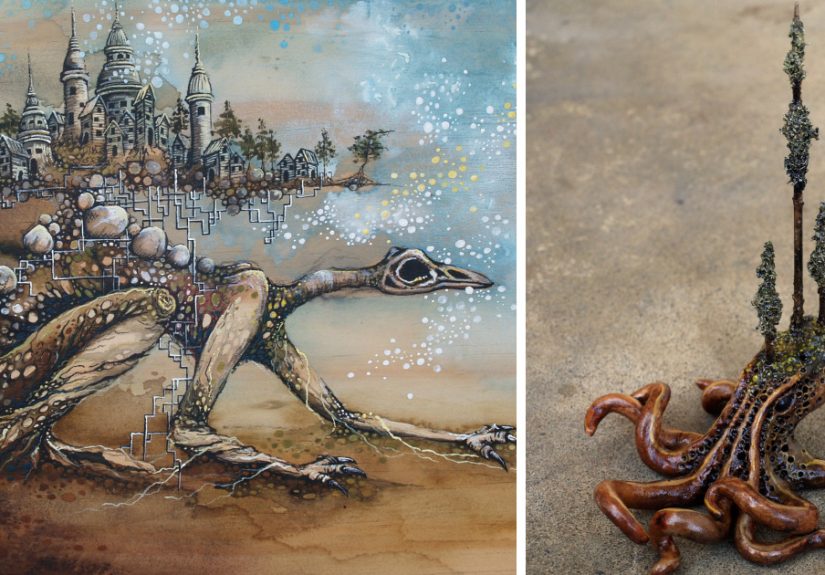
Nature-inspired fantasy art works because it gives imagination something solid to stand on. Viewers may not believe in moonlit stag spirits, coral castles, or stone guardians with flower crowns, but they do believe in roots, feathers, bones, petals, shells, fog, and erosion. Those details anchor the impossible. They make invented worlds feel tactile, lived-in, and emotionally convincing. In both fantasy illustration and sculpture, nature does more than decorate the work. It gives the work structure, logic, texture, symbolism, and mood.
That is why I keep returning to leaves, seed pods, insects, bones, branches, tide pools, lichen, and weathered stones. They are not just references. They are collaborators. They offer shape language, color harmony, pattern systems, and built-in storytelling. A single twisted root can suggest an ancient creature. A dried poppy head can become a royal lantern in a forest kingdom. A beetle wing can inspire armor. A wave-worn piece of wood can become the spine of a sculpture that looks half relic, half dream. The fantasy comes later. Nature writes the first draft.
Why Nature Is the Ultimate Fantasy Collaborator
Fantasy art often succeeds when it feels both wondrous and believable. That balance is easier to achieve when the work begins with observation. Nature is full of visual rules that make even the strangest forms feel coherent. Repetition, asymmetry, branching systems, growth spirals, layered textures, and adaptive structures all appear naturally in plants, animals, fungi, minerals, and landscapes. When those principles show up in fantasy illustration or sculpture, the result feels less random and more inevitable, as though the creature, object, or environment could have evolved somewhere just beyond the edge of the map.
There is also an emotional reason nature and fantasy belong together. Nature carries mystery without trying too hard. Fog hides. Vines overtake. Flowers bloom for a blink and vanish. Forests muffle sound. Caves distort scale. Oceans swallow certainty for breakfast. Those qualities create an atmosphere that fantasy artists love because they naturally suggest myth, transformation, danger, beauty, and rebirth. You do not have to force symbolism into a nest, antler, thorn, cocoon, or storm cloud. Symbolism arrives wearing muddy boots and lets itself in.
Nature already looks a little invented
One of the biggest creative breakthroughs is realizing that nature does not need much exaggeration to feel fantastical. Look closely at a luna moth, a fiddlehead fern, a carnivorous plant, a nautilus shell, or the veins in a translucent leaf. These are not dull forms waiting to be rescued by imagination. They are visual fireworks. When I create fantasy illustration, I often begin by sketching a natural subject almost faithfully. Then I stretch proportions, merge species, shift the lighting, or place the form in a mythic context. The foundation remains recognizable, which is exactly why the final image feels magical rather than messy.
How I Turn Natural Observation Into Fantasy Illustration
My process usually starts with collecting visual clues. I study the silhouette of a bird skull, the rhythm of fish fins, the folds inside petals, the architecture of mushrooms, or the way moss softens a hard surface. Then I ask a simple question: what story is hiding in this shape? A seed pod might become a floating temple. A fox tail might inspire the plume of a forest spirit. A thorn bush might become the crown of a guardian queen. In other words, I do not begin with a generic “fantasy character.” I begin with a natural form and let it tell me what it wants to become.
That approach helps fantasy illustration avoid a common problem: visual cliché. If every enchanted forest looks like the same pile of glowing mushrooms and blue mist, the viewer stops feeling wonder and starts feeling déjà vu. Nature solves that. When I base designs on real bark textures, specific flower anatomy, actual wing structures, or local rock formations, the work gains individuality. Even if the final image includes impossible creatures or dreamlike architecture, it still has the specificity that makes art memorable.
Color plays a huge role here too. Many artists think fantasy means inventing wild palettes from thin air, but some of the strongest color stories already exist in ecosystems. Desert landscapes teach restraint. Coral reefs teach contrast. Autumn forests teach saturation with discipline. Swamps teach subtle greens, bruised browns, and quiet golds. Snowfields teach the difference between white and the thousand not-quite-whites that make white interesting. When I borrow color cues from real environments, the illustration feels richer and less artificial. Even the weirdest magical scene benefits from chromatic common sense.
Exaggeration works best when it has a job
In fantasy illustration, exaggeration is not there just to show off. It should serve character, mood, or narrative. If I enlarge antlers, I want them to communicate age, burden, status, or sacred power. If I add vines curling around a figure, they should suggest protection, captivity, healing, or slow transformation. If I design a winged creature inspired by moths, I want the powdery softness of those wings to create a feeling that differs from a bird of prey. Big shapes are fun, yes, but meaningful shapes are unforgettable.
Lighting matters just as much. Nature-inspired fantasy rarely looks best under flat, generic illumination. I want the light to behave like weather, not like a supermarket ceiling. Mist, moonlight, bioluminescent glow, filtered woodland light, sunset haze, storm flashes, and underwater diffusion all create emotional context. In illustration, light is often the difference between “nice drawing” and “I would absolutely follow that suspicious fox into the glowing swamp.” One is competent. The other is cinema.
Why Sculpture Changes the Conversation
Illustration lets me invent a world. Sculpture lets me make that world occupy the same air as the viewer. That is a different kind of magic. When fantasy moves into three dimensions, texture, scale, shadow, and material become part of the storytelling. A branch-like structure can feel fragile or menacing depending on thickness and finish. A flower form can read as delicate in paint but become uncanny in bronze, resin, ceramic, wood, glass, or plaster. Sculpture turns metaphor into presence.
Nature is especially powerful in sculpture because the physical world already speaks through surface. Cracked clay recalls drought. Burnished metal can feel fossil-like or ceremonial. Rough wood suggests age and weather. Translucent materials can evoke wings, petals, ice, skin, or memory. The goal is not simply to imitate nature literally. The goal is to borrow nature’s tactile intelligence. I want people to feel, even before touching the piece, whether it belongs to a dream forest, a drowned kingdom, a volcanic plain, or a shrine hidden under roots.
Material is part of the myth
One of the smartest decisions in nature-inspired sculpture is choosing materials that support the fiction. If I am sculpting a creature based on fungi and deep-forest decay, glossy perfection may not be the answer. Maybe the work needs matte surfaces, irregular edges, layered stains, or a sense of organic growth. If I am building something celestial and floral, perhaps glassy translucence or pale ceramic better supports the mood. Material should not arrive late to the concept meeting. Material is the concept meeting.
This is also where sculpture can become beautifully strange. A seed can be enlarged to the size of a throne. A flower can be armored. A bird can be built from root systems instead of feathers. A chandelier can feel like a frozen branch. A wall piece can look like a fossil from a kingdom that never existed. Nature gives the vocabulary; fantasy rearranges the grammar.
A Practical Creative Process for Nature-Inspired Fantasy Art
If I had to explain my process simply, it would look like this: observe, collect, combine, transform, edit. Observation comes first because invention without observation often becomes shallow. I sketch from real leaves, stones, insects, feathers, seed heads, and weathered wood. I take close-up photos. I notice how things connect, overlap, split, dry out, curl, reflect light, and decay. Then I collect those fragments into a visual library.
Next comes combination. This is where the fantasy engine starts humming. I might combine the rib structure of a leaf with the architecture of a cathedral, the stance of a heron with the body language of a guardian, or the spiral of a shell with a ceremonial crown. The key is to merge references with intention. Random mashups can feel gimmicky. Strong combinations create a new visual logic.
Transformation follows. Here I push scale, sharpen silhouette, adjust rhythm, and develop narrative cues. I ask what the piece wants emotionally. Is it mournful, sacred, playful, eerie, ancient, or exuberant? Nature can support any of those moods, but not all at once. Choosing the emotional lane helps every later decision, from palette to edge quality to display method.
Editing is the final and often most painful stage, which is rude but necessary. Sometimes the work has too many clever details fighting for attention like unpaid actors at an audition. Nature is abundant, but art needs hierarchy. I remove motifs that do not strengthen the core idea. I simplify where needed. I let one or two forms carry the drama instead of asking every leaf to become the star of the movie.
Common Mistakes When Creating Fantasy Illustration and Sculpture Inspired by Nature
The first mistake is decorating instead of integrating. Sticking flowers on a character or adding antlers to a statue does not automatically create a meaningful nature-inspired design. The natural elements need to shape the idea from the inside out. The second mistake is overloading the work with motifs. Nature is generous, but your composition still needs breathing room. Too many textures, species references, and symbolic details can flatten the impact instead of increasing it.
The third mistake is forgetting that fantasy still needs design discipline. A work can be imaginative and still have weak silhouette, muddy values, awkward balance, or confusing focal points. Magic does not excuse messy craftsmanship. In fact, the more fantastical the subject, the more structure it needs. Viewers will follow you into a strange world, but only if the road is built well.
The fourth mistake is copying nature too literally without interpretation. If the goal is pure botanical accuracy, that can be beautiful, but it is not automatically fantasy. The sweet spot for me is translation. I want to retain the intelligence of the original form while giving it a new emotional function. A branch becomes a gesture. A shell becomes architecture. A fungus becomes a throne room. A flower becomes a warning.
The Emotional Power of Nature-Inspired Fantasy Art
What keeps drawing me back to this subject is not just aesthetics. It is emotional range. Nature-inspired fantasy art can feel ancient without being dusty, spiritual without being preachy, and surreal without becoming nonsense. It can hold grief, wonder, tenderness, menace, humor, and renewal in the same visual language. A creature made of roots can feel protective. A sculpture based on bloom and decay can feel heartbreaking. A luminous illustrated forest can feel like both refuge and test.
That emotional flexibility matters because audiences are hungry for work that feels immersive and meaningful. People do not only want pretty images. They want art that lets them feel the world differently. Nature-based fantasy does that well because it reflects a truth many of us already sense: the world is more alive, more interconnected, and more mysterious than our daily routines allow us to notice. Fantasy, at its best, is not a lie. It is a way of noticing more.
My Experiences Creating Fantasy Illustration and Sculpture Inspired by Nature
Some of my most useful creative experiences have started with very unglamorous moments. Not a thunderbolt. Not a prophetic dream. Usually it is me crouching near a patch of weeds, staring at a dead leaf like it owes me money. I have learned that nature rarely hands over ideas in a dramatic, cinematic way. It whispers. It hides the best concepts in textures, accidents, and overlooked forms. A broken branch, a bird nest after a storm, a stone with a strange hole worn through it, a mushroom pushing up through bark mulch, all of these have found their way into my fantasy illustration and sculpture.
I remember once collecting reference photos after a rainy afternoon, when everything looked like it had been freshly varnished by the universe. Wet bark became darker and more detailed. Moss looked like miniature architecture. Puddles reflected branches in ways that made the trees appear to grow downward into another world. I went home expecting to draw a simple forest scene and ended up creating an illustration of a hidden kingdom suspended between roots and reflections. That piece worked because the magic came from observation first. I did not invent the mood from nowhere. The weather handed it to me.
Sculpture has taught me a different lesson: ideas that look elegant on paper can become hilariously stubborn in three dimensions. A design inspired by twisting vines may seem graceful in a sketch, then turn into a structural diva when you try to build it. I have had pieces lean, crack, sag, or refuse to balance in ways that were deeply educational and only mildly offensive. But those moments improved the work. They forced me to think more like nature itself. How does weight travel? Where does tension live? What kind of support can stay hidden? Trees, shells, bones, and seed structures solve these problems constantly. The more I study them, the more my sculpture becomes stronger and more believable.
Another experience that changed my process was learning to stop treating every natural reference as something precious and complete. Sometimes I do not need the whole flower. I only need the fold where the petal meets shadow. Sometimes I do not need to sculpt a realistic bird. I only need the rhythm of wing bones to guide a completely invented creature. That shift made my work less literal and more expressive. It also made the art feel more personal. Instead of copying nature, I began collaborating with it.
There is also a quiet emotional benefit to working this way. Spending time with natural forms slows my thinking down. It makes me pay attention. In a world that encourages speed, noise, and endless scrolling, studying bark patterns or sketching seed pods feels almost rebellious. That slower attention shows up in the final work. Viewers often respond not just to the image or object itself, but to the sense that it was made with patience. I think people can feel when an artwork has actually looked at the world, instead of merely sampling visual trends online.
Some of my favorite finished pieces have come from blending beauty with unease. A floral sculpture with bone-like supports. An illustration where a deer spirit looks both majestic and slightly too intelligent. A wall relief that resembles coral, antlers, and fire all at once. Those hybrids feel honest to me because nature is not only soft and pretty. It is also competitive, adaptive, eerie, fragile, and relentless. When fantasy art captures that full emotional spectrum, it becomes much more compelling than a simple fairy-tale surface.
In the end, creating fantasy illustration and sculpture inspired by nature has made me a better observer, designer, and storyteller. It has taught me that imagination grows stronger when it has roots. It has taught me that texture can carry meaning, that materials can tell part of the story, and that wonder is often hiding in plain sight. Most of all, it has taught me that the line between natural and magical is thinner than it looks. Sometimes all it takes is a little attention, a sketchbook, and the willingness to admit that a seed pod can absolutely become a palace.
Conclusion
Creating fantasy illustration and sculpture inspired by nature is not about escaping the real world. It is about studying it so closely that it starts revealing its secret mythology. The best nature-inspired fantasy art feels grounded because it is grounded. It borrows the logic of growth, erosion, anatomy, weather, color, and texture, then transforms those observations into creatures, objects, and worlds that feel emotionally true. Whether I am drawing an enchanted landscape or sculpting a relic from an imagined forest civilization, nature remains my most generous creative partner. It offers endless forms, endless metaphors, and endless reminders that the strange and beautiful have been here all along.