Table of Contents >> Show >> Hide
- Why combining two apartments is the ultimate NYC flex (the wholesome kind)
- The Brooklyn Heights “two becomes one” makeover
- Design moves that make the combo feel like one home (not two apartments holding hands)
- What it takes to combine two apartments in NYC (legally, practically, emotionally)
- Steal these ideas for your own apartment-combination project
- FAQ: quick answers for the “Should we combine?” crowd
- Conclusion: when “more space” is also better space
- Experiences: What it feels like to live in a combined Brooklyn Heights–style apartment
Because in New York, “more space” is both a design goal and a full-blown personality trait.
If you’ve ever lived in an apartment where the “dining area” is technically the two square feet between the fridge
and your feelings, you’ve probably had this fantasy: What if I could just… take the apartment next door?
Not in a villain way. More in a “two closets and a door that opens all the way” kind of way.
That daydream became real for a Brooklyn Heights family who combined two adjacent units into one cohesive home,
with Shapeless Studio Architecture & Interiors doing the heavy lifting (and the light-gathering, and the storage
wizardry). The result is a calm, tactile, quietly clever apartment that feels loft-like and generouswithout
slipping into echo-y “converted warehouse chic” cosplay.
This is the story of how two apartments became oneplus what you can steal from the playbook if you’re planning
your own “apartment combo” (or just want your kitchen to stop shouting, “I AM A KITCHEN!” every time you walk by).
Why combining two apartments is the ultimate NYC flex (the wholesome kind)
Moving in New York is a hobby you never asked for, like collecting dust or refreshing listing sites at 2 a.m.
So when people find a way to get more space without leaving the neighborhood, the block, the buildingor the
one bodega guy who calls you “boss” no matter whatcombining apartments starts to look very rational.
But here’s the tricky part: a combination can feel like exactly what it istwo homes awkwardly stapled together.
You get duplicate “front doors,” weird hallways, and that suspicious moment when you realize you’ve created a
second kitchen you don’t legally want. The best combos don’t feel like a merger. They feel like a home that was
always meant to be that size.
Shapeless Studio’s Brooklyn Heights project is a masterclass in making the whole place read as one
visually, practically, and emotionally (yes, we’re being emotional about millwork; this is design).
The Brooklyn Heights “two becomes one” makeover
The building: history, quirks, and why light becomes a design problem
The apartment sits in a brick building with a layered pastindustrial bones, big-window potential, and the
classic New York surprise: a layout that’s deeper than you expect. That depth is dramatic, but it also creates
a daylight imbalance: bright near the windows, dim farther back. In other words, you get a sunny living room
and then… a cave-adjacent entry.
The starting point: two separate units with two separate vibes
The homeowners purchased two adjacent sixth-floor units and decided to do what every New Yorker wants to do
during a neighbor’s noisy dinner party: connect the spaces and reclaim peace. Before the renovation, the setup
included a smaller unit (studio-sized) alongside a larger apartment that had been divided up over time. Both
had the kind of “rental-quality” finishes that whisper, “I was installed quickly and I will not be remembered.”
The brief: a bright central hub plus private nooks
The design goal sounds simple, but it’s actually the entire ball game: create a large, bright, central family
space, then branch off into quieter rooms for work, downtime, and kid life. Think “great room” energy, but with
the ability to close a door and pretend you don’t own a television for 20 minutes.
The finished plan lands in that sweet spot: two bedrooms, a generous living area, a separate media/TV space that
can flex into guest territory, and practical support spaces pushed deeper into the apartment (laundry/utility,
a study zone, and a mudroom-like entry moment). The home feels open without feeling exposed.
Design moves that make the combo feel like one home (not two apartments holding hands)
1) “Embrace the dark” instead of fighting it
When a space is far from windows, you have two choices: spend your life trying to turn it into a bright room
it doesn’t want to be, or accept the reality and make it beautiful. This project chooses option twowith gusto.
The entry becomes intentionally moody: deep blue paint, dark flooring, and a mudroom vibe that’s practical
(shoes, bags, life) and cinematic (hello, drama). The payoff is the transition: you step from a rich, shadowy
threshold into a bright, calm central space and immediately feel the apartment “open.” It’s like design-level
storytellingone scene sets up the next.
2) Let light travel by keeping partitions smart and strategic
One of the quiet geniuses of this renovation is how it handles separation. There are divisions, but they’re not
heavy-handed. Sliding steel-and-glass doors define zones without blocking daylight, and they keep the apartment
flexible: family room becomes guest room, office stays private, and the main living/dining area remains airy.
This is how a big space stays livable. Openness is great until you realize you’re on a Zoom call while someone
else is watching an action movie at a volume that suggests they’re trying to contact NASA. The fix isn’t walls
everywhereit’s useful boundaries.
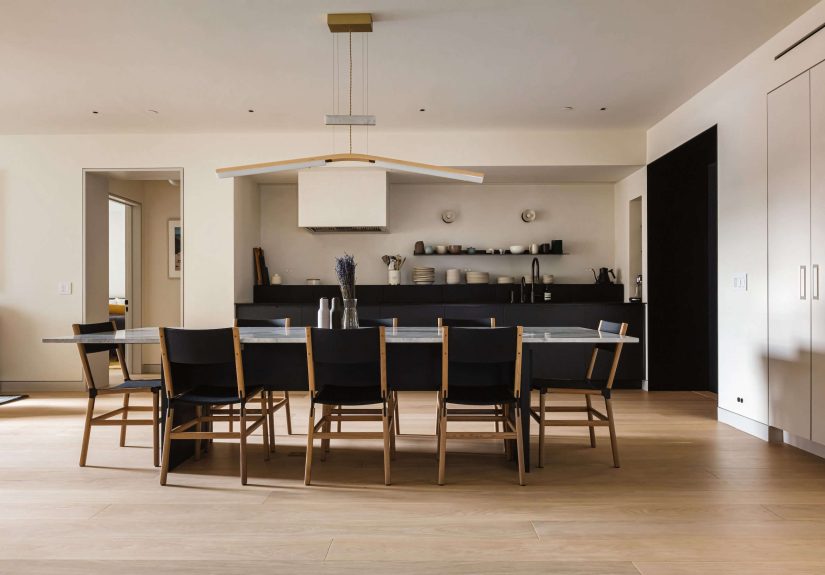
3) A kitchen that doesn’t look like a kitchen (but still works like one)
The kitchen sits near the entry and is designed to be discreet: minimal cabinetry, concealed appliances, and a
palette that reads more “architectural element” than “work zone.” It’s the difference between “this is where we
cook” and “this is a calm backdrop for living.”
Key moves include tone-on-tone cabinetry, a textured plaster finish that adds softness, and surfaces chosen for
durability without screaming “commercial.” There’s also a clever storage strategy: instead of cluttering the wall
with uppers, everyday items are tucked into closed cubbies and integrated storage so the room stays visually quiet.
Translation: the kitchen does its job and then politely steps out of the conversation.
If you’ve ever tried to keep a New York kitchen tidy, you know this isn’t aesthetic perfectionismit’s survival.
A “pretty” kitchen that can’t store anything is just a showroom with a sink.
4) Concealed storage as the true hero of the story
Every great apartment combination has a third partner: storage. It’s not glamorous, but it prevents the
combined home from feeling like two households worth of stuff stuffed into one.
Here, millwork is doing constant work behind the scenespantry and fridge integrated so they recede, cabinetry
that blends with wall color, and built-ins that allow “clear surfaces” to be a lifestyle rather than a fantasy.
The result is a home that feels serene because it isn’t constantly negotiating with its belongings.
5) Tactile materials + playful details = warmth without clutter
The palette stays calmsoft whites, deep blues, black accentsbut the apartment never feels flat because the
surfaces have texture: plaster, rich tile, and finishes chosen to be touched and lived with. This is minimalism
with a pulse.
And then there are the “delight” details: small geometric moments (like triangular accents and hardware
backplates) that repeat subtly, giving the home a signature without turning it into a theme park.
It’s the kind of design you notice slowlylike a joke that gets funnier the second time.
What it takes to combine two apartments in NYC (legally, practically, emotionally)
Design is the fun part. Paperwork is the part you’ll remember at 3 a.m. when you’re staring at your ceiling
wondering why the ceiling is also a “stakeholder.”
Step 1: Figure out what your building will allow
In a co-op, you’ll be dealing with an alteration agreement and board approval, which can include detailed
requirements about plans, insurance, deposits, contractor behavior, and work hours (yes, your building may have
an opinion about your hammering schedule). Condos still have rulesoften through condo documents and an approval
processeven if they tend to be more flexible than co-ops.
Step 2: Permits, filings, and the “one kitchen” reality check
In New York City, combining apartments typically triggers a formal filing process with the Department of Buildings.
One common requirement: eliminating the second kitchen and properly capping or repurposing connections, unless the
approved plan shows a lawful alternative use (like laundry or a bar sink). In plain English: you can’t keep two full
kitchens just because it feels luxuriousunless you want your renovation to become a choose-your-own-adventure
titled “Hello, Violations.”
Step 3: Plan for constraints that won’t move for your feelings
When you merge units, you often discover the building has non-negotiables: structural columns, risers, HVAC runs,
and “wet-over-dry” restrictions (meaning you can’t always put a bathroom wherever your Pinterest board demands).
Combinations can also require leveling floors, reworking electrical circuits, and coordinating mechanical systems
so the merged home feels seamless.
Step 4: Make it feel like one home, not a hallway compromise
The biggest design trap is the “connector hallway”a long, awkward stretch that exists only to prove the two units
are technically linked. The fix is what Shapeless Studio did here: build a central hub that everything branches
from, then make your darker, deeper zones do real work (mudroom, laundry, study) instead of pretending they’re
prime real estate.
Steal these ideas for your own apartment-combination project
Create one main circulation “spine”
Decide what the core experience of the home is. In this Brooklyn Heights renovation, the goal was a big, bright
shared space. Once that’s established, every other room can “pinwheel” off it without confusing the plan.
Use a dark entry on purpose
If your door lands in the deepest part of the apartment, stop trying to turn it into a sunroom. Lean into
saturation, durable flooring, and practical storage. The “dark-to-light” transition can become the home’s best
visual moment.
Choose partitions that flex
Sliding doors, glass-and-steel panels, and curtains can create privacy without shrinking the apartment. Bonus:
your guest room doesn’t have to be a permanent, lonely shrine to the once-a-year visitor.
Make the kitchen visually quiet
If your kitchen sits in your main living space, consider cabinetry and appliances that blend in, plus storage
that hides the daily chaos. A kitchen can be beautiful without becoming the room’s loudest object.
Repeat materials to unify the merged home
Consistent flooring, a cohesive wall palette, and repeating details (hardware, trim language, built-in motifs)
can erase the “two apartments” feeling fast. It’s design’s version of editing: fewer languages, one story.
FAQ: quick answers for the “Should we combine?” crowd
Is combining apartments always allowed?
Not always. It depends on your building type (co-op vs condo), governing documents, and city code requirements.
Expect approvals, filings, and plan review.
Does it always require removing a kitchen?
In many NYC combinations, the second kitchen must be eliminated, with connections capped or reassigned per approved plans.
What’s the biggest design mistake?
Creating a “link” that feels like a leftover corridor. The best combinations design a new center of gravity.
How do you handle rooms far from windows?
Give them a job: mudroom, laundry, pantry, study, storage. If it can’t be bright, let it be usefuland handsome.
What makes this Shapeless Studio project special?
It’s calm without being cold, minimal without being blank, and clever without acting clever. It feels like one home
with many moods, not two units forced into a partnership.
Conclusion: when “more space” is also better space
The charm of this Brooklyn Heights renovation isn’t just that it’s bigger. It’s that it’s better organized:
a bright central life zone, private rooms that can close off, and a deep plan that turns potential darkness into a
deliberate, functional entry moment. Add tactile materials, quiet colors, and millwork that actually respects the
reality of daily life, and you get a home that feels both designed and lived-in.
“It Takes Two” isn’t really about having more rooms. It’s about making the rooms you have finally behavelike a
well-cast ensemble where everyone knows their lines.
Experiences: What it feels like to live in a combined Brooklyn Heights–style apartment
Here’s the thing people don’t tell you about combining two apartments: the square footage is great, yesbut the
real upgrade is psychological. Life gets easier in tiny, surprising ways. You stop playing Tetris with your
day. You stop negotiating with your furniture. You stop doing that sideways crab-walk around a chair because the
chair technically lives in the only walkway.
In a layout like this onewhere the plan is organized around a bright, central shared spacemornings feel less like
a traffic jam. Someone can make breakfast without blocking the path to the bathroom. A kid can drift into the
living area with toys while an adult answers emails nearby. The apartment doesn’t require a schedule to function.
And if you’ve ever lived in a tight space, you know how luxurious that is: not the marble, not the fancy tilethe
luxury of not having to choreograph your movements like you’re rehearsing for a dance recital called “Finding My Keys.”
The moody entry is also one of those “you don’t get it until you live with it” features. A darker mudroom-like
foyer isn’t just dramatic; it’s forgiving. Wet umbrellas? Fine. Snowy boots? Drop them. That corner becomes a buffer
between the outside world and your calm interior, like a little decompression chamber. When you step from that deep,
saturated zone into the brighter main living space, you feel the shift in your body: shoulders down, brain quieter.
It’s a tiny daily reset. You’re not just entering an apartmentyou’re exiting the city for a moment.
Then there’s the kitchen strategy: making it visually discreet. In real life, that means you can host without
feeling like you’re entertaining inside an appliance showroom. Friends sit at the table, conversation happens, and
the kitchen doesn’t dominate the room. Even when you’re cooking, you’re still part of the social orbit. And when
the party ends, you can restore calm quickly because the design encourages it: stash the mess behind closed doors,
wipe the counters, and the room looks like itself again. It’s not about pretending you never eatit’s about keeping
the apartment from looking like a crime scene of cutting boards and spice jars.
A separate media room or family lounge is another quality-of-life multiplier. It changes your evenings. You can
watch something loud without it taking over the entire home. A kid can go to bed while adults stay up. Or a guest can
sleep in a space that feels intentionally creatednot like you shoved an air mattress into the only available corner
next to the radiator. The ability to close a sliding door is, in New York terms, basically a vacation.
Working from home becomes more realistic, too. When you have private nooks, “home office” stops meaning “laptop on
the dining table while you pretend you can ignore the dishes.” You can keep work contained, which is huge for
mental separation. You can end the day, close the door, and reclaim the apartment as a home again. That boundary
is hard to buy in a dense cityso when design makes it possible, it feels like you’ve hacked the system.
Finally, there’s the way a unified palette and repeating details change how you experience the apartment over time.
When two units are merged but don’t visually connect, you feel the seam constantly. You sense the “before” and
“after” every time you cross from one side to the other. In a cohesive renovation, the seam disappears. Your brain
stops tracking the old borders and starts treating the home as one continuous environment. That’s when you get the
best kind of spaciousness: not just room to move, but room to think.
So yes, combining apartments is complicated. But when it’s done this well, the payoff isn’t only extra square
footageit’s a calmer, smoother life inside the city’s chaos. Which might be the most Brooklyn Heights luxury of all.