Table of Contents >> Show >> Hide
- What the Anarchy Symbol Means at a Basic Level
- The History Behind the Symbol Starts Before the Symbol
- From Black Flags to the Circled A
- The Politics Behind the Symbol
- Why the Symbol Is So Controversial
- The Anarchy Symbol in Punk, Fashion, and Pop Culture
- Why the Anarchy Symbol Still Matters
- Final Thoughts
- Experiences Related to the Topic: What the Symbol Feels Like in Real Life
The anarchy symbol is one of those images that can start an argument faster than a group text about where to eat. To some people, it means chaos, smashed windows, and a teenager with a marker. To others, it signals a serious political tradition with deep roots in debates about freedom, authority, labor, and justice. That gap between the popular image and the actual meaning is exactly why the symbol remains so powerful.
Usually, when people talk about the anarchy symbol, they mean the circled A: a capital A drawn inside a circle. It shows up on jackets, protest signs, album art, skateboards, classroom notebooks, city walls, and probably at least one coffee shop bathroom in every major city. But the symbol did not appear out of nowhere, and it definitely does not mean only one thing. Its history is tied to the broader history of anarchism, a political philosophy that questions whether power, hierarchy, and government authority are truly justified.
So, what does the anarchy symbol mean? The honest answer is: it depends on who is using it. In political theory, it points to anti-authoritarian ideas and a belief in voluntary cooperation rather than top-down rule. In protest culture, it can signal resistance to state power, capitalism, or social hierarchy. In pop culture, it often becomes a general symbol of rebellion, anger, or DIY independence. And in some corners of the internet, it gets treated like edgy wallpaper with no homework attached. The symbol has range.
What the Anarchy Symbol Means at a Basic Level
At its simplest, the anarchy symbol stands for anarchism, not mere disorder. That distinction matters. In everyday speech, people often use the word “anarchy” to mean total chaos, lawlessness, or a collapse of order. That definition exists in ordinary dictionaries, and it is part of how the term is commonly understood. But politically, anarchism is much more specific. It is a tradition of thought that challenges the legitimacy of coercive authority and argues that human beings can organize social life through voluntary association, mutual aid, and decentralized forms of decision-making.
In other words, the symbol is not just shorthand for “nobody is in charge, good luck everybody.” It often represents the idea that bad authority should not rule simply because it has uniforms, money, buildings, and a talent for paperwork. Many anarchists argue that real social order does not have to come from domination. They believe communities can cooperate without being constantly managed from above like a doomed office team-building exercise.
The History Behind the Symbol Starts Before the Symbol
Anarchism Came First
The political philosophy behind the symbol is much older than the symbol itself. Long before the circled A became widely recognizable, writers and activists were already developing anarchist ideas. Thinkers such as William Godwin, Pierre-Joseph Proudhon, Mikhail Bakunin, and Peter Kropotkin argued in different ways that concentrated authority tends to corrupt, dominate, and distort human freedom.
Proudhon is especially important in the history of anarchism because he was one of the first major thinkers to openly identify himself with the term. His writing helped turn “anarchy” from a pure insult into a political label. Later anarchist traditions built on that foundation, though not always politely and not always in agreement. Anarchism has never been one tidy belief system in a matching sweater. It includes multiple schools of thought that disagree about economics, strategy, property, revolution, and even how much structure is too much structure.
Why the Public Often Heard “Chaos” Instead
If anarchism has a philosophical tradition, why do so many people hear the symbol and think only “chaos”? Partly because the word anarchy has long carried a negative everyday meaning. Partly because governments, newspapers, and political opponents often portrayed anarchists as dangerous radicals. And partly because some episodes in anarchist history did involve violence, bomb plots, or revolutionary acts that gave the public a simple, dramatic image to cling to.
That image hardened during the late nineteenth and early twentieth centuries, especially in the United States and Europe. Events such as the Haymarket affair, the assassination of President McKinley by Leon Czolgosz, the Palmer Raids, and the Sacco and Vanzetti case helped cement “anarchist” in the public imagination as a word tied to fear, foreignness, and unrest. The result was a stereotype that still shadows the symbol today: the idea that it automatically means destruction instead of a broader critique of power.
From Black Flags to the Circled A
The First Big Symbol Was Not the Circled A
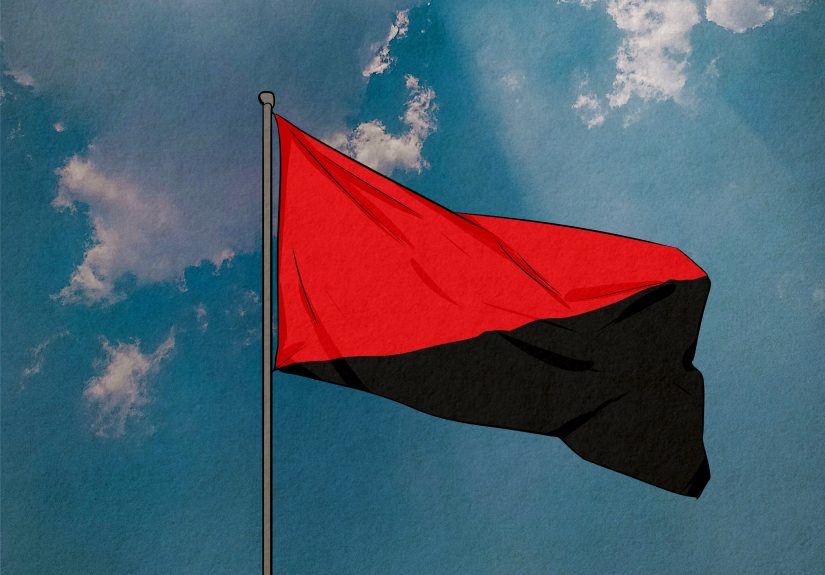
Before the circled A became the movement’s most recognizable emblem, anarchists were already using other symbols. The black flag became one of the best-known signs associated with anarchist politics. Black could suggest mourning, rebellion, refusal, and a rejection of traditional national flags. Later, red-and-black combinations became closely tied to anarcho-syndicalism and labor radicalism.
That matters because it shows the visual language of anarchism did not begin with one neat icon. It evolved. The movement experimented with symbols that could express opposition to the state, solidarity with workers, and distance from mainstream nationalism. By the time the circled A rose to prominence, anarchism already had a visual vocabulary. The newer symbol simply proved more portable, more legible, and much easier to spray-paint in under ten seconds.
Why the Circled A Worked So Well
The circled A eventually became the visual shorthand most people recognize today. Its appeal is obvious. It is fast to draw, easy to reproduce, and bold enough to survive bad handwriting. The letter A clearly points to anarchy or anarchism. The circle is often interpreted as unity, wholeness, community, or order. Many people also connect it to the slogan often linked with Proudhon: anarchy is order. Whether every person drawing it knows that history is another question, but the reading has endured because it gives the design a tidy symbolic logic.
And let’s be honest: it also looks good. Sharp, minimal, defiant, memorable. Political symbols that survive usually do more than communicate; they stick in the brain. The circled A has the graphic efficiency of a logo and the emotional charge of a warning label. That combination made it ideal for protest, posters, zines, patches, and subculture style.
The Politics Behind the Symbol
Anti-Authoritarian, Not Automatically Anti-Human
At the center of anarchist thought is skepticism toward authority that cannot justify itself. That includes the state, but many anarchists also critique capitalism, patriarchy, colonialism, racism, policing, prisons, and rigid hierarchy in everyday institutions. The symbol therefore often points to a broader anti-authoritarian worldview, not just opposition to government in the narrow sense.
Many anarchists emphasize mutual aid, direct action, local decision-making, voluntary cooperation, and horizontal organization. The idea is not that nothing should be organized. The idea is that people should be able to organize without domination. That is a huge difference. An anarchist commune, labor union, tenants’ group, neighborhood kitchen, or protest network is usually imagined as highly social, not anti-social. It just does not want a distant authority barking orders like a manager who discovered spreadsheets and lost all humility.
Different Types of Anarchism, Same General Family
One reason the symbol can mean several things is that anarchism itself has several branches. Mutualists have emphasized exchange and cooperative economics. Anarcho-communists focus on common ownership and communal life. Anarcho-syndicalists center workers, unions, and direct industrial action. Individualist anarchists place more emphasis on personal liberty and suspicion of imposed systems. There are also green anarchists, feminist anarchists, pacifist anarchists, and many other variations.
So when someone wears the symbol, you cannot always assume their exact politics. They may be invoking a whole tradition, one specific tendency within it, or just a broad hostility toward domination. Sometimes the symbol is ideological. Sometimes it is cultural. Sometimes it is decorative rebellion. Sometimes it is all three at once.
Why the Symbol Is So Controversial
History Made It Explosive
The anarchy symbol carries controversy because anarchism itself has always sat near the fault line between dissent and fear. Labor struggles, bomb scares, political assassinations, deportations, Red Scare repression, and sensational headlines all shaped how the public learned to see anarchists. In the United States especially, anarchism was often treated not as a political philosophy to be debated but as a threat to be crushed.
That history helps explain why the symbol can still trigger such strong reactions. For supporters, it can represent courage, solidarity, and resistance to unjust systems. For critics, it can evoke violence, instability, or nihilism. Neither reaction appears out of thin air. Both are tied to real historical conflicts, though one side usually reads the symbol as liberation while the other reads it as danger with really aggressive penmanship.
The Symbol Is Often Misread
A common mistake is to assume the anarchy symbol always endorses violence. That is too simple. Some anarchists historically embraced revolutionary violence; others fiercely rejected it. Some centered labor organizing, education, and communal alternatives. Others leaned toward insurrection. The symbol does not automatically tell you where its user falls on that spectrum.
Another mistake is to assume the symbol always signals a complete absence of rules. Many anarchists are not against rules in the everyday sense. They are against domination, coercion, and hierarchy that claim moral legitimacy without earning it. Plenty of anarchist thought is actually obsessed with how people might cooperate, deliberate, and care for each other without reproducing oppressive structures. That is not a rejection of order. It is an argument over what kind of order counts as just.
The Anarchy Symbol in Punk, Fashion, and Pop Culture
If politics gave the symbol its meaning, punk gave it mass visibility. By the late twentieth century, anarchy had become part of punk’s visual and musical vocabulary. The symbol appeared on clothing, flyers, record covers, graffiti, and stage aesthetics. Punk loved the image because it was confrontational, easy to reproduce, and perfectly suited to DIY culture. It looked like a refusal to behave.
But punk also changed the symbol. In political contexts, the circled A often referred to a serious tradition of anti-authoritarian theory. In punk, it could still mean that, but it could also mean rebellion in a looser sense: anti-establishment, anti-boredom, anti-corporate, anti-“you can’t tell me what to do.” Sometimes the ideology stayed intact. Sometimes the symbol got stripped down into mood, style, and attitude.
That is why the anarchy symbol can appear on a protest banner, a philosophy reading list, and a fast-fashion T-shirt with equal confidence and very unequal levels of political understanding. Symbols travel. Once they enter popular culture, they stop asking permission.
Why the Anarchy Symbol Still Matters
The symbol survives because it compresses a huge argument into one sharp visual mark. It asks questions that do not go away: Who gets to rule? Why should anyone obey? Can communities organize themselves differently? Is order always the same thing as justice? Can freedom exist inside systems built on hierarchy? Even people who reject anarchism often end up wrestling with versions of those questions.
That is also why the symbol keeps resurfacing in moments of distrust, unrest, and political frustration. When institutions look rigid, corrupt, violent, or indifferent, anti-authoritarian symbols gain fresh life. The circled A becomes more than a historical relic. It becomes a critique in miniature. A tiny graphic with a loud opinion.
Final Thoughts
The meaning of the anarchy symbol is bigger than its stereotype. Yes, many people still use it as a shorthand for disorder, rebellion, or punk energy. But historically and politically, the symbol points toward a much deeper tradition: one that challenges domination, questions authority, and imagines social life built on cooperation rather than coercion.
So the next time you see the circled A on a wall, jacket, patch, sign, or guitar case, the best question is not “Why do they love chaos?” The better question is “What kind of authority are they rejecting, and what kind of freedom are they imagining instead?” Once you ask that, the symbol becomes much more interesting. And a lot less like random vandalism with a branding strategy.
Experiences Related to the Topic: What the Symbol Feels Like in Real Life
One reason the anarchy symbol lasts is because people rarely meet it first in a philosophy class. They meet it in the wild. Maybe it is scratched into a school desk, doodled in the margin of a notebook, painted on a brick wall, or stitched onto the backpack of the one kid who always looked like they had opinions about three governments before lunch. That first encounter usually feels less like a lesson and more like a dare. The symbol announces itself before it explains itself.
For a lot of people, the earliest experience is confusion. They recognize the circled A, but only vaguely. It seems to mean rebellion, anger, or “rules are fake.” Maybe it appears next to band names, safety pins, and combat boots. Maybe it shows up in a movie to signal that a character is dangerous, alienated, or not planning to join the student council. In that setting, the symbol feels theatrical. It has attitude before it has footnotes.
Then comes the second experience: realizing the symbol carries more history than expected. People start reading about labor struggles, radical newspapers, Emma Goldman, black flags, punk scenes, mutual aid, police repression, and anti-authoritarian theory. The symbol changes shape in the mind. It stops looking like pure destruction and starts looking like a compact summary of arguments about power. That shift can be surprising. What first looked like a chaotic scribble turns out to belong to a long political conversation.
There is also the experience of seeing the symbol used by very different people for very different reasons. At a protest, it may appear beside serious demands about housing, labor rights, police violence, or war. At a concert, it may function more as a badge of outsider identity. Online, it can become a meme. On fashion merch, it may be flattened into a generic “bad attitude” accessory sold by the same marketplace that also sells scented candles and productivity planners, which is, frankly, an impressively capitalist plot twist.
Another common experience is discomfort. The symbol can unsettle people because it seems to challenge the basic promise that order equals safety. For some, that discomfort leads to dismissal: “It just means chaos.” For others, it opens a deeper question: if so many institutions claim to provide order, why do they so often produce inequality, surveillance, violence, or neglect? The symbol’s real power may lie in forcing that moment of discomfort. It pokes at the idea that authority deserves trust simply because it exists.
And finally, there is the experience of reinterpretation. The more people encounter the symbol across history, politics, and culture, the less fixed it becomes. It can still mean rebellion, but not always reckless rebellion. It can mean solidarity, mutual aid, local control, labor struggle, or resistance to domination. It can be sloppy, serious, performative, thoughtful, fashionable, radical, or misunderstood. That layered experience is why the anarchy symbol keeps surviving. People do not just see it. They argue with it, fear it, adopt it, parody it, and rethink it. Very few symbols stay alive that long without hitting a nerve.