Table of Contents >> Show >> Hide
- Why Small Desks Are Winning the Home Office Game
- How to Choose the Right Diminutive Desk
- The Diminutive Desk Roundup: Best Styles for Small Spaces
- What Actually Makes a Small Desk Feel Big Enough
- Common Mistakes People Make With Compact Desks
- Who Should Buy a Diminutive Desk?
- Life With a Small Desk: Real-World Experiences and Lessons
- Final Thoughts
If your home office is less “executive suite” and more “one suspiciously useful corner by the window,” welcome. You are among friends. The diminutive desk has become the unofficial hero of modern work life: compact, clever, stylish, and just disciplined enough to keep you from turning your workspace into a museum of old receipts, mystery chargers, and coffee mugs with emotional backstories.
Small desks are not just a compromise for apartments and spare bedrooms. They are a smart design choice for anyone who wants a workspace that feels intentional instead of invasive. A good compact desk carves out a place to focus without eating the whole room alive. It can tuck into a bedroom nook, slide behind a sofa, fit inside a closet office, or quietly do its job along a hallway wall like the reliable supporting character it is.
That is why this diminutive desk roundup matters. Today’s compact desks are not flimsy little afterthoughts. They come with storage, hidden cable management, wall-mounted designs, fold-down options, rounded edges, and finishes that look far more grown-up than the dorm furniture many of us would rather forget. In other words, the tiny desk has had a glow-up.
Why Small Desks Are Winning the Home Office Game
The appeal is easy to understand. Many of the most practical small-space desks land under 48 inches wide, and some go far smaller. That means you can create a real workstation in places that used to be written off as decorative dead zones. The empty stretch of wall in a bedroom, the awkward corner beside a bookcase, the niche in a living room, and even the former “I guess we store reusable bags here” closet can all become legitimate work areas.
But the real charm of a small desk is not just its footprint. It is the discipline it brings. A compact work surface forces you to decide what actually belongs in your workspace. Laptop? Yes. Notebook? Sure. Giant pile of unopened mail, three candles, two random adapters, and a decorative bowl for “vibes”? Probably not. In that sense, diminutive desks do not just save space. They save your focus.
There is also a style advantage. Oversized office furniture can overwhelm a room fast, especially in homes where the office shares territory with sleeping, eating, or relaxing. A slim writing desk, wall-mounted desk, or secretary desk tends to blend into the room instead of shouting, “Welcome to Corporate Bedroom.”
How to Choose the Right Diminutive Desk
Start With the Tape Measure, Not the Daydream
This is the least glamorous step and the most important one. Measure the width of your available wall, then check how much depth the room can handle without turning every chair movement into a three-point turn. A lot of compact desks work in the roughly 16- to 24-inch depth range, which is enough for a laptop setup and light office work. If you use dual monitors, large drawing pads, or enough paperwork to qualify as “paper-based weather,” you may need a little more room.
Also measure chair clearance and walking space. The best desk in the world is still a bad buy if it turns your room into an obstacle course.
Think About What Kind of Work Happens There
If your desk job is mostly laptop, email, video calls, and occasional note-taking, a slim writing desk may be perfect. If you need folders, tech accessories, stationery, or a place to hide the chaos of everyday work, look for drawers, shelves, or an attached hutch. If your desk must disappear at the end of the day because it shares space with a guest bed or family life, a fold-down or secretary-style option makes a lot of sense.
In other words, do not buy a tiny desk and then expect it to moonlight as a drafting table, gaming station, filing cabinet, vanity, and snack command center. That is how furniture ends up in therapy.
Do Not Ignore Ergonomics
A desk can be small without being punishing. You still want enough space under the desk for your legs, room for your feet, and a setup that lets your forearms stay roughly parallel to the floor when typing. Your elbows should feel relaxed, your monitor should not force your neck into a permanent question mark, and your chair should fit the desk rather than wage war against it. Tiny workspace does not have to mean tiny standards.
The Diminutive Desk Roundup: Best Styles for Small Spaces
1. The Minimal Writing Desk
This is the cleanest, simplest option and often the most versatile. A minimal writing desk is basically the little black dress of office furniture. It works almost anywhere, it does not demand a lot of decorating drama, and it can pivot between “productive workstation” and “tasteful console table” with impressive ease.
Look for one if you want a visual break in a busy room. It keeps the footprint light, works especially well in bedrooms and living rooms, and pairs nicely with floating shelves above it. The trade-off is obvious: no built-in storage means you must either stay organized or become very good at pretending.
2. The Small Desk With Drawers
This is the overachiever of the group. A compact desk with one or two drawers gives you a place for chargers, pens, sticky notes, documents, and all the tiny objects that somehow multiply when nobody is watching. If your workspace doubles as part of a living area, drawers are especially valuable because they let you close the visual loop at the end of the day.
These desks are ideal for people who want a tidy look without adding a separate filing cabinet or storage cart. They are also great for renters, students, and anyone who likes furniture that politely does two jobs at once.
3. The Wall-Mounted or Floating Desk
When floor space is precious, the floating desk enters like a magician. Mounted to the wall, it keeps the area underneath open, which makes the room feel less cramped and easier to clean. It is especially useful in narrow rooms, awkward corners, and closet offices where every inch counts.
Some versions include shelves above, cubbies within, or fold-down fronts that close when work is done. This style is a favorite for people using laptops rather than large desktop setups. It is sleek, space-savvy, and just smug enough to know it is the smartest option in the room.
4. The Fold-Down Desk
This is the stealth desk. When open, it gives you a surprisingly functional work surface. When closed, it all but disappears. If you are working from a bedroom, studio apartment, or multipurpose family room, this type is a serious contender. It is particularly useful for occasional remote work, homework zones, or spaces that need to look normal after office hours.
The main question is how permanent your setup is. If you need to spread out paperwork for days at a time, folding it away may become annoying. But if your dream workspace is “there when needed, gone when not,” this category deserves a gold star.
5. The Corner Desk
Corners are the introverts of interior design. They do not ask for much attention, but they can be incredibly useful when given the chance. A compact corner desk makes use of square footage that might otherwise sit empty. It can create a dedicated work zone without blocking the main flow of a room.
Corner desks are great for people who want a little wraparound feeling without committing to a giant L-shaped setup. They also work well if you need wall access for shelves, art, or task lighting on both sides.
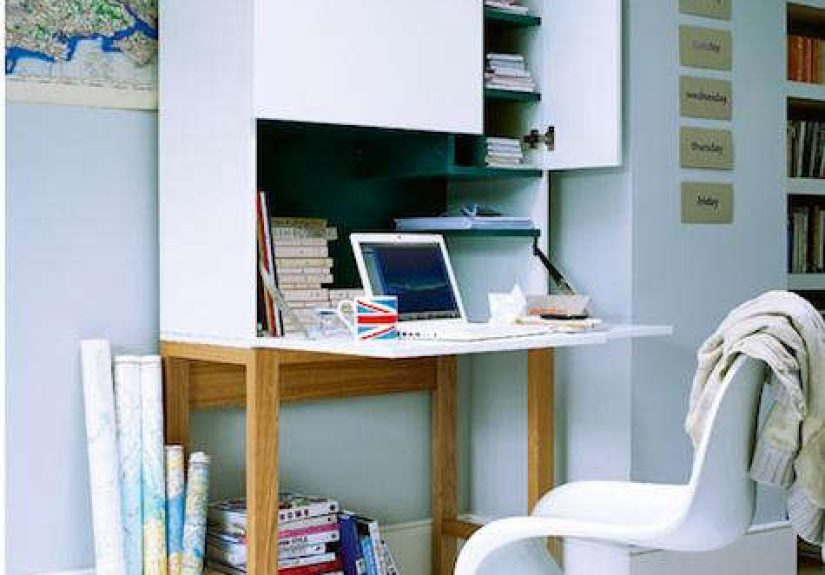
6. The Secretary Desk
If you like your office furniture with a side of charm, the secretary desk is hard to resist. It offers a smaller profile, vertical storage, and often a drop-front writing surface that can be closed at the end of the day. That means instant visual cleanup, which is very satisfying if you are the kind of person who wants your room to stop looking like work once the laptop shuts.
Secretary desks are especially appealing in traditional, transitional, or collected interiors. They bring personality while keeping the footprint relatively modest. Think of them as the desk equivalent of a person who owns both a planner and a sense of humor.
What Actually Makes a Small Desk Feel Big Enough
The secret is not always in the desk itself. Sometimes it is in the setup around it. Add a task lamp on the wall or clamp it to the surface so the desktop stays clear. Use vertical storage above the desk instead of piling everything beside it. Choose a chair that tucks neatly underneath. Hide cables whenever possible. Keep frequently used items within reach and everything else somewhere else.
Light colors can help a small desk visually recede, but darker finishes can look equally sharp if the rest of the room is balanced. Rounded edges can soften tight spaces. Open bases feel airy, while solid drawer pedestals feel grounded and storage-friendly. There is no one right answer. There is only the question of whether the desk works with your room instead of arguing with it.
Common Mistakes People Make With Compact Desks
The first mistake is buying for looks only. Yes, aesthetics matter. You deserve a workspace that is nice to look at. But a beautiful desk that cannot fit your knees, your chair, or your actual work is basically decor with ambition.
The second mistake is ignoring depth. Width gets all the attention, but depth is where comfort lives. A desk that is too shallow can make screens feel cramped and accessories impossible to place. Too deep, and suddenly your “small desk solution” is basically a dining table in disguise.
The third mistake is forgetting storage strategy. Even the tiniest desk needs backup. If the desk itself has no drawers or shelves, plan for a wall shelf, rolling cart, cabinet, or nearby basket system. Otherwise, clutter will stage a hostile takeover by week two.
Who Should Buy a Diminutive Desk?
Apartment dwellers, definitely. Students, absolutely. Remote workers in shared spaces, without question. But compact desks are also ideal for people creating a secondary workspace, a writing nook, a homework station, or a tidy command center for bills and life admin. Not every home office needs to look like a startup founder’s podcast set.
A diminutive desk is best for focused, intentional work. It suits people who like clean lines, compact solutions, and furniture that behaves itself. It is for anyone who wants a room to do more than one thing without looking confused about its identity.
Life With a Small Desk: Real-World Experiences and Lessons
Living with a small desk teaches you things that a giant office setup never will. First, it teaches honesty. A petite desk will tell you very quickly whether you truly need all the stuff you claim to need. The answer is usually no. Most days, the essentials come down to a laptop, a notebook, a pen you actually like, a drink, and maybe one well-behaved light source. Everything else is often just office theater.
It also teaches rhythm. In a large workspace, it is easy to leave everything out and slowly let the desk become a permanent monument to unfinished tasks. With a compact desk, there is more incentive to reset at the end of the day. You close the notebook, put the charger away, tuck the chair in, and suddenly the room belongs to itself again. That little ritual matters more than people expect. It creates a mental boundary between work mode and real life, which is especially helpful when both happen under the same roof.
Another surprising lesson is that a small desk can make you more creative about placement. People often assume a home office needs its own room, but compact desks prove otherwise. A stretch of wall in the bedroom can become a calm writing zone. A landing at the top of the stairs can hold a floating workstation. A living room corner can transform into a polished mini office with the right lamp, chair, and shelf. Once you stop searching for a whole room and start looking for a smart footprint, possibilities show up everywhere.
There is also a psychological benefit to scale. A big desk can sometimes make work feel endless, especially if it invites piles, stacks, devices, and side projects to spread in every direction. A smaller desk encourages focus. It says, “Pick the task. Do the task. Maybe do not build a paper mountain while you are at it.” That built-in limit can feel strangely calming. It turns the workspace into a tool instead of a holding area for every object related to productivity.
Of course, there are trade-offs. If you work with large monitors, paper-heavy projects, or a rotating cast of office equipment, a tiny desk can become frustrating fast. That is when support pieces matter. A nearby bookcase, rolling cart, or wall organizer can make the difference between “compact and efficient” and “why is my stapler in the kitchen.” Successful small-desk living is rarely about the desk alone. It is about the ecosystem around it.
Style-wise, small desks are surprisingly powerful. Because they take up less visual weight, they allow other design choices to shine. Art above the desk feels more intentional. A beautiful chair matters more. A textured lamp, a narrow shelf, or a single framed print can carry the whole setup without making it look busy. In some cases, the limited size actually improves the room because every choice has to earn its place.
Perhaps the biggest experience-based takeaway is this: a diminutive desk works best when you stop expecting it to be everything. It is not trying to be a boardroom table, a crafting island, a vanity, and a filing cabinet all at once. It is trying to be a smart, compact place to think, type, plan, and get things done. Once you let it do that job well, it becomes one of the most useful pieces in the house. Small desk, big main-character energy.
Final Thoughts
The best diminutive desk is not the tiniest one you can find. It is the one that fits your space, supports your work, and looks like it belongs there. Maybe that means a minimal writing desk with one lamp and zero drama. Maybe it means a wall-mounted fold-down desk that disappears after hours like a magician leaving the stage. Maybe it means a compact desk with drawers that quietly saves you from visual chaos every single day.
Whatever form it takes, the modern small desk proves that productive design does not have to be oversized. In fact, when done well, the opposite is true. A compact desk can make a room feel smarter, calmer, and more intentional. And honestly, any piece of furniture that helps you work better without swallowing your entire home deserves a standing ovation. Or at least a really good chair.