Table of Contents >> Show >> Hide
- Why Over-Engineer an Egg Cracking Machine at All?
- Inside the Hackaday Egg Cracking Robot
- How It Compares to Real Industrial Egg Breakers
- Rube Goldberg Energy in a High-Tech Package
- Key Engineering Lessons Hiding in the Yolk
- Should You Build Your Own Egg Cracking Machine?
- Experiences and Takeaways from Over-Engineering an Egg Cracking Machine
Cracking an egg is one of those kitchen tasks most people can do half-asleep: tap, pull apart, drop into the pan, move on with your life. So of course the internet looked at that five-second motion and said, “What if we turned it into a full-blown engineering problem?”
That’s exactly the spirit behind “Over-Engineering An Egg Cracking Machine | Hackaday”, a gloriously unnecessary mechanical solution inspired by YouTube maker Stuff Made Here. Instead of a messy thumb and a chip of shell in your omelet, you get silicone over-molded clamps, vacuum seals, precision scoring blades, and a tiny hammer following a choreographed sequence of moves.
On the surface, it’s a silly robot made to solve a non-problem. Under the hood, it’s a surprisingly serious lesson in mechanical design, fixture engineering, automation, and prototyping. Let’s crack it open and see what’s really going on.
Why Over-Engineer an Egg Cracking Machine at All?
Eggs are a nightmare combination for engineers: they’re fragile but strong, standardized but irregular, and cheap enough that nobody wants to spend real money solving them. A human hand can adapt instinctively to all those variables; a machine has to be explicitly designed to handle each one.
The Hackaday-featured build starts from a simple observation: eggs are messy to work with, and cracking them tends to put raw egg on your hands and countertop. So the goal becomes: hold the egg securely, weaken the shell in a predictable line, then fracture and dump the contentsall without spraying egg everywhere or dropping sharp shell fragments into your food.
As countless Rube Goldberg machines have shown over the last century, there’s something deeply satisfying about throwing advanced engineering at a basic task. The egg cracker sits firmly in that tradition: a tongue-in-cheek flex that also doubles as a practical demonstration of core engineering ideas.
Inside the Hackaday Egg Cracking Robot
1. The Egg Holding Problem: Fixtures Are Harder Than They Look
The first real challenge isn’t blades, motors, or hammersit’s holding the egg. Eggs vary in size, shape, and shell thickness, and any gripping system has to be gentle enough not to crush them, but firm enough to survive the later impact of a tiny hammer.
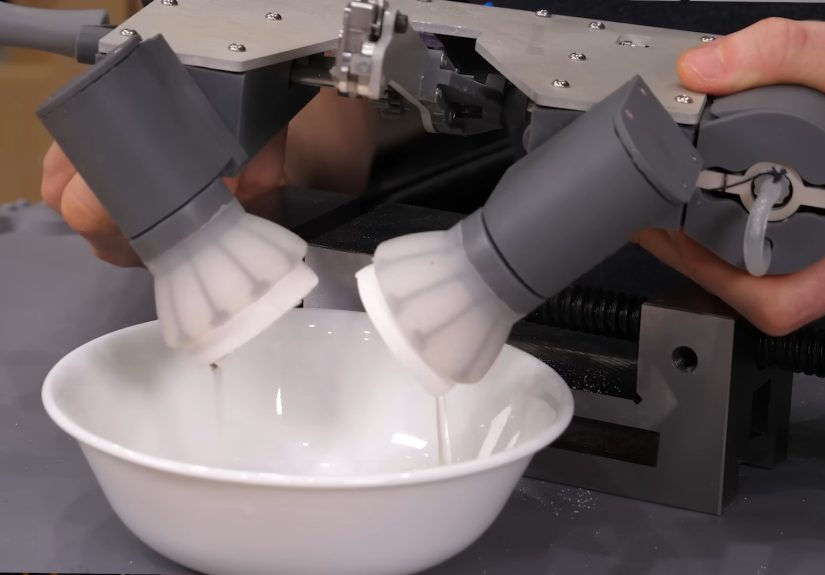
In the Hackaday build, the maker experiments with custom fixtures: a 3D-printed structure over-molded with silicone to create soft, compliant surfaces that conform to individual eggs while still keeping them centered. Over several iterations, these evolve into over-molded arms and a vacuum seal to add stiffness and rigidity. That kind of hybrid designhard printed shell with a soft elastomer interfaceis common in real-world robotics and industrial automation, especially when handling food or delicate components.
The lesson: if your fixture is wrong, everything downstream will be wrong. Before you worry about clever mechanisms, you have to make sure the thing you’re manipulating is actually where you think it is.
2. A C-Shaped Carrier That Spins and Slides
Once the designer can hold one egg, the next step is to build a carrier that can handle different sizes. The solution is a roughly C-shaped frame holding two egg fixtures facing each other. These fixtures can slide closer or farther apart to clamp anything from a small egg to an oversized one while staying centered on the axis of rotation.
That rotating carrier is what lets the robot spin the egg under a scoring blade. The machine doesn’t want a single crack; it wants a controlled, continuous score line around the shell so that the crack happens exactly where it’s intended. That’s the only way to get repeatable, clean breakssomething human cooks largely do by feel.
3. Scoring Blade and Tiny Hammer: Two-Stage Shell Control
Instead of smashing the shell outright, the mechanism uses a two-step approach:
- Score: A blade lightly etches a line around the egg’s circumference as the carrier rotates it. This weakens the shell in a controlled path.
- Tap: A small hammer delivers a gentle impact along that scored line, causing the shell to fracture neatly.
In many industrial egg breakers, eggs are cracked by moving them over knives and letting gravity and the conveyor line do the rest. Here, the machine aims for something closer to a precision fracture, similar in spirit to how glass cutters work: score first, then break along the weakened line.
The hammer can even be disengaged while the blade is in use, allowing experimentation with different scoring depths and impact strengths. That sort of tunability is what separates a clever toy from a real prototyping platform.
4. Mechanical “Computation”: Score → Hammer → Dump → Eject
The machine’s motion is built around a repeating cycle: score, hammer, dump, eject. Early designs tried to drive this entire sequence with a single crank and a cam-like arrangement, effectively using mechanical timing to “compute” the state of the machine.
Mechanical sequences like that are common in older factory equipment: cams, linkages, and levers encode what we’d now do in software. The problem is that eggs are annoyingly inconsistent. Some eggs need more scoring, some need a bigger impact, and some just refuse to cooperate. A single-crank solution that assumes every egg behaves the same will inevitably fail on the outliers.
That tensionbetween elegant mechanical timing and real-world variabilityis one of the reasons over-engineered projects like this are so educational. You quickly learn where simple mechanisms shine and where you need feedback, sensors, or independent axes of motion.
How It Compares to Real Industrial Egg Breakers
Of course, egg-breaking at scale is not a new problem. Industrial egg breakers used in food processing plants can crack and separate tens or even hundreds of thousands of eggs per hour. Many systems guide rows of eggs over knives, let the shells flare open, and channel yolk and whites into different streams with impressive efficiency.
Commercial machines focus on three main metrics:
- Throughput: Thousands of eggs per hour.
- Yield: Capture as close to 100% of the egg contents as possible.
- Hygiene: Minimal shell contamination, easy cleaning, and compliance with food safety rules.
Where industrial systems lean on conveyors, stainless steel, and wash-down friendly design, the Hackaday robot leans on 3D printing, silicone molding, and visual flourish. Industrial machines are about reliability and ROI; the over-engineered egg robot is about learning, curiosity, and delight.
That contrast is part of the charm. You get to see the same problem“how do I crack an egg?”framed through two completely different lenses: business efficiency versus maker experimentation.
Rube Goldberg Energy in a High-Tech Package
If this all feels slightly absurd, that’s on purpose. The project fits beautifully into the tradition of the Rube Goldberg machine: contraptions that use a chain of overly complex mechanisms to perform trivial tasks. Classic examples might use marbles, pulleys, candles, and teetering buckets of sand; here, the components are CNC’d parts, over-molded silicone, and a vacuum system.
Elsewhere in maker culture, you’ll find similar projects: egg-cracking Rube Goldberg demos that separate yolks and whites with elaborate ramps, systems that crack an egg onto a flatbed scanner just so a computer can capture the resulting splat, and motorized homebrew egg crackers that focus on solving breakfast for people with limited mobility or dexterity.
All of them share the same basic itch: “What if we took this tiny everyday motion and cranked the engineering dial to 11?”
Key Engineering Lessons Hiding in the Yolk
1. Prototyping Is Mostly Failing in Slightly Different Ways
The egg cracking machine didn’t pop out fully formed. It went through numerous prototypes as the creator tried different gripping strategies, arm geometries, materials, and motion sequences. With each failure, they learned something about how eggs behave under pressure, where friction appears, and which tolerances actually matter.
That mirrors stories from other hobbyists and students building egg crackers and food-handling robots. Early designs often crush eggs, fling them in random directions, or clog with sticky albumen. Through iterative testing, designers learn to:
- Adjust blade geometry to cut the shell without piercing the membrane too aggressively.
- Slow down certain motions to prevent splatter.
- Use compliant materials (like silicone) to absorb small misalignments.
For anyone learning mechanical design, it’s a perfect micro-project: low stakes, quick iteration, and instant feedbackyour machine either gives you a neat cracked egg or a comedy sketch.
2. Soft + Hard Materials Work Better Together
The combination of rigid 3D-printed frames with soft silicone over-molding is straight out of professional robotics playbooks. Hard materials hold shape and transmit force; soft materials handle contact with real-world, imperfect objects.
That hybrid approach shows up in:
- Robot grippers that pick up produce without bruising it.
- Medical devices that must be precise internally but gentle against skin.
- Industrial egg machines that use rubber or polymer cups to cradle eggs on conveyors.
By experimenting with over-molding in a fun context like this, makers get hands-on experience with techniques that scale to serious applications.
3. Mechanical Timing Has Limits
The attempt to drive “score → hammer → dump → eject” with a single crank is clever, but it highlights a fundamental trade-off: as soon as your process needs conditional behavior (“this egg is harder than that one”), purely mechanical timing feels stiff and unforgiving.
That’s why many modern systems blend mechanical hardware with electronics and software. You might still use cams and levers, but you wrap them in sensors, servo motors, and microcontrollers so the machine can adapt on the fly. The egg robot is a great case study in where the line between elegant mechanical design and flexible mechatronics actually sits.
Should You Build Your Own Egg Cracking Machine?
Is an egg cracking machine strictly necessary for your kitchen? No. Should you build one anyway? Honestly… maybe yes.
From an educational standpoint, a project like this lets you practice:
- CAD modeling complex multi-part assemblies.
- Designing fixtures for irregular, fragile objects.
- Force analysis (how much impact does it take to crack an egg without obliterating it?).
- Materials selection and over-molding techniques.
- Motion control using cams, gears, or microcontroller-driven motors.
Even simpler DIY egg crackerslike scissor-style hand tools with carefully curved bladestouch on the same themes in a more compact package. Many hobby builds start with modest goals (reduce mess, help someone with limited grip strength) and end up as delightful, overbuilt sculptures of springs and levers.
Will your eggs be dramatically better than those cracked by hand? Probably not. But your engineering skills certainly will be.
Experiences and Takeaways from Over-Engineering an Egg Cracking Machine
Spend a little time in the maker and engineering communities and you’ll start to see a pattern: people rarely talk about their “perfect” machines. They talk about the almost-working prototypes, the wild detours, and the unexpected lessons that came from obsessing over something as simple as an egg.
One common experience is the moment when a builder realizes that a “simple” task hides surprisingly deep complexity. On paper, cracking an egg looks like a single action. In practice, you discover micro-steps: aligning the egg, applying the right amount of force at the right angle, controlling how the shell fails, and directing the flow of the liquid inside. Each of those turns into its own tiny design problem. That shiftfrom “easy task” to “rich system”is addictive for engineers.
Another shared story is how these projects change the way people see everyday objects. After designing an egg fixture, you never look at a carton of eggs the same way again. You start noticing which brands are more consistent in size, which shells are slightly thicker, and how humidity or temperature changes the feel of the crack. The world gets more interesting because you’ve tried to formalize a motion most people never think about.
There’s also a strong emotional arc running through these builds. Early on, enthusiasm runs high: sketching concepts, modeling parts, imagining cinematic slow-motion B-roll of perfectly cracked eggs. Then reality hits. Parts don’t fit. Prints warp. The silicone mold tears. A linkage jams and flings an egg across the shop. The machine works beautifully on plastic test “eggs” and fails catastrophically on the real thing. That roller coasterhope, frustration, stubbornness, eventual successis the heart of hands-on engineering.
For many creators, projects like this are a safe way to practice being wrong in public. You can share failures, tweaks, and ugly prototypes without risking your job or a client relationship. Viewers love seeing the bloopers, and fellow makers relate instantly. That openness around failure is surprisingly rare in more formal engineering settings, yet it’s exactly where the most valuable learning happens.
There’s a social dimension too. Over-engineered egg crackers become conversation pieces: the machine you demo at a hackerspace open night, the video that draws non-engineer friends into asking, “Wait, how does it actually work?” It’s a gateway project that lets you explain concepts like force analysis, over-molding, and mechanical timing without putting anyone to sleep. The silliness makes the learning approachable.
Finally, people who have built or closely studied these machines tend to come away with a new respect for human hands. After weeks or months of effort, hundreds of design decisions, and a bench full of failed parts, you watch a line cook crack six eggs one-handed into a bowl without a single shell shard and think, “Oh. That’s what real optimization looks like.” The machine doesn’t replace that skill; it highlights just how sophisticated it already is.
In that sense, “Over-Engineering An Egg Cracking Machine | Hackaday” is less about the eggs and more about the mindset. It celebrates the urge to poke at the mundane, to ask “what if?”, and to build something delightfully unnecessary just to see if you can. Whether you’re a seasoned engineer or a curious beginner, there’s a lot to learn from a robot that exists purely to overthink breakfast.