Table of Contents >> Show >> Hide
- The Big Idea: Quiet Propulsion Without the “Motorboat Vibe”
- Meet the DIY “Robot Canoe” Setup
- How Two Robot Arms Paddle Like a Tank
- The Engineering Challenges (A Canoe Does Not Care About Your Dreams)
- What a Robot-Paddled Canoe Is Actually Good For
- If You Wanted to Make It Autonomous (The Next Logical Step)
- Safety and Etiquette: The Unsexy Stuff That Keeps This Fun
- The Takeaway
- Field Notes: of “Experience” From the Robot-Canoe Mindset
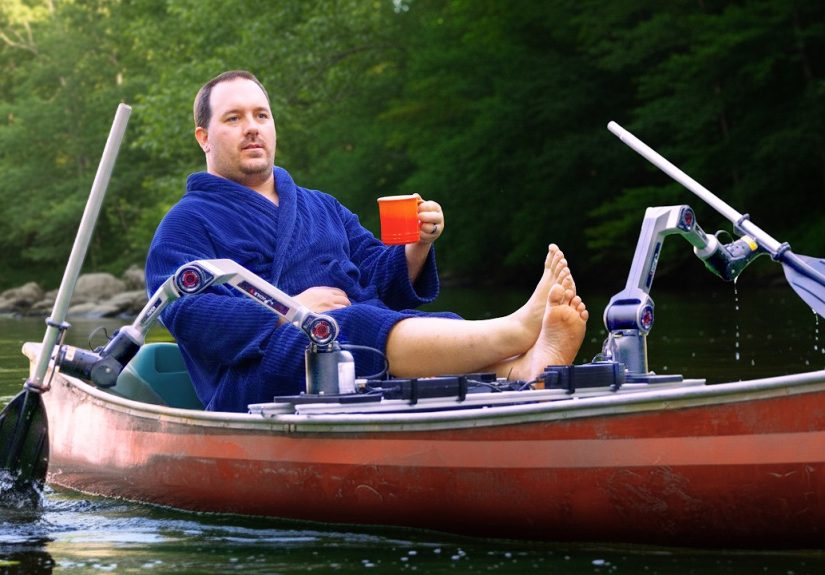
Picture a calm river, a gentle current, and a canoe that glides along like it has places to bewithout anyone doing the sweaty “am I paddling or just rearranging water?” routine. Now picture the paddling happening anyway… courtesy of two robotic arms swinging paddles like they’re clocking in for a shift. That’s the delightfully absurd (and surprisingly instructive) idea behind a recent maker-built robotic canoe: a human relaxes in the boat while robot arms do the hard part.
On the surface, it’s a goofy flexan engineer’s version of “I’m tired, let’s automate joy.” Under the hood (or, more accurately, under the splashes), it’s a real-world mashup of robotics, control theory, power management, and a harsh environment that never signs a warranty: water. And that makes it worth talking about. Because the same building blocks that move a self-paddling canoe can also help power quiet research craft, assist paddlers with limited mobility, and inspire new ways to propel small boats where propellers get tangled or damaged.
The Big Idea: Quiet Propulsion Without the “Motorboat Vibe”
If you’ve ever taken a canoe out to decompress, you already know the paradox: paddling is both peaceful and exhausting. A small electric motor solves the effort problem, but it also changes the whole mood. It adds noise, vibration, and a “we’re commuting, not floating” energy. A robot-paddled canoe aims for a weird middle ground: mechanical effort still happens, but it’s outsourced to hardware that doesn’t get blisters, complain about form, or ask to “switch sides” every five minutes.
In the maker build that sparked this headline, the goal wasn’t speedit was hands-off, low-drama movement on calm water. That constraint matters. A canoe is narrow, sensitive to shifting weight, and famously unimpressed by top-heavy add-ons. So the engineering challenge becomes: can you mount a robotic system securely, keep it light enough to stay stable, and still produce usable thrust with paddles?
Meet the DIY “Robot Canoe” Setup
The project making the rounds online centers on a canoe outfitted with two 6-degree-of-freedom robotic arms that hold paddles and stroke through the water. Instead of permanently modifying the boat, the builder designed a removable framethink aluminum extrusion rails and custom bracketsthat grips the canoe without drilling into it. That’s not just considerate; it’s smart. A non-destructive mount is easier to iterate on, easier to transport, and less likely to turn your canoe into an expensive “before” photo.
Hardware at a glance
- Two lightweight robotic arms holding paddle blades and cycling through a repeatable stroke path
- An onboard computer running robotics software (the kind used in lots of research robots)
- A control scheme that translates joystick input into coordinated left/right “paddle power”
- A portable power station to run the compute and motors away from shore power
- A frame and mounting system engineered to be stiff, light, and canoe-friendly
This is the kind of build that looks like a weekend project in photos and feels like a semester project in real life. The reason is simple: boats are an unforgiving platform. Everything is movingyour payload, your center of gravity, the water, the wind, the currentand none of it is impressed by your tidy cable management.
Why robot arms instead of a propeller?
A propeller is efficient, but it’s also vulnerable in shallow water, weedy areas, and debris-filled rivers. Paddles are more tolerant: they can be lifted, angled, or shaken free, and they don’t require a submerged drivetrain. Robot arms also give you a lot of “motion vocabulary.” They can change stroke depth, feather the blade, widen the sweep for turning, or backstroke for brakingwithout adding specialized marine hardware. In short: paddles are versatile, and arms are programmable.
How Two Robot Arms Paddle Like a Tank
Here’s the clever part: the control problem for paddling and steering can be treated a lot like a differential-drive robot (think two wheels on a rover or a tank tread vehicle). In a differential drive, you steer by changing the relative speeds of the left and right sides. Push the left “side” harder, and you arc right; push both evenly, and you go straight. The robotic canoe applies that same idea, except the “wheels” are paddle strokes.
From joystick to motion commands
The operator uses a game controller/joystick to request “go forward” or “turn left.” In robotics software, that often becomes a velocity command: how fast should the vehicle move forward, and how quickly should it rotate? Those commands can be represented as a simple pair: forward velocity plus turning rate. Software then converts that into left and right output valuesnormally wheel speeds, but here it becomes “left paddle effort” and “right paddle effort.”
Once you have target left/right values, the robot arms need a stroke pattern that produces thrust. That’s where inverse kinematics comes in. Inverse kinematics is the math that answers: “If I want the paddle blade to trace this path in 3D space, what joint angles do I command at each moment?” With two 6-DoF arms, you can define a repeatable paddle trajectory (plant, pull, exit, reset), then compute joint angles to follow it.
Stroke shaping: the difference between moving and flailing
A human paddler naturally “shapes” the stroke: blade angle, entry depth, and exit timing all matter. A robot has to be told what “good” looks like. Even a basic trajectory can work if it:
- Plants the blade cleanly (so it bites water instead of aerating it)
- Pulls with a mostly consistent angle (to convert motion into forward thrust)
- Exits without dragging (to reduce wasted energy)
- Resets efficiently (so the return stroke doesn’t undo progress)
In calm water, “good enough” can still feel magical: the canoe moves, turns, and keeps a steady rhythm. And unlike a propeller system, a paddling robot can be tuned like a drummerfaster cadence for speed, uneven cadence for turning, and short backstrokes for braking or station-keeping.
The Engineering Challenges (A Canoe Does Not Care About Your Dreams)
1) Weight and stability
Canoes are sensitive to load placement. Put heavy gear high or off-center and you’ll feel it immediately. Add robotic armstwo of themand now you’ve introduced a moving weight that swings back and forth. That movement can create small but meaningful roll and yaw forces, especially if the arms accelerate quickly or if the stroke path is jerky.
The practical response is boring but essential: keep the mount low, keep the mass centered, and keep the frame stiff so it doesn’t “spring” with each stroke. A flexible frame wastes energy and makes control harder because the paddle tip isn’t where the software thinks it is.
2) Water exposure: splashes are inevitable
Mixing electronics and water is a classic engineering hobbyright up there with “I can totally lift that alone” and “this ladder seems fine.” Robotic arms often aren’t designed for wet environments, and even light splashing can lead to corrosion, connector issues, or motor problems. If your hardware has only modest ingress protection, you’ll need shields, covers, careful routing, and the humility to carry a towel like it’s safety equipment.
A smart approach is to treat “wet” as the default and build defense in layers: splash guards, elevated electronics enclosures, drip loops in cables, and quick-disconnects that don’t require you to do a wet puzzle when something needs service.
3) Power management: your canoe is now a floating battery demo
Robotics hardware draws power in peaks. A steady cruise is one thing; a hard turn or a stalling stroke can spike current demand. Add a computer running robotics software and you’ve got a load profile that looks more like a workshop than a picnic.
Portable power stations make this feasible because they combine battery storage, inverters, DC outputs, and monitoring. The tradeoff is weight. More capacity usually means more pounds. The best setup balances runtime against stabilitybecause a canoe with infinite battery life isn’t very useful if it’s one surprise wake away from becoming a very expensive aquarium exhibit.
What a Robot-Paddled Canoe Is Actually Good For
It’s easy to laugh at “robots doing paddling so I can relax.” But prototypes like this are valuable because they demonstrate control strategies and mechanical designs that can be repurposed for real needs.
Quiet research and environmental monitoring
Researchers already use uncrewed surface vehicles to collect ocean and weather data, sometimes for long durations. Those platforms often rely on wind, waves, and solar-powered systems to go far. A small robotic canoe is the opposite end of the spectrum: short-range, near-shore, and highly maneuverable. That makes it useful for local workthink lakes, calm rivers, reservoirs, and protected bayswhere you might want to take water samples, measure temperature or turbidity, or run shoreline scans without spooking wildlife with a motor.
Accessibility and assisted paddling
Paddling can be a barrier for people with limited upper-body strength, injury, or fatigue conditions. A robot-assisted craft could provide adjustable assistance: a little help on the flats, more help against current, and manual control when the user wants to paddle themselves. Even partial assist is meaningfullike power steering, but for leisure.
Filmmaking, photography, and “hands-free” tasks
Anyone who’s tried to film from a canoe knows the struggle: you paddle, you drift, you lose the shot, you paddle again, you question your life choices. A self-paddling canoe could hold a steady heading at low speed while the operator uses a camera, binoculars, or sampling tools. The goal isn’t replacing skillit’s freeing hands for the actual mission.
If You Wanted to Make It Autonomous (The Next Logical Step)
In the showcased build, joystick control is the starting point: a human decides where to go, the system handles stroke coordination. Autonomy would mean adding sensors and software so the canoe can hold a course, avoid obstacles, and reach waypoints without constant input.
Key upgrades for autonomy
- Position and heading sensing (GPS for location, IMU/compass for orientation)
- Obstacle awareness (camera, lidar, sonar, or a cautious “slow and scan” strategy)
- Geofencing and failsafes so it can’t wander into restricted zones or dangerous currents
- Remote stop capability (a physical kill switch plus a wireless emergency stop)
The trick is to stay realistic: autonomy on open water is different from autonomy in a hallway. Wind, current, drift, and lighting conditions can mess with navigation. So the best “first autonomy” is often conservative: waypoint cruising at low speed, with lots of safety margins and a default behavior of “stop and wait.”
Safety and Etiquette: The Unsexy Stuff That Keeps This Fun
If you build or ride something like this, treat it like a real vesselbecause the water doesn’t care whether your propulsion came from muscles, motors, or robot arms.
Practical safety checklist
- Wear a properly fitted life jacket (not “it’s nearby,” not “I’m a strong swimmer,” but actually on your body)
- Carry a backup paddle (robots can fail; rivers do not pause for debugging)
- Keep electronics secured and protected so nothing becomes a projectile in a tip or sudden stop
- Use a kill switch and clear emergency procedure for both humans and the robot system
- Test in calm, shallow, low-traffic water first before attempting longer trips
Also: don’t be the person who blocks a narrow launch ramp while rebooting a computer. Do your preflight checks on land, then get in, get moving, and let everyone else enjoy the water too.
The Takeaway
A robotic canoe with robot arms paddling isn’t just a meme-worthy contraptionit’s a compact demo of modern robotics in a brutally practical setting. It combines mechanical design, ROS-style control logic, inverse kinematics, and off-grid power into a system that has to work outside the comfort of a lab. That’s valuable, whether your end goal is relaxation, research, accessibility, or simply proving that “because I can” is still a valid engineering motivation.
And if nothing else, it answers a question nobody asked out loudbut plenty of us have thought after a long day: “Could I enjoy the river and let something else do the paddling?” Apparently… yes. And it comes with robot arms.
Field Notes: of “Experience” From the Robot-Canoe Mindset
Let’s talk about what it feels like to be around a robotic canoebecause the emotional journey is half the point. First, there’s the launch. A normal canoe launch is already a tiny dance: one foot in, weight low, don’t drift, don’t tip, act casual. Now add two robotic arms sitting there like quiet bodyguards holding paddles. Suddenly you’re hyper-aware of balance. You don’t step in so much as negotiate a peace treaty with gravity.
Next comes the “power on” moment, which is always a little dramatic on water. On land, you can reboot, replug, and mutter at your wiring in peace. On a river, every second of troubleshooting feels like the canoe is gently voting to leave without you. The best ritual is to do a dry run: power station on, computer on, controller paired, arms homed, paddles clearbefore you push off. It’s not paranoia; it’s watercraft hygiene.
Then you try the first forward command. The arms dip, the paddles bite, and the canoe starts moving with a rhythm that’s almost humanbut not quite. It’s like watching someone paddle who learned from a textbook and never got the memo about “smooth.” You’ll feel tiny vibrations as the arms cycle, especially if they’re operating near their strength limits. But here’s the surprise: that slightly mechanical cadence can still be relaxing. It’s more “gentle machine” than “angry motor.”
Steering is where the differential-drive idea clicks in your brain. Give a little left turn input and you see one paddle work harder than the other. The canoe arcs, and your inner nerd whispers, “Yes… yes… yaw control.” The biggest “aha” is realizing how much paddling is basically left-right power management. Humans do it instinctively; robots do it with math and joint angles.
You also start noticing the environment in an engineer’s way: wind gusts that push your bow off-line, current seams that pull your stern, and little waves that slap your paddle blades mid-stroke. Those are the moments you appreciate conservative tuningslower strokes, gentler accelerations, and a control scheme that doesn’t overreact. On water, stability beats aggression every time.
Finally, there’s the social experience: people stare, smile, and ask questions you did not prepare for, like “Is that legal?” and “Does it have a mind of its own?” Your best answer is a calm: “It’s basically a robot-assisted paddle… and I still brought a backup paddle.” Because that’s the truth. The real win isn’t replacing the joy of paddling. It’s expanding who can enjoy the water, and turning a simple canoe trip into a floating robotics lab that just happens to be very, very scenic.