Table of Contents >> Show >> Hide
- What Scientists Actually Found
- Why This Is a Big Deal for Egyptology and Astronomy
- Meet Nut, the Sky Goddess With One of the Best Job Descriptions in Mythology
- Why the Nesitaudjatakhet Coffin Stands Out
- So Did Ancient Egyptians “Know” the Milky Way?
- Why the Headline Works and Why the Nuance Matters
- What This Discovery Says About Ancient Egyptian Culture
- Experience the Discovery: What It Feels Like When History and the Night Sky Suddenly Touch
- Conclusion
No, astronomers did not pop open an Egyptian coffin and find a tiny spiral galaxy folded between linen wrappings like a cosmic souvenir. What they found is much better for history nerds: evidence that ancient Egyptian artists may have painted the Milky Way onto funerary imagery thousands of years ago. And once you get past the headline-friendly drama, the real story is even more fascinating.
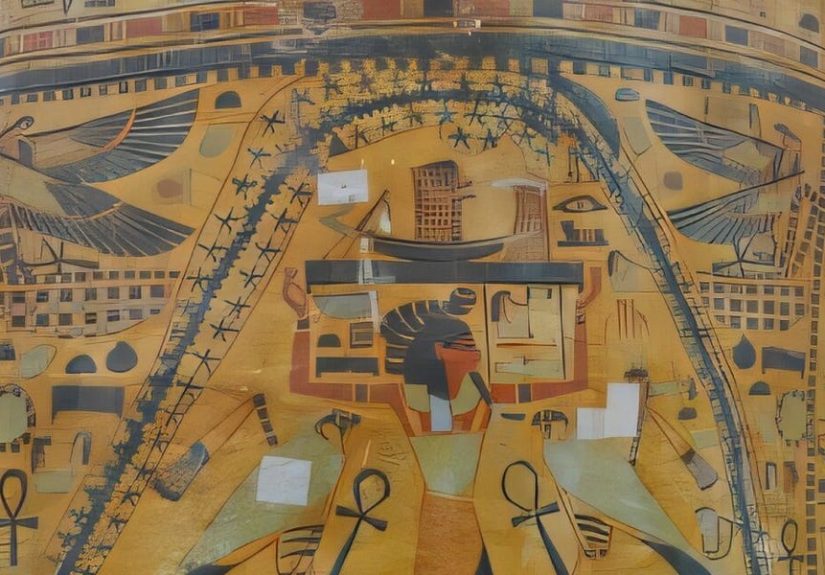
A recent study examining depictions of the sky goddess Nut on ancient Egyptian coffins argues that one especially striking image shows a dark, wavy band cutting across her star-covered body. That band appears to resemble the Great Rift, the shadowy lane of dust that visually splits the Milky Way. In other words, what looked for generations like symbolic decoration may actually be one of the clearest known visual references to our home galaxy in ancient Egyptian art.
This is the kind of discovery that makes archaeology and astronomy look like they’ve been quietly dating for years. One brings painted coffins, tomb ceilings, and old religious texts. The other shows up with sky simulations, galactic structure, and a flashlight aimed at 3,000 years of iconography. Together, they tell a bigger story about how the ancient Egyptians looked up, made meaning out of the night sky, and carried that meaning into death, rebirth, and the architecture of eternity.
What Scientists Actually Found
The new attention centers on research into Nut, the Egyptian sky goddess often shown arching over the earth god Geb. In many funerary scenes, she is painted as a woman stretched across the heavens, sometimes dotted with stars, sometimes associated with the sun’s daily cycle, and often positioned as a protective cosmic figure over the dead. That part was already well known. The new twist is that one coffin image may preserve something more specific: a visual rendering of the Milky Way itself.
The most talked-about example comes from the outer coffin of Nesitaudjatakhet, a chantress connected to the cult of Amun-Re. On that coffin, Nut appears covered in stars, but she is also crossed by a thick, undulating dark curve. According to the study, that unusual band recalls the Great Rift, the dark dust lane that divides the bright band of the Milky Way when viewed from Earth under dark skies. This is why the story has traveled so quickly: it is not merely about a goddess and the sky in general, but about a possible painting of a specific celestial feature.
That matters because the research does not rely on a single pretty coincidence. The scholar behind the study reviewed 125 images of Nut drawn from a larger catalog of 555 coffin elements and related scenes. Similar undulating lines also appear in tomb decorations associated with figures such as Seti I and Ramesses IV, VI, and IX. So the argument is not that one artist had a weird paintbrush day. It is that a recurring visual motif may reflect a real astronomical concept embedded in Egyptian religious art.
Why This Is a Big Deal for Egyptology and Astronomy
For years, scholars suspected that Nut and the Milky Way were linked. Ancient Egyptian texts had already encouraged that possibility. But text-based interpretation can be slippery, especially when religion, metaphor, ritual, and astronomy are all tangled together like holiday lights in a storage box. The new study adds something researchers have long wanted: visual evidence.
That distinction is huge. It moves the conversation from “this might be implied in mythology” to “this may have been deliberately painted.” In archaeology, that is not a small upgrade. It is the difference between reading symbolism and seeing it.
Even better, the new findings build on earlier work that used ancient texts and astronomical simulations to explore Nut’s relationship to the night sky. That earlier interpretation suggested the Milky Way may have highlighted different parts of Nut across the seasons, tracing her arms in winter and her backbone in summer. The newer coffin analysis strengthens the broader idea that ancient Egyptians did not treat the Milky Way as random background sparkle. They likely noticed it, named it, integrated it into religious thought, and represented it visually in some contexts.
But No, Nut Was Not Simply “The Milky Way”
This is where the nuance matters. The study does not say Nut equals the Milky Way in a one-to-one way. In fact, it argues the opposite. Nut was the sky in a broader theological sense. The Milky Way seems to have been one celestial phenomenon associated with her, alongside the sun, stars, and other heavenly cycles.
That may sound like a technical footnote, but it is actually the key to understanding the whole discovery. Ancient Egyptian religion was not trying to produce a modern astronomy textbook. It was creating a sacred cosmic system in which divine figures expressed real observed phenomena without being reduced to them. Nut was not a diagram. She was a cosmological being.
So the better interpretation is this: the Milky Way may have been understood as part of Nut’s celestial body or presence, not as her entire identity. Think less “this goddess is secretly a galaxy” and more “this galaxy was one visible expression of the goddess who embodied the sky.” Ancient religion loved layered meaning. Frankly, it would have found modern headline writing a little too literal.
Meet Nut, the Sky Goddess With One of the Best Job Descriptions in Mythology
To understand why this possible Milky Way depiction matters, you need to know Nut. In Egyptian belief, Nut was the sky goddess, often shown arching over Geb, the earth god, while Shu, associated with air, held them apart. She was connected to cosmic order, protection, rebirth, and the daily movement of the sun.
She also had an unforgettable role in the solar cycle. Nut was believed to swallow the sun at dusk and give birth to it again at dawn. If that sounds dramatic, it is because Egyptian religion rarely did subtle when cosmic theater was available. But the imagery was not random spectacle. It expressed a worldview in which the heavens were alive, cyclical, and deeply tied to death and rebirth.
That is one reason Nut appears so often on coffins and in tomb decoration. She was not just decoration with excellent posture. She was a divine protector of the dead, a figure who embraced the deceased and connected the burial chamber to the sky, the afterlife, and renewal. Museum collections in the United States preserve many coffins showing Nut with outstretched wings or elongated across a lid, reinforcing how central she was to funerary art.
Once you know that, the new interpretation clicks into place. A coffin was not merely a container. It was a religious object, a cosmic map, and a promise. If the Milky Way was painted across Nut, then the coffin was doing even more than scholars realized: it may have been placing the dead beneath a recognizable model of the heavens.
Why the Nesitaudjatakhet Coffin Stands Out
The coffin of Nesitaudjatakhet is the star of this story, and yes, that pun was inevitable. What makes it so striking is not just that Nut appears on it, but how she appears. The dark, wavy band across her starry body is visually unusual enough to demand explanation. It is not the standard “sky goddess, stars, job done” formula. It looks intentional, specific, and astronomically suggestive.
The comparison to the Milky Way’s Great Rift is especially persuasive because the Great Rift is one of the most visually distinctive naked-eye features of the galaxy. Under dark skies, the Milky Way is not simply a milky smear of light. It is crossed by shadowy bands of interstellar dust that create visible breaks and dark lanes. If ancient Egyptian observers were paying close attention to the night sky, and all signs suggest they were, this is exactly the kind of feature they might encode symbolically.
The coffin also fits a larger Egyptian pattern of sophisticated sky awareness. Ancient Egyptians tracked stars, used decans for timekeeping, oriented monuments with celestial precision, and wove astronomical observation into ritual literature. So while they did not think in modern astrophysical terms about galaxies, dust lanes, and spiral arms, they clearly observed the sky with care and treated it as meaningful. The leap from observation to sacred image is not only plausible; it is very Egyptian.
So Did Ancient Egyptians “Know” the Milky Way?
Yes, but with an asterisk the size of a pyramid.
If by “know” we mean “understood the Milky Way as a barred spiral galaxy containing hundreds of billions of stars and a supermassive black hole at its center,” absolutely not. That is modern astronomy speaking after telescopes, spectroscopy, and centuries of science.
But if by “know” we mean “observed the bright river of light in the night sky, noticed its dark divisions, associated it with divinity, and represented it in religious art,” then yes, this research strongly suggests they did. That kind of knowledge is not lesser. It is different. It is observational, symbolic, and culturally embedded rather than mathematical and astrophysical.
And honestly, that should make the discovery more interesting, not less. The point is not that ancient Egyptians accidentally became modern astronomers in linen skirts. The point is that they built a meaningful cosmology from the sky they could see with their own eyes, and they did it with enough consistency that modern researchers can still recognize the pattern.
Why the Headline Works and Why the Nuance Matters
The phrase “Scientists Just Found the Milky Way on an Ancient Egyptian Sarcophagus” is a great headline because it is vivid, weird, and just a little outrageous. It also needs translation.
Scientists did not discover a literal labeled picture of the Milky Way with a helpful caption reading “galaxy goes here.” What they found is likely visual evidence that ancient Egyptian artists incorporated the galaxy into depictions of Nut on coffins and tomb ceilings. That is a subtler claim, but it is still remarkable.
It is also worth noting that the popular shorthand often says “sarcophagus,” while the research itself focuses heavily on coffin imagery and funerary vignettes. That is not a fatal error; people use the words loosely all the time. But archaeology loves specifics, and this story rewards precision. The real thrill lies in the image, the pattern, and the interpretation, not in whichever burial-container term wins the headline beauty contest.
What This Discovery Says About Ancient Egyptian Culture
The biggest takeaway may be that ancient Egyptian art, religion, and astronomy were never separate departments with bad interoffice communication. They were part of one worldview. A coffin could be theology, astronomy, social identity, ritual technology, and visual storytelling all at once.
That integrated worldview helps explain why discoveries like this feel so rich. The Milky Way was not only something to look at. It was something to live with, die under, mythologize, and paint into the architecture of eternity. Nut did not merely decorate the coffin. She transformed it into a piece of the cosmos.
There is also a broader human story here. Across cultures, people have looked at the Milky Way and seen roads, rivers, backbones, paths of souls, divine traces, and celestial beings. The ancient Egyptians were doing what humans everywhere do: turning the night sky into meaning. The difference is that they left behind some of the most visually stunning evidence on Earth.
Experience the Discovery: What It Feels Like When History and the Night Sky Suddenly Touch
Imagine standing in a museum gallery in front of an ancient Egyptian coffin. The room is quiet in that special museum way, where even a cough feels historically inappropriate. At first, you notice the obvious things: the painted face, the geometry, the colors that somehow survived dynasties, empires, looters, collectors, scholars, and climate-control systems. Then your eyes settle on the goddess stretched across the surface, arms wide, body impossibly elegant, stars scattered across her like someone turned theology into constellations.
Now imagine hearing that one dark, wavy line on a coffin like this might be the Milky Way.
That is the moment the object changes. It stops being only a funerary artifact and becomes a conversation across millennia. Suddenly, the person who painted it does not feel abstract anymore. You can almost picture them looking up into a black desert sky with no city glare, seeing the galaxy burn across the darkness, noticing the dark split running through it, and deciding that this belonged on the body of Nut. Not because they were making “art about space” in the modern sense, but because the sky, religion, and the afterlife were all one giant system of meaning.
There is something deeply moving about that. Modern people often experience the universe through screens, telescope images, and headlines about black holes. Ancient Egyptians experienced it with naked eyes, ritual memory, and stories powerful enough to survive 3,000 years. And yet the emotional response may not be so different. We still look up and feel small, fascinated, humbled, maybe even a little haunted. We still want the sky to mean something.
The experience becomes even more powerful if you have ever seen the Milky Way in a truly dark place. Not a sad suburban version with three visible stars and one airplane pretending to be Venus. A real dark sky. The kind where the Milky Way looks textured, layered, almost physical. When you have seen that, the coffin image stops feeling like a scholarly abstraction. You understand how a civilization could weave that spectacle into myth, burial, and rebirth.
It also changes how you read ancient objects. Instead of asking only, “What is this made of?” or “Who was buried here?” you start asking, “What sky did these people know?” That is a beautiful question, and this research helps answer it. It reminds us that the ancient world was not intellectually dim, only differently illuminated.
In the end, the experience of this discovery is part wonder, part intimacy. Wonder because the Milky Way may be sitting there in Egyptian funerary art, hiding in plain sight. Intimacy because it reveals a human continuity that is hard to shake: thousands of years ago, someone looked up at the same galaxy we see today and found a way to paint it into eternity.
Conclusion
So, did scientists just find the Milky Way on an ancient Egyptian sarcophagus? In the headline sense, yes. In the scholarly sense, they found compelling evidence that ancient Egyptian artists may have visually encoded the galaxy, especially its dark central rift, into depictions of the sky goddess Nut on coffins and tomb ceilings.
That is not a small correction to history. It is a reminder that ancient Egyptian funerary art was doing far more than symbolizing generic heaven vibes. It may have preserved careful observations of the night sky inside one of the most sophisticated religious cultures of the ancient world.
And that is why this story sticks. It gives us the rare pleasure of seeing two kinds of distance collapse at once: the distance between art and science, and the distance between us and the ancient people who stood under the same river of stars.