Table of Contents >> Show >> Hide
- Quick Verdict
- What Is the ThermoPro TempSpike?
- Setup and App Experience
- Accuracy and Speed: The Part That Actually Matters
- Range and Connection Reliability (Bluetooth, but Make It Realistic)
- Temperature Limits: Read This Before You Sear
- Battery Life, Charging, and Durability
- Real Cooking Examples: Where TempSpike Shines
- Food Safety: TempSpike Helps, But You’re Still the Chef
- TempSpike vs. Other Wireless Meat Thermometers
- Common Pitfalls (and How to Avoid Them)
- So, Is the ThermoPro TempSpike Worth It?
- Extra : Real-World Experience Notes (TempSpike in Daily Cooking)
If you’ve ever tried to tiptoe across a patio while dragging a spaghetti tangle of thermometer wires behind you, you already understand the emotional appeal of a truly wireless probe.
The ThermoPro TempSpike promises exactly that: a leave-in meat probe that talks to a small booster, which then relays temps to your phoneso you can “check the brisket” from the couch without doing the awkward screen-door shuffle.
This review digs into what TempSpike does well (a lot, honestly), where the fine print matters (it really does), and who should consider a different style of smart thermometer.
I’ll also share an extra 500-word “real-life experience” section at the endbecause specs are nice, but dinner is made of moments (and occasionally panic).
Quick Verdict
ThermoPro TempSpike is a strong value if you want a straightforward wireless probe with solid accuracy, a practical app, and enough range for typical home cookingespecially grilling,
roasting, and smoking where you want both internal meat temperature and ambient cooker temperature in one place.
What I like
- Truly wire-free probe with a booster that helps maintain connection and extends usable range.
- Dual sensing: internal meat temp plus ambient/pit temp in one probe setup.
- Good accuracy and consistent readings in third-party testing.
- Helpful app tools: presets, graphs for meat temp, alarms, and “heads-up” pre-alarms.
- Great price-to-performance compared with many wireless probe competitors.
What to watch out for
-
Internal sensor limit matters: the food-temp sensing area is designed for typical meat internal temperaturesnot extreme heat.
That means placement and technique are important for high-heat searing. - Bluetooth reality: range claims are best-case; walls, grills, and closed lids can shorten it.
- One probe in most kits (unless you buy variants/bundles or add probes), so multi-meat cooks may need planning.
What Is the ThermoPro TempSpike?
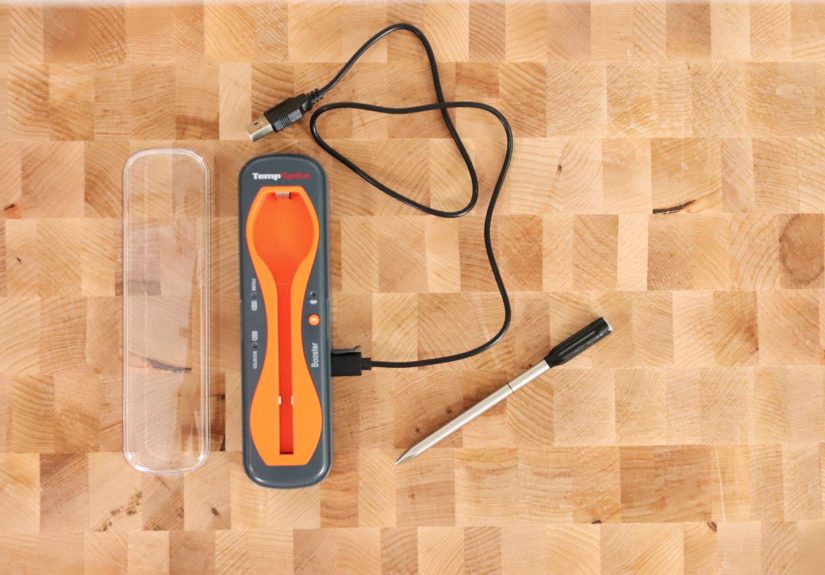
The TempSpike is a wireless meat thermometer system built around two pieces:
- A stainless steel probe you insert into the food. It measures internal temperature at the tip and ambient temperature nearer the handle end.
-
A booster/charger that sits near the cooker. The probe connects to the booster, and the booster connects to your phone via Bluetooth.
The booster also stores and recharges the probe.
The concept is simple: keep the booster close to the grill/smoker, keep your phone wherever you want, and let TempSpike do the constant checking.
ThermoPro markets the phone-to-booster range around 500 feet under ideal conditions, with the probe-to-booster link shorter and meant to stay “near the action.”
Setup and App Experience
A smart thermometer lives or dies by the experience of setting it up while you’re holding raw chicken.
Fortunately, TempSpike’s workflow is pretty painless: charge, pair, pick a target temperature, and go.
In listings and reviews, the app is described as straightforward, offering USDA-style presets, custom targets, and alarms.
You can also view a temperature-over-time graph for the meat temperature, which is useful for long cooks when you want to confirm that progress is steady.
One of the most practical features is the pre-alarm option: instead of waiting until the exact final temp, you can set alerts when you’re 5°F, 10°F, or 15°F away.
That’s perfect for steaks and chicken where carryover cooking can overshoot quickly, and it’s a lifesaver if you’re trying to time sides and don’t want to play “guess the last five minutes.”
Accuracy and Speed: The Part That Actually Matters
ThermoPro’s published accuracy is commonly listed around ±1.8°F (±1°C) over the internal temperature range, with quick read updates.
In third-party hands-on testing, TempSpike’s readings tracked closely against a reference thermometer across multiple temperature points, and the ambient sensor performed well at common oven/smoker temps.
Translation for normal humans: if you set your chicken target to 165°F, you’ll feel confident that 165°F is actually 165°Frather than “somewhere between safe and sorry.”
And confidence is the whole point of buying a thermometer you don’t have to babysit.
Range and Connection Reliability (Bluetooth, but Make It Realistic)
ThermoPro advertises long range via Bluetooth (with the booster acting as a relay), and reviewers note it holds up well in typical home setupsgrill outside, phone inside.
Still, it’s worth remembering that Bluetooth range is famously environment-dependent.
Your grill is basically a metal box that closes like a tiny radio-signal dungeon, and your house has walls, appliances, and assorted “why is the Wi-Fi slow in the kitchen” mysteries.
Tips to get the best range
- Keep the booster near the cooker (not inside a drawer, not behind the propane tank, not under a wet towel).
- Give it line-of-sight when possible: a patio table near the smoker usually beats “behind the chimney.”
- Don’t chase the last foot: if you’re trying to monitor from the back bedroom through two walls and a fridge, even great Bluetooth will have a rough day.
Bottom line: in a normal “backyard cook + indoor hanging out” scenario, TempSpike’s connection model is a practical fitjust don’t expect physics to take the day off.
Temperature Limits: Read This Before You Sear
Wireless probe thermometers typically have two different temperature realities:
the internal sensor (meant for meat temps) and the ambient sensor (meant for grill/oven air temps).
With TempSpike, the internal temperature range is commonly listed up to about 212°F, while ambient monitoring is rated much higher (often cited around the 527–572°F neighborhood, depending on the specific listing/version).
That means TempSpike is excellent for:
- Smoking (225–275°F pit temps, slow rises, long cooks)
- Roasting (turkey, prime rib, pork loin)
- Grilling with control (indirect zones, finishing, thicker cuts)
- Sous vide-style monitoring (where temperatures are inherently moderate)
And it means you should be thoughtful about:
- High-heat searing directly over flame, especially for extended time.
- Very thin foods where the probe’s sensing zones may sit too close to extreme surface heat.
A simple technique solves most of this: use TempSpike to nail the finish temperature, then sear quickly at the end if you want a crust.
For steaks, the classic reverse-sear pattern is practically made for a wireless probe:
cook low until you’re near target, pull, sear fast, rest, and enjoy being smug about your doneness.
Battery Life, Charging, and Durability
Battery life is one of TempSpike’s strongest selling points.
The probe is commonly claimed around 48 hours of use per full charge, and the booster is often claimed around months per charge (with figures like “three months” appearing in reviews and product info).
In real terms, that means you aren’t constantly playing the “why is it dead today?” gameunless you’re the kind of person who also never charges their phone and blames the phone.
Durability-wise, TempSpike is typically rated IP67 waterproof for the probe, which supports rinsing under running water after a cook.
(Still: be kind to electronics. “Waterproof” is not a challenge, it’s a convenience.)
Charging generally happens by storing the probe in the booster.
ThermoPro’s support documentation for TempSpike family variants notes full charging can take several hours for certain models (for example, a TempSpike Pro support note mentions roughly four hours to fully charge booster and probes).
Exact times vary by variant and battery state, but the overall pattern is easy: charge between cooks and you’ll rarely think about it again.
Real Cooking Examples: Where TempSpike Shines
1) Chicken thighs on the grill (no more “looks done” roulette)
Chicken is where a good thermometer pays rent.
Use a safe target temperature (many cooks aim for at least 165°F for poultry, per U.S. food-safety guidance),
and let TempSpike alert you as you approach the finish so you can stop chasing flare-ups and start focusing on browning the skin.
Bonus: set an ambient low-temp alarm so you know when your grill is losing heat and your cook time is about to drift into “why is everyone hungry?” territory.
2) Pork tenderloin (tender, not dry)
Pork tenderloin goes from perfect to “why is it so chewy?” in a blink.
Set your target based on your preferred doneness and food-safety guidance, use a pre-alarm so you can pull early, and let carryover do the last bit of work.
TempSpike’s graph is surprisingly helpful here because you can see how fast the internal temp climbs near the endexactly when you’re most likely to overcook it.
3) Ribs or pork shoulder in a smoker (the long-game cook)
Low-and-slow is where wireless makes the biggest lifestyle difference.
Instead of “open lid, stab meat, lose heat,” you get a constant temperature feed.
For big cooks, the ambient sensor is just as valuable as the meat sensorbecause a smoker running 50°F low will make your timeline fictional.
4) Prime rib or roast (holiday peace of mind)
If you’ve ever cooked a holiday roast with relatives hovering like a reality TV judging panel, you know why alarms are beautiful.
Set your target, set a pre-alarm, and enjoy being the calm person in the kitchen for once.
Food Safety: TempSpike Helps, But You’re Still the Chef
A thermometer is a tool, not a magical protection spell.
Use reputable safe-minimum temperature guidance for meats and leftovers, and remember that visual cues aren’t reliable.
In U.S. public guidance, poultry is commonly listed at 165°F, ground meats often at 160°F, and whole cuts like steaks/roasts often at 145°F with rest timebut always follow the guidance appropriate to your food and situation.
TempSpike’s presets can be a useful starting point, but don’t be afraid to customize targets for your preferred doneness (especially for steak) while respecting safety guidelines.
TempSpike vs. Other Wireless Meat Thermometers
TempSpike sits in a crowded world of smart thermometers, so here’s how it generally stacks up by category.
TempSpike vs. MEATER-style Bluetooth probes
MEATER popularized the “wireless probe + app” idea, and its typical range claims are shorter than TempSpike’s booster-to-phone marketing numbers.
MEATER ecosystems can expand range with linking/cloud approaches, but that sometimes adds complexity (and occasionally requires workarounds like keeping a spare device near the cooker).
TempSpike’s booster relay model is built around keeping things simple: booster by the grill, phone wherever.
TempSpike vs. Wi-Fi hub systems (CHEF iQ, ThermoWorks gateways, etc.)
If you want monitoring from anywhere (like leaving the house and still watching temps), Wi-Fi hub systems can be the better fit.
CHEF iQ’s hub-style approach advertises “unlimited range” through Wi-Fi when paired with its smart hub, and newer pro-level systems from companies like ThermoWorks lean into more robust connectivity designs.
The trade-off is usually price and ecosystem complexity.
TempSpike’s sweet spot
TempSpike makes the most sense if your goal is: wireless freedom around the house, not “monitor brisket from across town.”
For most backyard cooks, that’s exactly the right target.
Common Pitfalls (and How to Avoid Them)
Insert depth and placement
- Avoid bone: it can skew readings and slow response.
- Hit the thermal center: thickest part of the meat, not the edge.
- Mind the probe’s safe-insertion markings: wireless probes have internal limits; correct placement helps keep the sensing zones in the right environment.
Don’t confuse “ambient” with “grate” temperature
Ambient sensors read the air around the probe’s handle end, which is very usefulbut it won’t be identical to a grate clip reading at a different height or location.
Use it as a directional guide and alarm system, and you’ll be happy.
Expect perfect agreement with every thermometer in every spot, and you’ll be posting on the internet at 2 a.m.
Clean-up habits
Rinse the probe after each cook and keep the booster reasonably clean and dry.
The goal is to keep the business end sanitary without treating the electronics like a dish sponge.
So, Is the ThermoPro TempSpike Worth It?
For most home cooks, yes.
The TempSpike hits a rare balance of accuracy, usability, and price.
It’s especially satisfying for grilling and smoking where you want to stop opening lids and start trusting your process.
The main “gotcha” isn’t a flaw so much as a category reality: wireless probes have internal sensor limits, and you need to cook with that in mind.
If your cooking life happens mostly within Bluetooth distance of your backyard, TempSpike is an easy recommendation.
If you want true anywhere-in-the-world monitoring, or you regularly run extreme high-heat setups for long stretches, consider stepping up to a Wi-Fi hub system or a more heavy-duty wireless ecosystem.
Extra : Real-World Experience Notes (TempSpike in Daily Cooking)
Here’s what TempSpike “feels like” in practicebased on common cook workflows and the way the device is designed to behave (not magic, not telepathy, just good temperature tracking).
Day 1: The steak confidence boost. You set up a reverse sear because you’re done gambling with expensive ribeye.
TempSpike goes in, you set a target that matches your doneness vibe, and you turn on a pre-alarm.
The best part isn’t the final alertit’s the steady climb you can watch from the kitchen while you prep salad and pretend you’re the kind of person who plans meals.
When the pre-alarm hits, you’re not surprised; you’re ready.
You pull the steak a touch early, sear hot and fast, and the inside lands right where you wanted.
Your brain stores this as: “I am now a person who cooks steak correctly,” which is an underrated psychological benefit.
Day 2: Chicken thighs, zero drama edition. Chicken is where overconfidence goes to die.
With TempSpike, the cook becomes boringin the best way.
You get an alert near your target, you confirm the thickest piece is there, and you stop cooking based on superstition.
The thighs come off juicy, and you realize how much time you used to waste hovering because you didn’t trust your own timeline.
Day 3: The smoker session where you reclaim your Saturday. You start ribs or a pork shoulder and put the booster near the cooker.
Instead of opening the lid “just to check,” you watch the ambient temperature and let the alarms do the worrying.
When the pit temp dips, you notice immediatelybefore your cook schedule quietly stretches into the evening.
This is where wireless feels like a genuine upgrade: you’re not chained to the patio, and you’re not constantly bleeding heat from the smoker.
Day 4: The holiday roast where you look unreasonably calm. There’s always someone who asks, “How much longer?”
With TempSpike, you don’t answer with vibes; you answer with numbers.
You use the graph to see the roast’s pace and decide when to start the gravy.
The timer becomes less of a guess and more of a plan.
You pull at the right moment, rest properly, and carve without the “is it done?” anxiety.
That calm is contagiousuntil someone starts a politics conversation, but that’s outside the scope of this review.
What surprises most people: the biggest upgrade isn’t the phone notificationsit’s the way you stop “checking” and start “managing.”
Once you trust the thermometer, you focus on flavor: seasoning, fire control, timing sides, and resting meat properly.
TempSpike doesn’t replace skill, but it removes the most annoying part of skill-building: uncertainty.
And if cooking is part science and part art, TempSpike is basically the lab partner who doesn’t talk too much and always writes down the data.