Table of Contents >> Show >> Hide
- The Real Story Behind the Headline
- Who Was the Woman Who Made Contact?
- Why the Coconuts Mattered More Than the Cameras
- North Sentinel Island Is Isolated for a Reason
- The John Allen Chau Case Changed the Global Conversation
- Why This Story Is Really About Boundaries
- What the World Still Gets Wrong About the Sentinelese
- Related Experiences That Make This Story Even Bigger
- Conclusion
Some headlines arrive wearing hiking boots and carrying way too much drama. This is one of them. Behind the viral, thunderclap title is a real story, a rare story, and honestly a much more interesting story: the story of Indian anthropologist Madhumala Chattopadhyay, the first woman known to make peaceful contact with the Sentinelese people of North Sentinel Island.
If you only know the Sentinelese from alarming headlines, you might imagine a place frozen in time and a people defined entirely by danger. But that picture is lazy. The reality is more human, more historical, and more uncomfortable for the modern world. North Sentinel Island is not some haunted dot on a pirate map. It is a protected homeland. The Sentinelese are not a tabloid plot twist. They are an Indigenous community that has repeatedly made one thing clear: they want to be left alone.
That is exactly why Madhumala Chattopadhyay’s encounter remains so remarkable. She did not “conquer” anything. She did not burst onto the island like a reality-show explorer with a camera crew, a protein bar, and a heroic monologue. She approached with caution, patience, and the most low-tech diplomatic tool imaginable: floating coconuts.
This article looks at the true story behind the headline, why Chattopadhyay’s contact mattered, what it revealed about the Sentinelese, and why the larger lesson is not about thrill-seeking at all. It is about restraint. In a world obsessed with access, content, and crossing every line just because a line exists, North Sentinel Island remains one of the last places where “no” still means “no.”
The Real Story Behind the Headline
Yes, North Sentinel Island has a reputation for deadly hostility toward outsiders. That reputation did not appear out of thin air. Over the years, the Sentinelese have attacked approaching boats, resisted official contact missions, and responded aggressively to trespassers. In 2006, two fishermen who drifted ashore were killed. In 2018, American missionary John Allen Chau died after illegally landing there. In 2025, another American, a YouTuber from Arizona, was arrested after visiting the off-limits island and leaving a coconut and a Diet Coke behind like some cursed version of a snack-based peace treaty.
But reducing the Sentinelese to “people who kill outsiders” misses the point so badly it practically deserves its own apology card. Their violence is not random spectacle. It is defensive resistance. North Sentinel is protected because isolated communities can be devastated by common diseases that outsiders carry without even noticing. Flu, measles, and other infections that barely interrupt a city commuter’s coffee run can become catastrophic in communities with no acquired immunity.
That is why India has long restricted access to the island and adopted what has often been described as an “eyes-on, hands-off” approach. The goal is not only to protect visitors from arrows. It is to protect the Sentinelese from us.
Who Was the Woman Who Made Contact?
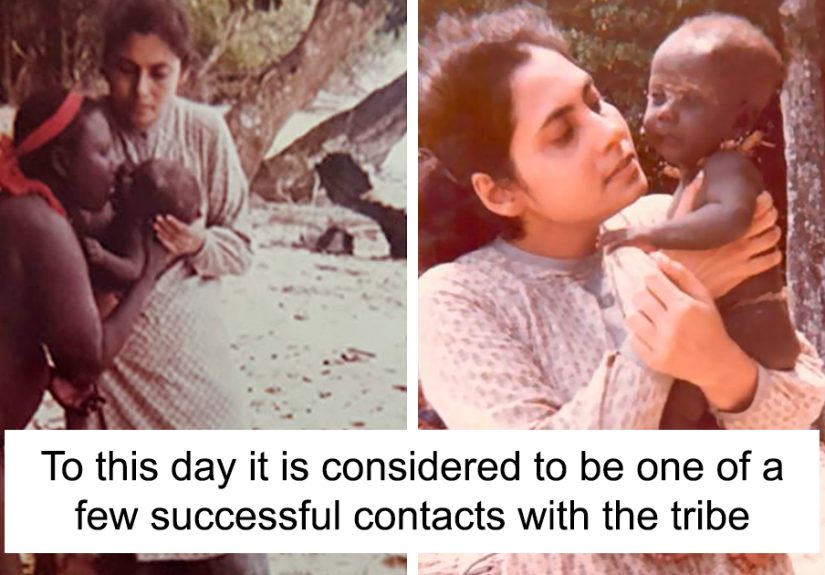
Madhumala Chattopadhyay was not a tourist, influencer, missionary, or adrenaline collector. She was an anthropologist who spent years studying the Indigenous peoples of the Andaman and Nicobar Islands. Long before her name became linked with North Sentinel, she had already devoted serious academic work to understanding the region’s tribal communities. In other words, she did the opposite of what the internet usually does: she prepared.
Even then, joining a contact expedition was not simple. Women were not normally included in missions involving groups considered hostile, and Chattopadhyay reportedly had to sign documents acknowledging the risks. Her parents had to do the same. That detail matters because it shows how tense these expeditions were. Nobody was strolling into an anthropology field trip with matching hats and a tote bag full of optimism.
In January 1991, Chattopadhyay joined a team that approached North Sentinel Island by boat. Previous encounters had often ended with the islanders signaling warnings or preparing to attack. This time, the team floated coconuts toward the shore. The Sentinelese came into the water and collected them. What followed was a rare moment of cautious, limited acceptance. Women and children watched from a distance. Men moved in and out of the surf. At one tense point, a young man raised a bow, but the situation eased. According to Chattopadhyay’s later account, some Sentinelese even came close enough to touch the boat.
That does not mean the barrier vanished. It means, for a brief window, the atmosphere shifted from outright rejection to guarded curiosity. There was no handshake summit. No speech. No triumphant soundtrack. Just a fragile encounter built on distance, observation, and an understanding that the outsiders were not in charge.
Why the Coconuts Mattered More Than the Cameras
The coconuts in this story are basically the quiet heroes. They sound simple, almost funny, and yes, they do not have the cinematic flair of helicopters or dramatic voiceovers. But they mattered because they represented an offering that was useful, visible, and nonintrusive. Coconuts do not grow on North Sentinel, so they were novel. More importantly, they could be received without forcing close physical contact.
That is the key difference between respectful approach and reckless intrusion. Chattopadhyay’s expedition did not storm the beach with a savior complex. It allowed the Sentinelese to decide the distance, the pace, and the level of engagement. In modern terms, this was not “networking.” This was consent in geographic form.
And even then, the encounter was temporary. The team was not invited into the settlement. They did not suddenly decode the Sentinelese language. They did not unlock the island’s “secrets,” because Indigenous communities are not escape rooms designed for outsiders to solve. The value of the contact was not that it opened the door to more interference. Its value was that it showed how much humility contact would require, and why even seemingly successful encounters could remain ethically risky.
North Sentinel Island Is Isolated for a Reason
To understand the Sentinelese reaction to outsiders, you have to zoom out. The Andaman Islands carry a brutal colonial history. During the 19th century, the British established a penal colony in the archipelago. Across the region, Indigenous communities were exposed to disease, coercion, displacement, and violence. Neighboring groups suffered severe declines after contact. So when historians and anthropologists suggest the Sentinelese are not merely “mysterious” but intentionally resistant, that argument has weight.
In plain English: history taught a devastating lesson, and the Sentinelese appear to have learned it well.
That is also why the familiar cliché about “Stone Age tribes” is so misleading. The Sentinelese are not relics from a museum diorama. They live in the present. They use tools skillfully, build canoes adapted to their environment, and have incorporated salvaged metal into arrowheads. Their way of life is different from industrial society, but different does not mean backward. It means theirs.
Modern audiences often love to romanticize isolation right up until isolation refuses to entertain them. We want untouched places, but only if we can film them, tag them, review them, and maybe complain about the lack of Wi-Fi. North Sentinel does not play that game. It remains one of the clearest rebukes to the idea that every place must eventually become available to outsiders.
The John Allen Chau Case Changed the Global Conversation
In 2018, North Sentinel Island returned to international headlines after American missionary John Allen Chau illegally traveled there, hoping to make contact and convert the Sentinelese to Christianity. His death triggered a fierce debate about faith, colonial attitudes, missionary work, and the ethics of “reaching” people who have clearly rejected contact.
For some observers, Chau’s story was framed as zeal, sacrifice, or personal conviction. For many others, it was a textbook example of dangerous entitlement wrapped in religious language. Whatever one thinks of his motives, the facts remain stark: he entered a restricted Indigenous homeland that outsiders are barred from visiting, and he did so despite well-known risks to both himself and the island’s inhabitants.
What makes Chattopadhyay’s story so important in comparison is that it offers a different model entirely. Her work was not about forcing transformation. It was about approaching with knowledge and accepting limits. The Chau story made global audiences ask whether the Sentinelese are hostile. The better question is why so many outsiders keep acting as though refusal is an invitation.
Why This Story Is Really About Boundaries
The biggest lesson here is not “wow, what a dangerous tribe.” It is “wow, modern civilization is terrible at hearing boundaries.” North Sentinel Island may be geographically remote, but the ethical issue is familiar. The Sentinelese have expressed refusal again and again, through law, history, and direct action. Yet outsiders still appear with boats, cameras, religious agendas, or online clout in mind.
That is where this story gets strangely modern. The island may feel distant from ordinary life, but the pattern is not. People ignore warnings. People confuse curiosity with entitlement. People assume access is their right. Then they act shocked when reality does not cooperate.
Chattopadhyay’s peaceful encounter is memorable precisely because it did not erase those boundaries. It respected them. Her story survives not as proof that the Sentinelese should be contacted more often, but as evidence that even the rarest successful encounter requires extraordinary care, restraint, and cultural respect.
What the World Still Gets Wrong About the Sentinelese
They are not a tourist attraction.
Any attempt to turn North Sentinel into a bucket-list destination is reckless. The island is protected for legal, medical, and ethical reasons. It is not forbidden in the cool, cinematic way; it is forbidden in the “please stop trying to endanger an entire community” way.
They are not a fantasy of purity.
Popular culture swings between two bad extremes: demonizing isolated peoples as savage, or romanticizing them as spiritually pure symbols of a better world. Both are distortions. The Sentinelese are real people with their own choices, risks, social structure, and history. They do not exist to flatter modern anxieties.
They do not owe the outside world contact.
This might be the hardest truth for a hyperconnected age. We are used to assuming more contact is always good, more visibility is always progressive, and more access is always the answer. North Sentinel Island reminds us that survival can also depend on distance.
Related Experiences That Make This Story Even Bigger
The experiences surrounding North Sentinel Island over the decades only deepen the meaning of Chattopadhyay’s story. Consider what happened when colonial powers entered the broader Andaman region in the 19th century. Neighboring Indigenous populations were devastated by disease, coercion, and social disruption. That history is not dusty background material for professors and footnotes. It is the living context that helps explain why the Sentinelese remain fiercely defensive today. If your neighbors get crushed by “civilization,” you do not greet the next boat with a welcome basket.
Then there are the accidental encounters. In 1981, the crew of a ship called the Primrose ran aground near North Sentinel. The crew saw armed islanders gathering onshore and feared an attack before they were eventually rescued. That episode became part of the island’s modern legend, reinforcing the image of North Sentinel as one of the world’s last true no-entry zones. Again, the lesson was not that the Sentinelese are inexplicably violent. The lesson was that they defend their space when outsiders arrive uninvited.
The same pattern appeared after the 2004 Indian Ocean tsunami. When officials checked on the island from the air, the Sentinelese signaled that they were alive in the most Sentinelese way possible: by making it crystal clear the helicopter was not welcome. It was one of the strangest and most unforgettable reminders in recent history that survival does not always look like grateful rescue. Sometimes survival looks like saying, “We’re still here. Please leave.”
And then came the modern intrusions, which feel almost too on-the-nose. In 2018, Chau tried to bring religion to people who had not asked for it. In 2025, a YouTuber tried to bring internet-era nonsense to people who had not asked for that either. Different motives, same underlying mistake: outsiders treating a protected Indigenous homeland as a stage for personal meaning. One wanted a spiritual breakthrough. The other seemed to want a story. Both cases underline why Chattopadhyay’s experience remains such an outlier. She approached as a trained observer under official conditions. They approached as individuals convinced their mission mattered more than the boundary itself.
That is why this story still resonates. It is not just about one woman, one island, or one tribe. It is about the clash between restraint and intrusion. Chattopadhyay’s experience suggests that knowledge begins with humility. The other experiences suggest that disaster begins with ego. If there is a moral here, it is not especially mysterious: not every silence is a puzzle to solve, and not every closed shore is waiting for your arrival.
Conclusion
So yes, a woman did contact the tribe known in headlines for killing outsiders. But the real headline should be smarter than that. Madhumala Chattopadhyay’s story is not thrilling because she flirted with danger. It matters because she showed what respect looks like in one of the most ethically sensitive places on Earth.
Her encounter with the Sentinelese remains extraordinary precisely because it was limited, careful, and humble. It did not prove that the tribe should be opened up to the world. It proved the opposite: that any contact, however brief, must be approached with extreme caution, and that the strongest act of respect may be knowing when not to approach at all.
North Sentinel Island still fascinates the modern imagination because it resists the modern habit of turning every human story into content. The island refuses access. The Sentinelese refuse assimilation. And in an age where everybody wants to go viral, that refusal may be the most powerful message of all.