Table of Contents >> Show >> Hide
- What Is the Rule of Thirds?
- Why Designers Love It
- Don’t Confuse These “Thirds” Rules
- How to Apply the Rule of Thirds in a Room (Fast)
- Rule of Thirds for Furniture Layout
- Rule of Thirds for Wall Art and Decor
- Rule of Thirds for Color and Pattern
- Styling Surfaces: Use Thirds + Threes
- Walls as Canvases: Paint Lines and Trim Heights
- Room-by-Room Mini Playbook
- Common Mistakes (and How to Avoid Them)
- Conclusion
- Real-World Experiences: What People Notice When They Actually Try It
Interior design has a secret hobby: borrowing ideas from everywhere. Art. Architecture. Photography. (Sometimes your neighbor’s questionable “accent wall” choices, toomostly as a cautionary tale.) One of the best crossovers is the rule of thirds, a simple composition trick that helps rooms feel balanced, intentional, and pleasantly “put together” instead of accidentally “put somewhere.”
Below, you’ll get a plain-English explanation of the rule of thirds, why it works, and exactly how to use it for furniture placement, wall art, color, and stylingwithout turning your home into a geometry final exam.
What Is the Rule of Thirds?
The rule of thirds is a visual guideline that divides a space into three equal parts horizontally and verticallylike overlaying a tic-tac-toe grid. That creates nine rectangles and four intersection “sweet spots.” Instead of centering every element, you place key pieces along those lines or near the intersections to create a more dynamic, balanced composition.
In photography, the “frame” is the photo. In interior design, the frame can be a wall, a shelf, a coffee table, or the main view you see when you walk into a room.
Why Designers Love It
Rooms that feel good usually have three things: a focal point, balance, and breathing room. The rule of thirds supports all three.
- Less “bullseye.” Perfect centering can look stiff. Shifting visual weight to a third adds energy.
- Clear hierarchy. A focal point near an intersection reads as importantwithout yelling.
- Built-in negative space. Leaving part of the area calmer keeps the room from feeling cluttered.
Think of it as guardrails for good tastenot a speed limit for creativity.
Don’t Confuse These “Thirds” Rules
People often mix up three different (helpful) ideas:
- Rule of thirds (grid): place elements in third zones or near intersections for better composition.
- Rule of three (grouping): style objects in sets of three (or other odd numbers) for a natural, relaxed look.
- Two-thirds sizing rule: size items so they relate proportionallylike art above a sofa spanning roughly one-half to two-thirds of the furniture width.
You can use all three together, but the grid-based rule of thirds is the “big picture” tool: it helps you decide where things should go.
How to Apply the Rule of Thirds in a Room (Fast)
- Choose one viewpoint. Stand where you usually enter the room. That’s your “camera angle.”
- Mentally draw the grid. Split the main wall/scene into thirds.
- Pick your focal point. Fireplace, bed, art, big plant, statement lightchoose one star.
- Place the star in a third zone. Aim for left or right third (or an intersection), not dead center.
- Balance the other side. Add a smaller element so the room doesn’t feel lopsided.
Pro tip: painter’s tape lets you “audition” art placement and sizes before you commit to holes in drywall.
Rule of Thirds for Furniture Layout
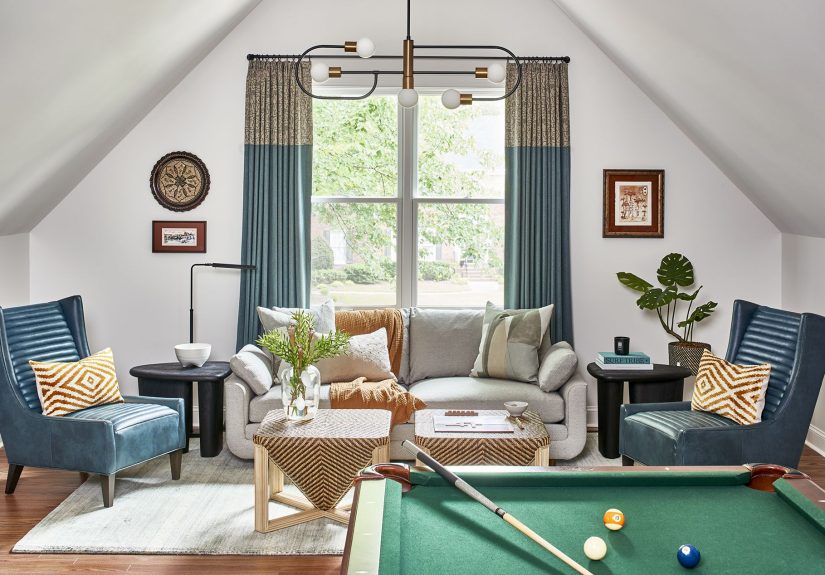
Living room: build a seating “island”
Instead of pushing everything against the walls (hello, awkward empty dance floor), use thirds to create a clear conversation zone:
- Let the main seating cluster (sofa + chairs + coffee table) visually occupy about two-thirds of the room.
- Reserve the remaining one-third for walkways, a reading corner, or open space that makes the room feel bigger.
Example: In a rectangular living room, float the sofa so the seating area lands in one side’s third-to-two-thirds zone, then balance the opposite side with a floor lamp and a plant. The room looks designedand you can still walk through it like a person.
Bedroom: keep the bed important, not over-posed
If your bed must be centered (windows, symmetry, or just the laws of “where else would it go?”), shift the decor emphasis to a third zone: a reading chair and lamp, a tall mirror, or a dresser vignette. That asymmetry keeps the room from feeling like a staged catalog set.
Rule of Thirds for Wall Art and Decor
Hang art off-center on purpose
Centering a single frame in the middle of a large wall often reads as “I didn’t know what else to do.” Try placing it in the left or right third instead, leaving the remaining space calmer. Off-center placement adds rhythm and looks intentional.
Use the two-thirds sizing check above furniture
When hanging art above a sofa, bed, or console, a widely used proportion guideline is to aim for artwork (or a gallery grouping) that spans roughly one-half to two-thirds of the furniture width. This anchors the art to the piece below so it doesn’t look like it’s floating away.
Quick example: Over a 72-inch console, art that totals about 48–60 inches wide usually looks balanced. If your favorite piece is smaller, “build the width” with sconces or flanking objects rather than hanging tiny art all alone in the middle of a big blank wall.
Bonus: use thirds to balance “visual weight” on a wall
If one side of a wall feels heavy (big bookcase, tall plant, chunky media console), you don’t have to mirror it with an identical twin. Instead, balance that heavy third with two lighter pieces in the opposite thirdlike a slim floor lamp plus a small accent chair, or a medium artwork plus a narrow ladder shelf. This kind of asymmetrical balance keeps a room feeling relaxed rather than overly matched.
Example: A large TV on the right third of a wall can look less dominating if the left third gets a tall floor lamp and a textured plant. You’re not “hiding” the TVyou’re giving your eyes another place to go.
Rule of Thirds for Color and Pattern
Thirds can guide visual weight too. Dark colors and bold patterns feel heavier; light neutrals feel lighter. A simple way to avoid a random-looking palette is to create a three-part color story:
- Dominant: your main backdrop (often walls and large upholstery).
- Secondary: a supporting tone (wood, rugs, major textiles).
- Accent: a punchier color in smaller repeats (pillows, art, decor).
If you’re using a dramatic wallpaper or patterned rug, let it “own” one third-to-two thirds of the visual story and keep the rest quieter. It’s the difference between bold and busy.
Styling Surfaces: Use Thirds + Threes
Coffee table: three zones, three heights
Mentally split the table into three sections and create a simple triangle of interest:
- a low stack (books or a tray),
- a medium element (candle or sculptural object),
- a taller element (vase with greenery).
Leave some empty surface areabecause your coffee table should still be allowed to hold, you know, coffee.
Shelves: edit for negative space
Thirds are great for preventing shelf chaos. Keep one third of a shelf bay lighter (open space or fewer items), and group the remaining objects in small clustersoften in threesfor a calmer, curated look.
Walls as Canvases: Paint Lines and Trim Heights
For chair rails, wainscoting, or color-block paint, thirds can help you pick a line that looks intentional:
- One-third up often makes a room feel taller.
- Two-thirds up can make tall rooms feel cozier and more grounded.
A paint line in the exact middle can look accidental; a line at one-third or two-thirds tends to feel designed.
Room-by-Room Mini Playbook
Once you “get” thirds, you start spotting quick wins everywhere. Here are a few low-effort ways to apply it without a full makeover.
Entryway
Instead of centering every piece, shift your mirror or art slightly toward the left or right third. Balance it with one tall element (a lamp or vase) on the opposite side, and leave part of the console clear for real-life drop-zone needs.
Dining table
Skip the giant centerpiece in the exact middle. Try a runner or tray that covers roughly two-thirds of the table length, with a small cluster (often three items) placed toward one end so plates still have room to land.
Kitchen counters
Treat the counter like a wide “frame” and pick one third as the styling zone: a cutting board, utensil crock, and a small plant. Keep the remaining area mostly open for cookingyour eye reads “clean” because the visual weight is contained.
Small rooms
If furniture can’t move much, use thirds in the details: art placement, curtain height, shelf styling, and how you distribute bold color. Even one off-center wall moment can make a tight space feel calmer.
A fast phone check
Turn on your phone camera grid and snap the room from the doorway. If everything piles up in the center or one corner, you’ll see it immediatelyand you’ll know which third needs help.
Common Mistakes (and How to Avoid Them)
- Being too literal: you’re aiming for zones, not perfect math.
- Forgetting function: flow and comfort beat grid purity every time.
- Over-centering everything: one centered statement is great; a whole room of centered statements can feel stiff.
Conclusion
The rule of thirds is a quick, flexible way to improve proportion, visual balance, and composition in interior design. Use it to place furniture and art with intention, distribute color and pattern more thoughtfully, and style surfaces without clutter. Start with one wall or one vignette, and you’ll be surprised how fast your home goes from “fine” to “finished.”
Real-World Experiences: What People Notice When They Actually Try It
If you’ve ever watched someone redecorate a room (or done it yourself), you’ll recognize a common storyline: first comes the urge to center everything. Center the sofa. Center the rug. Center the art. Center the coffee table books like they’re lining up for class photo day. It feels safe. And thenmysteriouslythe room still feels “off.”
When people start experimenting with thirds, the first thing they usually notice is how quickly a space feels less rigid. Shifting a single large elementlike sliding a piece of art into the left third of a wallcan make the room feel more relaxed, like it’s breathing. That surprise is part of the fun: you didn’t buy anything new, but the room suddenly looks like you meant it.
The next big “aha” tends to happen with artwork sizing. Many homeowners default to art that’s too small because smaller feels easier to commit to. But once you mock up a piece that spans closer to two-thirds of the furniture width (even with painter’s tape), the room reads as more complete. People often describe it as the difference between “decor” and “design.” The art stops floating and starts belonging.
Thirds also helps people edit. In real homes, clutter usually isn’t caused by one dramatic mess; it’s caused by lots of small items spread everywhere. Using thirds encourages intentional negative spacekeeping one third of a shelf or tabletop quieter. The funny part is that leaving empty space can feel uncomfortable at first (we’ve been trained to “fill” surfaces). But once someone lives with that breathing room for a week, they rarely want to go back. It looks calmer, and it’s easier to cleantwo wins that deserve a small parade.
Furniture layout is where thirds gets practical. In open-plan spaces, people often push everything to the perimeter, leaving a big empty center that feels like an awkward dance floor no one asked for. When they instead build a seating “island” that occupies roughly two-thirds of the roomwith the remaining third reserved for pathways and functionthe room starts working. Conversation zones feel defined, traffic flow improves, and the space looks larger because it’s organized.
But real-world use also teaches flexibility. In small rooms, strict thirds can feel impossible. The trick is to apply the concept to what you can control: a wall vignette, a shelf, the balance of heights on a nightstand. People who succeed with the rule of thirds don’t force it everywhere; they use it where it solves a specific problemlike an off-balance wall, a too-busy shelf, or a living room that can’t decide if it’s a lounge or a hallway.
Finally, many people discover that “breaking the rule” is easier once they understand it. After you’ve used thirds to create balance, you can intentionally choose a centered momenta dramatic pendant light, a perfectly centered bed, a bold piece of artbecause the rest of the room supports it. In other words: the rule of thirds doesn’t limit creativity. It gives you a baseline so your bold choices look confident instead of accidental.