Table of Contents >> Show >> Hide
- What Does “Scarier Than T. rex” Really Mean?
- 1. Spinosaurus: The River Monster With a Sail
- 2. Giganotosaurus: The Giant Southern Lizard
- 3. Carcharodontosaurus: The “Great White Shark” on Land
- 4. Mapusaurus: The Flesh-Ripper That Hunted in Packs
- 5. Acrocanthosaurus: The Spined Giant of Early Cretaceous North America
- 6. Utahraptor: The Super-Sized Raptor
- 7. Dakotaraptor: The Late-Cretaceous Giant Raptor
- 8. Therizinosaurus: The Edward Scissorhands of Dinosaurs
- 9. Allosaurus: The Lion of the Jurassic
- 10. Carnotaurus: The Demonic Sprinter With Horns
- So… Was T. rex Still the Ultimate Apex Predator?
- Experiences and Encounters: Imagining Life With These Nightmares
Tyrannosaurus rex gets all the movie roles, toy lines, and Halloween costumes. It’s the rock star of the dinosaur world and, to be fair, a bone-crunching apex predator with the strongest known bite force of any land animal. But if you could step into a time machine and visit the Mesozoic, there are several lesser-known dinosaurs you’d actually be even more terrified to meet in the wild.
Some were bigger than T. rex, some hunted in packs, and others carried weapons so bizarre they look like they were designed by a chaotic game developer. Let’s meet 10 underrated nightmares from prehistory that could give the “tyrant lizard king” a serious run for his money.
What Does “Scarier Than T. rex” Really Mean?
Paleontologists agree that T. rex was brutally effective: huge size, crushing bite, great sense of smell, and a reinforced skull built to break bone. However, “scary” isn’t just about bite force. It’s also about:
- Size and reach: Long jaws, enormous claws, or towering height.
- Hunting style: Pack hunting, ambush attacks, or fast pursuit.
- Weapons: Horns, sails, scythe-like claws, or slashing teeth.
- Environment: Predators that can get you on land and in the water are a special kind of nightmare.
T. rex still likely wins most one-on-one paleontological “who’d beat whom” debates, but these 10 contenders are absolutely scarier in their own unique ways especially if you imagine actually sharing their habitat.
1. Spinosaurus: The River Monster With a Sail
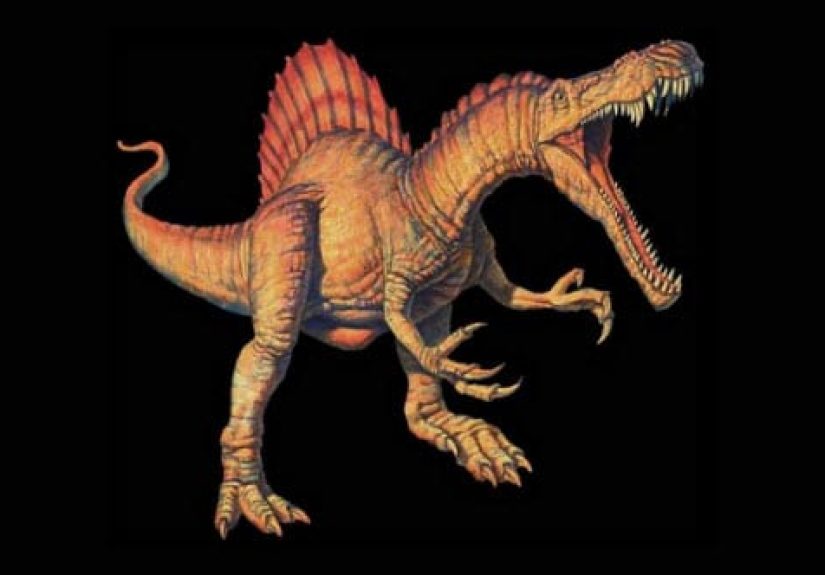
If T. rex is the king of land predators, Spinosaurus is the aquatic horror movie remake. This sail-backed giant from North Africa may have stretched 40–50+ feet from snout to tail and weighed as much as (or more than) T. rex. Its long, crocodile-like skull, conical teeth, and powerful, paddle-like tail suggest a semi-aquatic lifestyle, stalking rivers and wetlands.
Modern studies describe jaws adapted for fast-snapping attacks rather than bone-crushing, similar to modern crocodiles. Combined with strong forelimbs and that massive tail, Spinosaurus could have blitzed fish, crocodile-like reptiles, and unlucky animals that wandered too close to the water’s edge.
Why It’s Scarier Than T. rex
- It could likely hunt in both water and on land, reducing your list of “safe places” to exactly zero.
- Its towering sail would have made it visually terrifying long before it even reached you.
- Imagine a super-sized crocodile that can walk you down on shore that’s Spinosaurus energy.
2. Giganotosaurus: The Giant Southern Lizard
Giganotosaurus (“giant southern lizard”) prowled what is now South America roughly 30 million years before T. rex appeared in North America. Many estimates put it at around 40–43 feet long, possibly edging T. rex in overall length, though likely a bit lighter in build.
Instead of a bone-crushing skull like T. rex, Giganotosaurus had a long, blade-mouthed head built for slashing. Think of it as a shark-on-legs approach to hunting: big, serrated teeth for carving massive chunks out of giant plant-eaters and letting blood loss do the rest.
Why It’s Scarier Than T. rex
- Giganotosaurus likely specialized in hunting huge sauropods the dinosaur equivalent of tackling armored buses.
- Its size and slashing bite would make a human about as challenging as a crouton.
- In a chase scene, its long legs and lighter frame might be even more intimidating than T. rex’s lumbering charge.
3. Carcharodontosaurus: The “Great White Shark” on Land
The name Carcharodontosaurus literally references the great white shark, and its teeth earned that comparison. This North African predator may have reached 40–43 feet in length and rivaled the largest theropods in mass. Its skull was enormous but more lightly built than T. rex, filled with long, razor-edged teeth designed for slicing flesh rather than smashing bone.
Carcharodontosaurus lived in an ecosystem already packed with megapedators, including Spinosaurus and other large theropods. To stand out in that crowd, you had to be very good at your job namely, turning giant herbivores into prehistory’s most terrifying charcuterie board.
Why It’s Scarier Than T. rex
- Teeth that functioned like serrated steak knives, capable of opening catastrophic wounds in a single bite.
- Likely targeted enormous sauropods, meaning its “default prey size” is way bigger than you.
- The idea of a shark-inspired dinosaur hunting on land is the stuff of nightmares.
4. Mapusaurus: The Flesh-Ripper That Hunted in Packs
Mapusaurus, another massive carcharodontosaurid from Argentina, adds an extra horror element: possible pack hunting. Paleontologists discovered a bone bed containing the remains of several individuals of different ages, suggesting that these theropods may have hunted or at least lived together.
Estimates place Mapusaurus at roughly the same length as Giganotosaurus, around 11–12 meters (36–40 feet). Built with a long, deep skull and slicing teeth, Mapusaurus likely preyed on titanosaurs like Argentinosaurus some of the largest animals ever to walk the Earth.
Why It’s Scarier Than T. rex
- One giant predator is bad enough. A coordinated group of them circling a victim is horror on an entirely different level.
- Pack behavior would allow Mapusaurus to bring down prey vastly larger than itself.
- If you’re imagining “Jurassic Park raptors, but Giganotosaurus-sized,” you’re not far off emotionally even if the science is more nuanced.
5. Acrocanthosaurus: The Spined Giant of Early Cretaceous North America
Acrocanthosaurus roamed what is now North America around 110–113 million years ago, long before T. rex existed. It reached roughly 36–40 feet in length and may have weighed up to several tons, making it one of the largest predators of its time. Its most distinctive feature was a series of tall neural spines along its neck, back, and hips, forming a raised ridge or low sail.
Fossil evidence and trackways suggest Acrocanthosaurus was the dominant apex predator in its ecosystems, likely targeting large herbivores such as early sauropods and ornithopods. Its long, powerful legs and muscular build hint at a surprisingly agile megatherepod.
Why It’s Scarier Than T. rex
- Acrocanthosaurus is like meeting an earlier, heavily customized beta version of the “big slashing predator” design that produced later giants.
- The exaggerated spines along its back would have made it look taller and more intimidating no one wants a predator with built-in intimidation fins.
- It dominated huge swaths of North America; if you time-traveled there in the Early Cretaceous, this was the landlord.
6. Utahraptor: The Super-Sized Raptor
If Velociraptor is the sleek, dagger-footed hunter Hollywood loves, Utahraptor is the terrifying, upscaled version that would actually keep you awake at night. Fossils from Utah describe an early, giant dromaeosaurid that could exceed 16–20 feet in length and weigh up to 1,000 kilograms. Its most iconic feature: a curved, sickle-shaped claw on each second toe, around 9.5 inches (24 cm) long.
Utahraptor likely hunted in groups, using those claws to slash or pin prey while jaws and forelimbs did the rest. And yes, it almost certainly had feathers imagine a murderous, oversized bird of prey with a mouth full of teeth and a tactical kick.
Why It’s Scarier Than T. rex
- Speed, agility, and huge slashing claws make Utahraptor terrifying in close quarters where T. rex might struggle.
- Potential pack behavior means multiple large raptors coordinating attacks not ideal for your survival odds.
- At human scale, those foot claws are overkill in the most literal way.
7. Dakotaraptor: The Late-Cretaceous Giant Raptor
Dakotaraptor, known from the famous Hell Creek Formation in North America, was another mega-raptor, likely comparable to Utahraptor in overall size. Despite scientific debate about its exact classification, the picture is still chilling: a large, fast-running predator with long legs, powerful hindlimbs, and a vicious sickle claw on each foot.
Fossilized forearm bones show quill knobs attachment sites for large feathers meaning Dakotaraptor sported full-on wings, even though it was far too heavy to fly. Those feathered arms may have helped stabilize it during attacks, shield eggs, or make it look larger and more intimidating.
Why It’s Scarier Than T. rex
- A giant, sprinting, feathered raptor with blade-like claws is nightmare fuel, full stop.
- Its long legs suggest pursuit-predator abilities T. rex might not match over shorter distances.
- You wouldn’t even get a cool Hollywood roar before it pounced just rapid footsteps and then silence.
8. Therizinosaurus: The Edward Scissorhands of Dinosaurs
Therizinosaurus might be the strangest dinosaur on this list. It was likely herbivorous or omnivorous, but that doesn’t make it less terrifying. This towering, pot-bellied, long-necked theropod from Late Cretaceous Asia could reach around 30 feet in length and carry the longest known claws of any land animal up to about 3 feet (1 meter) long on each hand.
Those claws were probably used for pulling down branches and defending itself, not systematically shredding prey. But if you’re a human, the distinction is academic: being accidentally swatted by a dinosaur with meter-long scythes on its hands is not an experience you walk away from.
Why It’s Scarier Than T. rex
- Its claws alone look like a horror prop department got a blank check.
- Closer to you in height than T. rex, it would feel more like facing a monstrous, armed biped than a distant towering beast.
- Even if it wasn’t trying to eat you, a panicked Therizinosaurus could do catastrophic damage just by flailing.
9. Allosaurus: The Lion of the Jurassic
Allosaurus dominated Late Jurassic North America, long before T. rex existed. Often 28–35 feet long, it was lighter and more agile than later megatheropods. Its skull held dozens of sharp, serrated teeth, and many paleontologists compare its ecological role to that of a lion a top predator that likely hunted in groups or at least fed in numbers.
Allosaurus skeletons often show healed injuries and bite marks, hinting at a life of violent hunts and intraspecies conflict. Some biomechanical studies suggest it may have used its head like a hatchet, striking downward into prey with powerful neck muscles.
Why It’s Scarier Than T. rex
- In its own time, Allosaurus was the apex terror fast, agile, and potentially social.
- Its “hatchet-bite” hunting style is viscerally disturbing: imagine a predator literally chopping into flesh with its skull.
- If you dropped into the Jurassic, T. rex wouldn’t be your problem. Allosaurus would.
10. Carnotaurus: The Demonic Sprinter With Horns
Carnotaurus (“meat bull”) looks like it was designed to star in horror posters. This South American theropod had a deep skull, muscular neck, tiny arms that make T. rex’s look athletic, and two thick horns above its eyes. Its body was surprisingly lightly built, with long, slender legs indicating serious running ability.
Studies of its skeleton suggest Carnotaurus could achieve impressive speeds for such a large animal, potentially making it one of the fastest big theropods. The combination of speed, horns, and powerful jaws would have made it a terrifying pursuit predator.
Why It’s Scarier Than T. rex
- T. rex is scary lumbering toward you; Carnotaurus is scary sprinting at you.
- Its horns and thick skull may have been used to head-butt rivals or slam prey basically a charging bull with teeth.
- The preserved skin shows rows of bumps and scales, giving it a rough, almost armored appearance that only adds to the intimidation factor.
So… Was T. rex Still the Ultimate Apex Predator?
Recent biomechanical research suggests T. rex had the most powerful bite and a heavily reinforced skull, making it a uniquely efficient bone-crushing carnivore. It may also have had relatively advanced senses and problem-solving ability compared to many other theropods. In a one-on-one, neutral-setting showdown, T. rex probably holds its own or wins against many of the dinosaurs on this list.
But “scarier” is about perspective. Spinosaurus blurs the line between land and river predator. Mapusaurus and possibly other carcharodontosaurids may have hunted in groups. Utahraptor and Dakotaraptor combine speed, claws, and intelligence. Therizinosaurus wields claws that look like they were built solely to fuel nightmares. Carnotaurus adds speed and brutal headbutts.
If you somehow ended up in the age of dinosaurs, T. rex would not be your only problem and depending on where (and when) you landed, it might not even be your worst one.
Experiences and Encounters: Imagining Life With These Nightmares
It’s one thing to read about these dinosaurs on a screen; it’s another to imagine what it would feel like to share a world with them. Let’s step out of the museum label text and into a few scenarios that bring their terror a little closer to home.
Walking Under a Spinosaurus Skeleton
Picture yourself in a modern natural history museum. You walk into a dimly lit gallery and suddenly realize the “ceiling” is actually a reconstructed Spinosaurus towering above you. Its skull is longer than you are tall. The sail unfurls overhead like the ribs of some enormous shipwreck. You can read the numbers 40+ feet long, tens of thousands of pounds but it’s the emotional punch that hits hardest: this was once alive, moving, and hungry.
Now imagine being on a muddy Cretaceous riverbank, the air thick with insects and humidity. You hear a splash you can’t see. The same silhouette you just admired in a museum is now a shadow sliding through the water, and you realize you don’t even know which direction to run.
Utahraptor Country
In parts of Utah, you can hike near the formations where Utahraptor fossils were found. Today, the danger is sunburn, dehydration, and the occasional rattlesnake. Back in the Early Cretaceous, though, those same rocky ledges might have hidden feathered shapes watching from above.
Utahraptor doesn’t need to roar. It just needs to stay silent until you’re within range of a single, well-timed leap. Think about modern birds of prey eagles or hawks barely rustling the air as they strike then scale that up to a half-ton predator with sickle-claws and a pack mentality. You wouldn’t see a cinematic showdown. You’d likely see a flash of movement and then teeth.
Facing a Pack of Mapusaurus
The idea of giant theropods hunting together comes from bonebeds like the one that preserved multiple Mapusaurus individuals. Even if scientists still debate exactly how they behaved, the visual is chilling: a group of enormous predators pacing around a single enormous herbivore, testing it for weakness.
Now shrink the scene down to human scale. You’re not Argentinosaurus more like the world’s least-threatening snack. In a pack-hunter’s territory, the terror isn’t just the size of a single dinosaur, but the fact that you can be flanked, surrounded, and cut off. You don’t outrun them. You don’t outmuscle them. You just hope they’re already full.
Therizinosaurus in the Forest
You’re pushing through a dense, fern-choked forest. The canopy filters the light into greenish shadow, and you hear something up ahead: rhythmic tearing, like thick branches being dragged through gravel. You creep closer and finally see it Therizinosaurus, standing upright, calmly raking down foliage with claws longer than your arm.
It may not view you as food, but that doesn’t reduce the fear. Those claws can slice branches, fend off predators, and accidentally erase bystanders. Your brain doesn’t care that it’s mostly interested in salad; it just registers “gigantic scythe-handed dinosaur” and sends a very clear message: back away, slowly.
Carnotaurus in Motion
Most of the time we see dinosaurs in static poses bones mounted in galleries or illustrations frozen mid-roar. Carnotaurus breaks that mental mold. With its long legs and deep tail built for powerful muscle attachments, it was likely a surprisingly fast runner for a large theropod.
Imagine standing on an open plain and seeing Carnotaurus at a distance. At first, you might mistake it for some odd, horned statue. Then it moves not the slow, heavy trudge you expect, but a sharp, accelerating sprint. The head bobs like a bull’s, horns forward, jaws slightly open. You don’t get the luxury of calmly analyzing its forelimb anatomy. You just see a charging, horned predator coming at a speed your legs absolutely cannot match.
Why These Dinosaurs Still Matter
Part of the fun (and fear) of learning about prehistoric life is realizing just how creative evolution can be. T. rex deserves its fame, but it’s only one branch of a much larger and stranger family tree. From sail-backed fish hunters to pack-hunting flesh-rippers, from clawed herbivores that look like walking nightmares to high-speed horned predators, these lesser-known dinosaurs broaden our sense of what “apex predator” and even “scary” can mean.
Museums, documentaries, VR experiences, and even science-based video games give us a safe way to “meet” these animals to stand under their skeletons, compare our height to their claws, and appreciate the ecosystems they ruled. You leave with a new respect for T. rex, yes, but also with the unsettling realization that if you woke up in the Mesozoic by mistake, Tyrannosaurus might not be the first name on your “things to worry about” list.