Table of Contents >> Show >> Hide
- Quick Apollo Snapshot (So Your Brain Has a Map)
- 17 Facts About the Apollo Program
- Fact #1: Apollo began as a national promisewith a hard deadline.
- Fact #2: NASA picked a Moon-plan that required docking… around the Moon.
- Fact #3: The Saturn V was a skyscraper that moved.
- Fact #4: Apollo’s spacecraft was a three-part system, not one “ship.”
- Fact #5: The Lunar Module was built for one joband it never had to be aerodynamic.
- Fact #6: Apollo 1 reshaped NASA’s approach to safety.
- Fact #7: Apollo 4 tested the Saturn V “all-up”because time was expensive.
- Fact #8: Apollo 7 proved NASA could fly crewed Apollo hardware again.
- Fact #9: Apollo 8 went to lunar orbit before NASA even had a ready Lunar Module.
- Fact #10: Apollo 10 was a dress rehearsalright down to “almost landing.”
- Fact #11: Apollo 11’s landing wasn’t smoothit was controlled chaos with calm voices.
- Fact #12: The Apollo Guidance Computer had laughable memory by modern standards.
- Fact #13: Apollo helped push integrated circuits into the mainstream.
- Fact #14: Apollo 12 showed NASA could land with real precision.
- Fact #15: Apollo 13 never landedbut it became a masterclass in failure management.
- Fact #16: Apollo’s last three landings brought a “car” to the Moon.
- Fact #17: Apollo brought back about 842 pounds of lunar materialand scientists are still learning from it.
- Conclusion: What Apollo Proved (Beyond “We Landed”)
- Experiences: How Apollo Feels When You Touch the Story Today (500+ Words)
The Apollo Program was basically the world’s most intense group project: hundreds of thousands of people, thousands of contractors, and one extremely non-negotiable deadlineget humans to the Moon and bring them back. It wasn’t just a “Moon landing.” It was an engineering revolution, a management marathon, and a crash course in “yes, we really do need that checklist.”
Below are 17 real, can’t-make-this-up facts about NASA’s Apollo missionscovering the rockets, the computers, the close calls, and the scientific payoff. If you’re here for trivia, you’ll leave with trivia. If you’re here for inspiration, you’ll also leave with the strong urge to label everything in your house with a procedure number.
Quick Apollo Snapshot (So Your Brain Has a Map)
- Timeframe: Early 1960s through 1972 (with Apollo hardware later used for other missions).
- Primary goal: Land humans on the Moon and return them safely to Earth.
- How many landings: 6 successful crewed lunar landings.
- Signature tech: Saturn V rocket, Lunar Module, and the Apollo Guidance Computer (AGC).
- Scientific legacy: hundreds of kilograms of lunar samples and decades of research.
17 Facts About the Apollo Program
Fact #1: Apollo began as a national promisewith a hard deadline.
In 1961, President John F. Kennedy set a specific challenge: land a man on the Moon and return him safely to Earth before the decade was out. That clarity mattered. It turned Apollo into a program with a measurable finish line: not “explore space eventually,” but “do the impossible on a schedule.” Deadlines can be stressfulunless you’re a rocket, in which case deadlines are basically your love language.
Fact #2: NASA picked a Moon-plan that required docking… around the Moon.
Apollo didn’t simply “fly to the Moon and land.” NASA selected lunar orbit rendezvoussending a spacecraft to lunar orbit, then using a separate lander to descend and return. That choice reduced the mass that had to land and take off from the Moon, making the whole architecture feasible with the rockets NASA could build. Translation: they solved the Moon problem by adding a second Moon problem (docking), because engineers are like that.
Fact #3: The Saturn V was a skyscraper that moved.
The Saturn Vthe heavy-lift rocket used for lunar missionsstood about 363 feet (111 meters) tall. Fully fueled, it weighed millions of kilograms and generated staggering thrust at liftoff. The point wasn’t “big for the vibe.” The point was physics: escaping Earth’s gravity while hauling a spacecraft capable of taking three humans to lunar orbit and returning them alive.
Fact #4: Apollo’s spacecraft was a three-part system, not one “ship.”
Apollo missions used a Command Module (where the crew lived during launch and reentry), a Service Module (propulsion, power, and life support), and the Lunar Module (the two-stage lander). This division kept each part specialized: one piece designed to survive reentry, one piece optimized for deep space, and one piece engineered to land on a world with no atmosphere.
Fact #5: The Lunar Module was built for one joband it never had to be aerodynamic.
The Lunar Module (LM) looks like a bug made of foil because it didn’t need to slice through airit operated in vacuum. It was a two-stage vehicle: the descent stage landed and served as a launch pad; the ascent stage took the astronauts back to lunar orbit. It’s one of the best examples of “form follows function” in engineering history… and also of “nobody will see it in a showroom.”
Fact #6: Apollo 1 reshaped NASA’s approach to safety.
In January 1967, a ground test tragedy claimed the lives of three astronauts (Gus Grissom, Ed White, and Roger Chaffee). The loss forced major redesigns and cultural changeshardware, procedures, and the way risks were evaluated. Apollo’s later successes weren’t in spite of this; they were built on hard lessons learned early.
Fact #7: Apollo 4 tested the Saturn V “all-up”because time was expensive.
Rather than test each rocket stage separately in a slow sequence, NASA flew the first Saturn V test (Apollo 4) as an “all-up” mission: multiple stages and systems working together on the same flight. It was bold and efficient, and it helped compress the timeline. Apollo didn’t just require new technologyit required new ways of testing technology.
Fact #8: Apollo 7 proved NASA could fly crewed Apollo hardware again.
Apollo 7 (October 1968) was the first crewed Apollo mission, flown in Earth orbit to test the Command/Service Module. It validated critical systemspower, propulsion, life support, navigationunder real conditions with astronauts onboard. Think of it as the “hardware confidence restore” mission: no Moon, but a huge step toward the Moon.
Fact #9: Apollo 8 went to lunar orbit before NASA even had a ready Lunar Module.
Apollo 8 (December 1968) was the first crewed mission to orbit the Moon. It proved navigation and operations far beyond Earth orbit, and it delivered an emotional gut-punch of perspective with the famous Earthrise view. Strategically, it also demonstrated momentum at a time when the world was watching who would reach the Moon first.
Fact #10: Apollo 10 was a dress rehearsalright down to “almost landing.”
Apollo 10 (May 1969) tested the full lunar mission flow: travel to the Moon, enter lunar orbit, separate the Lunar Module, and descend close to the surfacewithout touching down. It was the rehearsal that made Apollo 11 less like a leap into darkness and more like step 19 on a very long checklist.
Fact #11: Apollo 11’s landing wasn’t smoothit was controlled chaos with calm voices.
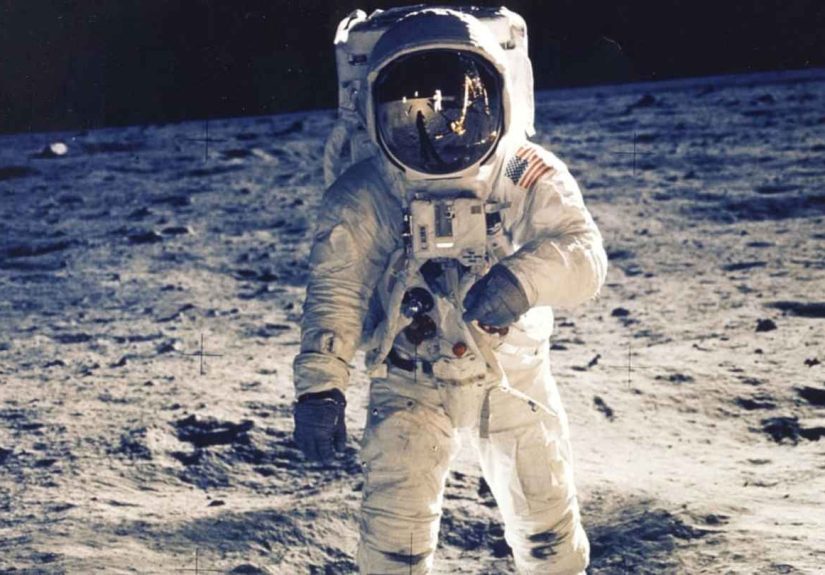
Apollo 11 (July 1969) delivered the first human Moon landing, but the final descent included alarms from the onboard computer and a last-minute manual piloting decision to avoid a hazardous landing area. It’s a reminder that Apollo’s “historic moment” was also a real-time problem-solving sprintdone while wearing a spacesuit, inside a machine, on another world.
Fact #12: The Apollo Guidance Computer had laughable memory by modern standards.
The AGC (used in the Command Module and Lunar Module) ran mission-critical navigation and control with tiny memory compared to today. It used rope memory (a form of read-only memory) and limited erasable memory for software tasks. Yet it managed real-time priorities, crew inputs, and guidance calculations with reliability that would make many modern apps cry. The lesson: good engineering isn’t about having more resourcesit’s about using what you have extremely well.
Fact #13: Apollo helped push integrated circuits into the mainstream.
Apollo’s computers relied on integrated circuits at a time when the technology was still young. That demand supported manufacturing scale, quality improvements, and confidence in microelectronics. Apollo wasn’t the only reason modern computing happenedbut it was a very loud customer with a very serious return policy: “If this fails, we don’t get a refund. We get a memorial.”
Fact #14: Apollo 12 showed NASA could land with real precision.
Apollo 12 (November 1969) demonstrated pinpoint landing ability by touching down close enough to visit the uncrewed Surveyor 3 spacecraft. That mattered because science improves when you can choose landing sites for geology, not just safety and luck. In other words, Apollo shifted from “can we do it?” to “can we do it exactly there?”
Fact #15: Apollo 13 never landedbut it became a masterclass in failure management.
In April 1970, Apollo 13 suffered a major onboard emergency that forced the lunar landing to be aborted. Engineers and crew worked together to improvise power management, navigation, and life-support solutionsusing the Lunar Module as a lifeboat. Apollo 13 is famous not because everything went right, but because the system (and people) could adapt when everything went wrong.
Fact #16: Apollo’s last three landings brought a “car” to the Moon.
Starting with Apollo 15 (1971), astronauts used the Lunar Roving Vehicle to travel farther from the landing site, carry more tools, and collect more diverse samples. This expanded the science dramaticallymore terrain, more geology, more experiments, more “hey, what’s that rock over there?” time. Mobility turned short Moon walks into real fieldwork.
Fact #17: Apollo brought back about 842 pounds of lunar materialand scientists are still learning from it.
Across six landing missions, astronauts returned roughly 842 pounds (382 kilograms) of Moon rocks and regolith. Those samples helped reshape ideas about the Moon’s origins, volcanic history, and bombardment timeline. Some samples were preserved for decades specifically so future generationswith better tools and better questionscould study them. Apollo didn’t just visit the Moon; it stocked a scientific library.
Conclusion: What Apollo Proved (Beyond “We Landed”)
The Apollo Program proved that giant goals become reachable when you combine clear objectives, test-driven engineering, and relentless attention to detailsfrom propulsion to software to human factors. Apollo also proved something more human: when thousands of people coordinate well, a “crazy idea” can become a normal Tuesday in Mission Control.
Today, Apollo is still the benchmark for ambitious engineering programs because it wasn’t one inventionit was a whole ecosystem of inventions working together. Rockets, computers, procedures, materials, training, communications, navigation, scienceApollo stitched them into one story. And then it left bootprints on the Moon as the closing signature.
Experiences: How Apollo Feels When You Touch the Story Today (500+ Words)
Most of us will never pilot a Lunar Module (and honestly, that’s probably for the bestparallel parking is hard enough on Earth). But Apollo is one of those rare historical events you can still experience in surprisingly personal ways, even decades later. The trick is to approach it less like a statue and more like a living projectbecause the records, artifacts, and human voices are still here.
If you ever walk through a space museum with Apollo hardwarelike a Command Module capsule or a Lunar Module displayyou’ll feel it immediately: these machines are smaller than your imagination expected. Photos make Apollo look like a grand floating cathedral. In person, you realize three astronauts crossed a quarter-million miles in something closer to a tough, meticulously wired camping pod. It changes the story from “wow, technology!” to “wow, humans agreed to do that in this.”
There’s also a different kind of awe that hits when you read mission transcripts or listen to recorded audio. You expect high drama; what you hear instead is competencecalm callouts, problem-solving, quick confirmation loops. It’s the sound of a system doing what it was designed to do: identify the next action, verify it, move on. And thensuddenlysomeone cracks a dry joke that reminds you these were real people living inside the checklist. The humor isn’t decoration; it’s pressure relief, the human brain staying human under maximum stakes.
Another “Apollo experience” is learning to see it as a chain of tradeoffs. The more you dig in, the more you notice how often Apollo’s success came from choosing one path and accepting the consequences: picking lunar orbit rendezvous meant mastering docking; relying on a tiny computer meant writing software that prioritized tasks elegantly; building the Lunar Module meant accepting a design that looked weird because it was honest about physics. Once you start noticing tradeoffs, you can’t unsee themand it makes Apollo feel less like magic and more like the ultimate case study in decision-making.
Even a simple night of stargazing can become an Apollo moment. The Moon stops being a decoration and becomes a destination. You look at the same bright disk people have stared at for thousands of yearsthen remember that Apollo turned it into a place with specific valleys, ridges, landing sites, and sample bags. The Moon becomes strangely “map-like.” It’s not just up there. It’s there.
And maybe the most lasting experience Apollo offers is inspiration without fluff. Apollo doesn’t say, “Dream big” in a poster-font way. Apollo says, “Dream big… and then write the procedure, test the hardware, run the simulation, fix what breaks, and do it again.” That’s why Apollo still matters: it’s proof that boldness and discipline aren’t opposites. They’re partners.