Table of Contents >> Show >> Hide
- Sir John Soane: The Original “My House Is a Museum” Guy
- The NYC Case Study: A 900-Square-Foot Apartment That Thinks It’s a Gallery
- Soane’s Playbook, Translated to Manhattan Life
- Light Like Soane: Brighten the Collection, Not Just the Room
- Color and Mood: Maximalist, Not Messy
- Storage That Performs: Built-Ins, Plinths, and Micro-Exhibitions
- Curating Like a Pro: The “Yes, But Why?” Rule
- NYC’s Superpower: The City Is Your Supply Chain
- The Soane-Inspired NYC Apartment Checklist
- Conclusion: Wonder Wins When the Room Can Breathe
- Experiences: What It Feels Like to Live in a Soane-Inspired NYC Collector’s Apartment (Approx. )
New York City apartments are famous for two things: impossibly small closets and impossibly big opinions. So when a serious collector tries to live
with serious art in a not-so-serious amount of square footage, the home can tip into chaos fastlike a museum gift shop during a surprise rainstorm.
The fix isn’t “minimalism” (NYC already gives you that in cabinet space). The fix is curation.
Enter Sir John Soane, the 19th-century English architect who treated his home like a living, breathing gallerypart labyrinth, part light machine,
part “how is there another room back here?” His London house-museum has become a pilgrimage site for designers because it proves something
comforting to anyone with a growing collection: you don’t need more space. You need better ideas.
Sir John Soane: The Original “My House Is a Museum” Guy
Sir John Soane (1753–1837) wasn’t just an architect; he was a world-class collector and storyteller who used architecture to frame objects, paintings,
and artifacts into one continuous experience. His home became a study in “worlds within worlds”tight, theatrical spaces that reveal surprises
through mirrors, skylights, layered sightlines, and unexpected openings. The house doesn’t merely store a collection; it stages it.
Soane’s secret sauce: display systems, not display piles
What makes Soane feel so modern is that he treated display as an architectural problem. Instead of asking, “Where do I put this?”
he asked, “How do I make this belong?” He used built-ins, niches, recesses, and clever wall strategies so the collection could expand without the
house collapsing under the weight of its own interestingness.
That’s exactly why Soane is such a good match for New York: when space is limited, your walls and sightlines become prime real estate.
You’re not decorating a voidyou’re designing a sequence.
The NYC Case Study: A 900-Square-Foot Apartment That Thinks It’s a Gallery
The most delightful part of this story is that the Soane approach translates beautifully to Manhattan scale. Consider a real example:
a 900-square-foot New York City apartment in a former 1890 brewery, redesigned for a dedicated art collector who had (1) run out of wall space
and (2) hit the “my apartment is in disarray” stage of passionate collecting. The goal wasn’t to sterilize the personality out of the home.
The goal was to keep the drama while installing a little… adult supervision.
Step one: the edit (a collector’s least favorite cardio)
A Soane-inspired home starts with a truth that hurts: not everything can be on display at once. Editing doesn’t mean less love; it means better
impact. Think of it like a museum exhibition: the storage room exists so the gallery can breathe.
In this apartment, the redesign followed a three-part strategy:
cull extraneous pieces, create a system to display what remains, then identify gaps and add pieces that strengthen the overall “story” of the collection.
The result still felt like a collector’s lairbut an organized one, where your eyes can land, linger, and actually enjoy what you’re seeing.
Step two: install a flexible display “infrastructure”
One of the smartest Soane-to-NYC translations is treating the walls as a changing exhibition surface. In the entry foyer of this apartment,
a picture-rail system was devised using copper tubing and hanging hardware so art could be rearranged without repeatedly damaging the walls.
That matters for two reasons: collectors rotate pieces, and New York leases are not known for their emotional support.
Translation: build a system once, then change the show whenever you want. That’s Soane energypractical magic.
Soane’s Playbook, Translated to Manhattan Life
1) “Worlds within worlds”: design your sightlines like plot twists
Soane mastered the art of the reveal. Instead of presenting everything head-on, he created moments: a framed view through a doorway,
a mirrored reflection that doubles perceived space, a vignette glimpsed from an angle that makes you walk closer.
In NYC, you can do this without touching your walls (and definitely without asking your co-op board for permission to breathe):
use tall bookcases as soft partitions, place a sculptural object where it’s visible from the entry, or align a mirror so it reflects a favorite piece
from a surprising direction. Your apartment becomes a sequence of discoveries, not a single “here’s all my stuff” blast.
2) Layer your walls: the “museum density” trick that still feels intentional
One of Soane’s most famous moves is his Picture Room strategy: a small room engineered to display far more art than seems possible.
The lesson isn’t “cram it in.” The lesson is “use structure.” Salon-style hanging works when it’s anchored by consistent spacing, a clear centerline,
and a deliberate mix of sizes.
Want the Soane effect without living in a literal maze? Try this:
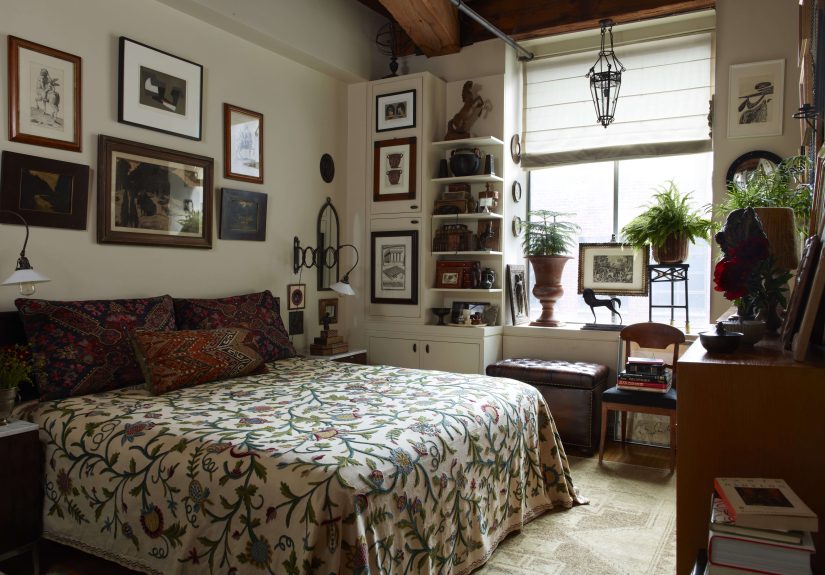
pick one wall as the “gallery wall,” define its boundaries (between the window trim, above the sofa line, or within a molding frame),
and treat it like a curated exhibition. Add a few three-dimensional objectssmall mirrors, wall-mounted sculptures, or shadowbox pieces
to break up the rectangle-on-rectangle repetition. That layered look reads “collector,” not “I lost a fight with my own frames.”
3) Consider hinged panelsyes, really (or at least the spirit of them)
Soane’s most ingenious spaces use movable surfaces to multiply display area. In modern interiors, designers borrow the idea by creating
fold-out or layered wall elementsespecially when a collection grows faster than available wall space.
If custom hinged panels aren’t in your budget (or your building’s emotional range), you can still capture the concept:
use double-hang systems (picture rails plus a lower row), lean art on shelves in front of art hung above, or mount smaller works on
panels that can be swapped seasonally. The point is flexibility and rotation, not permanence.
Light Like Soane: Brighten the Collection, Not Just the Room
Soane wasn’t chasing brightness for brightness’ sake. He was sculpting lightbouncing it, warming it, and aiming it so objects feel
dimensional and alive. A Soane-inspired NYC apartment pays attention to how light hits surfaces, frames, and textures.
Warm light, reflective surfaces, and “glow” strategies
One modern example of Soane influence is the use of warm-toned reflective materials (like yellow-tinted mirror or plexiglass) near skylights
to refract and enrich daylight. It’s a sophisticated way to combat gray days and make artworks and objects feel more luminous without blasting them
with harsh overhead fixtures.
In a typical NYC apartment, you can apply the same logic with a few moves:
- Use mirrors as light tools, not just outfit-check stations. Place one where it catches daylight and throws it deeper into the room.
- Layer lighting: one ambient source, one task source, and one accent light aimed at art or objects.
- Choose warmer bulbs in display areas so skin tones and materials (wood, bronze, textiles) look flattering, not clinical.
The aim is museum-like: the collection should feel intentionally lit, even if the “museum” is also where you eat cereal.
Color and Mood: Maximalist, Not Messy
People assume a collector’s home must be neutral to “let the art speak.” That’s only true if your art is shy.
Soane-style interiors prove that saturated color can act like a velvet backdropdramatic, stabilizing, and oddly calming when used consistently.
Use color to unify a busy room
In the NYC collector apartment, moody, saturated tones and “subdued, muddy colors” in textiles helped tie together a visually dense environment.
A strong foyer color created a theatrical entry moment, while deeper accents (like a dark, inky kitchen wall) gave the eye a place to rest.
Here’s a practical NYC-friendly rule: pick a palette of three to five repeating colors and use them like a playlist. You can add new songs,
but stay in the same genre. That keeps the home feeling curated rather than chaotic.
Architectural fragments and “curiosity objects” (without turning into a props warehouse)
Soane famously displayed fragmentscasts, architectural bits, relic-like objectsbecause they carry texture and history.
In a modern apartment, you can nod to that with a few carefully chosen pieces: a plaster fragment, a small classical bust,
a carved wood panel, or even an intentionally “imperfect” object that reads as found and storied.
The key is restraint: one great fragment is a conversation piece; fifteen fragments is a foam storage problem pretending to be aesthetic.
Storage That Performs: Built-Ins, Plinths, and Micro-Exhibitions
Soane didn’t hide everything. He organized everythingoften in ways that felt like a museum display case, but still livable.
That’s the sweet spot for NYC: storage that doubles as presentation.
Three NYC-ready display-storage moves
-
Use shelves as rotating galleries. Create “exhibitions” on a shelf: one theme (ceramics), one palette (black/cream/bronze),
or one era (mid-century pieces). Rotate quarterly so the room feels refreshed without adding clutter. -
Add plinth moments. A pedestal (or a sturdy side table used as one) elevates a sculpture or object so it feels intentional.
Elevation is psychological: it tells the brain, “This is important,” not “I set this down and forgot.” -
Make one cabinet a cabinet of curiosity. One enclosed, glass-front, or partially closed storage piece can hold the dense “small stuff”
that would otherwise scatter. It’s the difference between “collection” and “breadcrumbs.”
Curating Like a Pro: The “Yes, But Why?” Rule
Collectors often buy with their eyes and display with their anxiety. A Soane-inspired apartment flips that: buy with curiosity, display with intention.
Before anything earns a place on the wall or shelf, ask: Why is this here?
Good answers include:
- It anchors a color story (this painting stabilizes the room’s palette).
- It creates a dialogue (this sculpture echoes the curve of that chair).
- It completes a narrative (this piece fills a gap in the collection’s theme or era).
- It marks a memory (this object is personal, not just decorative).
Bad answers include:
“Because I own it” and “Because there was an empty spot.” Empty spots are allowed. Empty spots are restful. Empty spots are not failures.
Empty spots are the lungs of a room.
NYC’s Superpower: The City Is Your Supply Chain
New York rewards collectors. Between flea markets, galleries, print fairs, and the steady churn of estate sales and vintage dealers,
you can build a collection with deptheven on a “normal person” budgetif you shop thoughtfully and learn fast.
The collector in our case study gained expertise by connecting with dealers and learning how to buy with discernment.
That’s the underrated skill behind every great collector’s home: not just acquiring, but developing an eye.
The Soane-Inspired NYC Apartment Checklist
- Edit first. Store what doesn’t support the current “show.”
- Install a flexible hanging system. Picture rails, shelf-ledges, or modular hardware.
- Create sightlines. Make at least three “reveal moments” visible from different angles.
- Layer lighting. Use warm ambient + accent lighting to highlight art and objects.
- Repeat a palette. Let color unify density. Keep the vibe intentional.
- Display in groups. Micro-exhibitions beat scattered singles.
- Rotate. A living collection should move. Soane would approve.
Conclusion: Wonder Wins When the Room Can Breathe
A Sir John Soane–inspired apartment isn’t about turning your home into a museum with ropes and stern guards. It’s about using museum logic
editing, framing, lighting, and storytellingto make your collection feel at home and make your home feel larger, richer, and more alive.
In New York, where square footage is precious and personality is non-negotiable, Soane’s approach is a gift: build systems, create moments,
and let the collection unfold like a great city itselflayered, surprising, and best explored one room at a time.
Experiences: What It Feels Like to Live in a Soane-Inspired NYC Collector’s Apartment (Approx. )
Imagine coming home on a winter evening when the city is doing its usual performance artwind tunnel sidewalks, taxi horns in B-flat,
and someone arguing with a bagel. You open your apartment door and, instead of walking into a “room,” you step into a scene.
The entry is a warm, enveloping color that makes the outside world feel temporarily muted, like you’ve stepped behind the curtain at a theater.
Your eye doesn’t take in everything at once (thankfully). It catches a single object firstmaybe a small sculpture on a pedestal,
maybe a framed drawinglit just enough to feel important. Not expensive-important. Story-important.
As you move in, the apartment reveals itself in beats. A mirror catches a slice of the living room and bounces it back toward you,
turning one view into two. A framed piece you’ve seen a thousand times feels new because it’s now part of a tighter cluster,
surrounded by works that share a palette or a rhythm. You didn’t buy more art. You simply changed the hang, like rotating an exhibition.
The home feels freshly editedstill dense, still personal, but not overwhelming. The collection is present, but it’s not shouting over your life.
You start to notice how your habits shift in a space like this. Instead of dropping mail on the nearest surface (a classic New York sport),
you become slightly more intentional, because the surfaces feel “curated” and you don’t want to break the spell. Your coffee table isn’t just a table;
it’s a temporary plinth for whatever book, catalog, or object is in rotation that week. And because the room is designed for change,
you stop feeling guilty about storing pieces. Storage becomes part of the process, not a failure. The collection has seasons now.
Hosting friends becomes a different kind of pleasure, too. People don’t just sit; they explore.
Someone drifts toward the shelf that holds a cluster of ceramics because the lighting makes the glaze look alive.
Someone else notices a small framed work tucked near a doorwayan intentional “reward” for walking closer.
Conversations happen around objects, but they also happen around the logic of the space: “How did you fit all this in here?”
The answer is never “I got a bigger apartment.” The answer is “I got smarter about how the apartment works.”
And on the nights when you’re alone, the apartment feels less like a storage unit for beautiful things and more like a companion.
You catch a reflection of a favorite piece in a mirror and it surprises you, even though you arranged it yourself.
That’s the Soane trick: the home keeps offering little discoveries. It stays dynamic. It stays curious.
In a city that moves fast and asks a lot, living with that kind of wonderwithout the clutter stressis a quiet, daily luxury.