Table of Contents >> Show >> Hide
- What Happened: A Black Santa, a Mailbox, and a Very Un-Christmas Letter
- Why a Black Santa Decoration Isn’t “Political”It’s Personal
- How the Neighborhood Responded: Solidarity With a Side of Tinsel
- Zooming Out: The Long, Complicated History of Santa Imagery in America
- What a Racist Letter Is Really Trying to Do
- If You Receive a Hateful Note From a Neighbor: Practical Steps That Protect You
- How to Be a Good Neighbor When This Happens to Someone Else
- Inclusive Holiday Decorating Ideas That Don’t Feel Like a Lecture
- of Real-World Experiences and Lessons From “Black Santa” Moments
- Conclusion: The Decoration Was Never the ProblemThe Bias Was
Holiday decorating is supposed to be the low-stakes part of winter. You put up lights, your neighbor puts up lights,
and the only drama is whether “tasteful twinkle” ends up looking like “airport runway guidance system.”
But every so often, a yard display turns into a cultural flashpointespecially when it challenges someone’s narrow idea
of what’s “normal.”
That’s exactly what happened when an Arkansas homeowner placed a Black Santa decoration in his yard and later found
an anonymous, racist letter in his mailbox demanding he remove it. The story went viral, not because the note was new
(sadly, hate mail has a long history), but because the community response was a masterclass in how to handle ugliness:
with solidarity, humor, and an unshakable commitment to making kids feel seen.
Let’s unpack what happened, why a Black Santa matters, what the backlash reveals, andmost importantlywhat individuals
and neighborhoods can do when prejudice shows up uninvited like a fruitcake that’s been regifted since 1998.
What Happened: A Black Santa, a Mailbox, and a Very Un-Christmas Letter
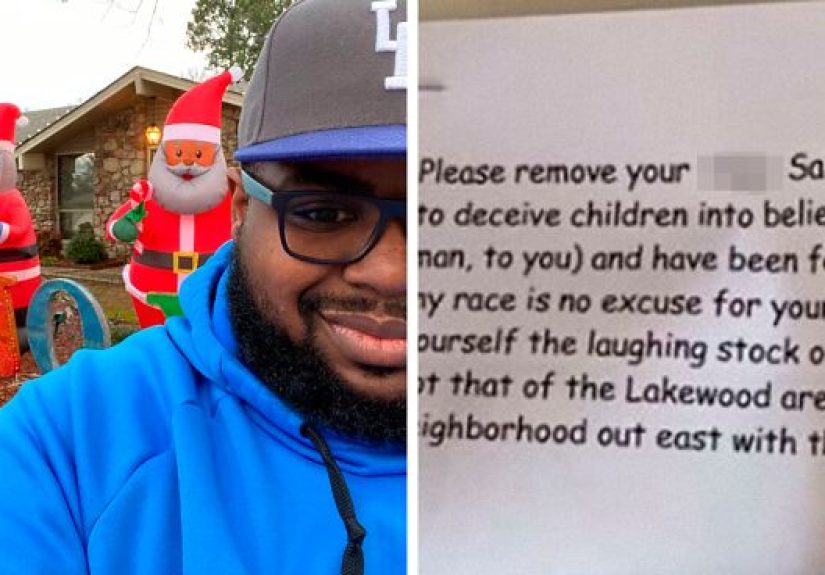
In late November 2020, Chris Kennedy of North Little Rock, Arkansas, displayed a large Black Santa decoration in his yard.
Soon after, he received an anonymous letter containing racist language and a demand that he remove the decoration. The writer
reportedly tried to sound official, suggesting the note came from a neighborhood association and even mimicking a “signed by Santa”
gimmickan odd choice for someone attempting to be taken seriously while behaving like a cartoon villain.
The message wasn’t subtle. It leaned on outdated, offensive racial framing and tried to shame the family into compliance.
The intent was clear: make the display disappear, and with it, the idea that Santaor any beloved holiday symbolcan be represented
as Black.
The “HOA Impersonation” Twist
One reason the letter caused immediate alarm is that it appeared to reference the local property owners’ association.
In coverage of the incident, the association denied sending it and expressed support for the family.
That detail matters: when anonymous hate tries to hide behind institutions, it can escalate neighborhood tension and create
confusion over who’s actually responsible.
Kennedy shared the letter publicly, and the story spread quickly. Once it did, something remarkable happened: neighbors responded
by putting up Black Santa decorations of their ownturning a single yard display into a neighborhood-wide message of belonging.
Why a Black Santa Decoration Isn’t “Political”It’s Personal
If you’re thinking, “It’s just a decoration,” you’re right… and you’re also very close to the point.
Holiday icons work because they’re symbolic. They represent generosity, wonder, and the idea that magic can show up for everyone.
When kids see themselves reflected in those symbols, it can be affirming in ways adults sometimes underestimate.
In interviews, Kennedy has explained that representation for his child was part of the motivationso she could grow up seeing
holiday joy that includes her, not just observes her from a distance.
Representation Works Like a Mirror (Not a Memo)
A Santa figurewhether in a mall, a book, or a front yarddoesn’t come with a scientifically verified skin-tone requirement.
Santa is a story character shaped by culture, art, and tradition. For many families, a Black Santa is simply a way to make the
story feel welcoming and true to their lived experience.
And the broader culture has been moving in this direction for years. Major public spaces have featured Black Santas, including
high-profile mall programs, and media outlets have documented how families seek out inclusive holiday experiences so children can
feel that sense of wonder without the unspoken message that “magic only looks one way.”
How the Neighborhood Responded: Solidarity With a Side of Tinsel
The racist letter aimed for isolationone family singled out, one yard pressured into silence. Instead, neighbors multiplied the
message. Black Santas “popped up” across the neighborhood like a coordinated flash mob, except with more inflatables and fewer
choreographed dance moves.
This kind of response matters because it changes the social math:
- Targeting becomes harder when one home becomes many.
- Shame loses power when the community rejects it openly.
- Kids learn a lesson about fairness and support that lasts longer than holiday break.
A Quiet but Powerful Message: “You Belong Here”
Community support does two things at once. It comforts the person targeted, and it signals to the anonymous writer that their views
are not the “default setting” of the neighborhood. That doesn’t magically erase prejudice, but it draws a clear boundary:
hate doesn’t get to speak for everyone.
Zooming Out: The Long, Complicated History of Santa Imagery in America
Santa’s modern image has never been one fixed, original “truth.” It’s been shaped by folklore, art, advertising, and the evolving
culture around Christmas in the United States. That’s why it’s not surprising that Santa representation has expanded too.
For decades, Black Santas have existed in different contextsespecially in communities that wanted children to experience the same
magic without being asked to mentally “translate” it into someone else’s image. In more recent years, mainstream spaces have
increasingly featured Santas of different races and backgrounds, reflecting the reality of American families.
The Mall Effect: When Representation Becomes Normal
One of the biggest shifts has come through mall and community Santa programs. When children see multiple SantasBlack Santas, bilingual
Santas, Santas with different cultural approachesthe “surprise” disappears. It becomes normal, which is the whole point.
Inclusive traditions aren’t about making a statement every time; they’re about letting kids enjoy the season without carrying the
weight of someone else’s limitations.
What a Racist Letter Is Really Trying to Do
The letter in this story wasn’t just a complaint about décor. It was an attempt to police identity and control public spaceone front
yard at a time. That’s why it used humiliation tactics (“you’re embarrassing yourself”), an appeal to tradition (“Santa is only X”),
and an implied threat (“you don’t belong here”).
In other words, it wasn’t about Santa. It was about power.
If You Receive a Hateful Note From a Neighbor: Practical Steps That Protect You
If something like this happens to you, you deserve supportand a plan. The goal is to protect your safety, document what happened,
and decide how you want to respond without being rushed into silence.
1) Save the Evidence
Keep the letter, envelope, and anything that came with it. Avoid handling it more than necessary, and take clear photos of the
contents. Documentation helps if you decide to report it, and it prevents the “it wasn’t that bad” minimization that often follows
anonymous harassment.
2) Consider Reporting It (Especially If It Came Through the Mail)
If the letter was delivered through the U.S. Mail and contains threats or intimidation, you can report it to the U.S. Postal Inspection
Service. If the message suggests bias-based harassment or a hate incident, you can also report concerns through federal channels.
Local law enforcement may be appropriate as well, depending on what the letter says and whether you feel unsafe.
3) Loop In the Right Local GroupsWithout Handing Them the Steering Wheel
If you have a homeowners association or neighborhood association, it can be helpful to inform leadershipespecially if the writer tried
to impersonate them. You can also speak with trusted neighbors, not as a request for permission, but as a way to build community support
and reduce isolation.
4) Choose Your Response Style: Quiet, Public, or Somewhere in the Middle
There’s no single “correct” response. Some people keep their display up and say nothing publicly. Others share the incident so it can’t
be hidden. Some do both: they document privately and respond publicly in a way that centers their values rather than the harasser’s words.
The healthiest approach is the one that:
- keeps you and your family safe,
- aligns with your values,
- doesn’t let an anonymous stranger dictate your choices.
How to Be a Good Neighbor When This Happens to Someone Else
One of the most encouraging parts of this story was how neighbors showed up. If you want to support someone targeted by bias or harassment,
here are actions that actually help (and don’t accidentally turn support into a spotlight they didn’t ask for).
Support That Lands Well
- Check in directly. A simple “I’m sorry this happenedhow can we support you?” goes a long way.
- Offer practical help. Cameras, extra lighting, walking with them to the mailboxsmall things can reduce anxiety.
- Mirror the message. If they’re comfortable with it, join inlike the neighbors who displayed Black Santas too.
- Don’t amplify hate language. Focus on values and support, not repeating the worst lines of the letter.
What Not to Do (Even If You Mean Well)
- Don’t pressure them into a public response. Safety and choice come first.
- Don’t turn it into gossip. “Did you hear?!” spreads harm faster than hope.
- Don’t minimize. “It’s probably just a crank” can feel like being dismissed.
Inclusive Holiday Decorating Ideas That Don’t Feel Like a Lecture
If you love the idea of making your holiday décor more inclusive, you don’t have to overhaul your entire home into a museum exhibit
titled “Diversity: Now With More Garlands.” Small choices can create a big sense of welcome.
Easy, Warm, Inclusive Ideas
- Choose décor that reflects your family. Santas, angels, nutcrackers, and ornaments come in many styles and skin tones.
- Mix traditions. Blend cultural holiday symbols if your household celebrates more than one tradition.
- Use story-friendly items. Books, stockings, and ornaments that show different families can normalize inclusion for kids.
- Focus on values. Signs that say “joy,” “peace,” and “welcome” are not controversialunless someone is allergic to kindness.
The goal isn’t to win an argument. It’s to build a home environment where children and guests feel like the warmth extends beyond the space heater.
of Real-World Experiences and Lessons From “Black Santa” Moments
Stories like this resonate because they connect to experiences many people recognizesometimes in holiday décor, sometimes in school events,
neighborhood groups, or even the tiny politics of who gets to be front-and-center in a community tradition. Homeowners who choose inclusive
decorations often describe a similar arc: first, it feels like a simple choice (“This is cute, and my kid will love it”), then it becomes a
conversation starter, and occasionally it becomes a stress test for how welcoming a neighborhood really is.
In many communities, the most common experience is quietly positive: kids wave at the display, parents smile, and nobody makes it weird.
Some families say the best part is the unplanned joylike a child pointing and saying, “Look! Santa!” with zero follow-up questions about
race, because children are remarkably good at accepting what adults model as normal. That’s one reason inclusive décor can be powerful:
it teaches without preaching. It simply exists, confidently, on a front lawn.
Another frequent experience is the “unexpected ally” moment. People report that neighbors they barely knew suddenly stop by to compliment the
display, share a quick story about their own family, or offer a supportive “Hey, love what you’re doing.” These small exchanges matter.
They’re how neighborhoods become communities instead of just ZIP codes with similar trash pickup schedules. In the Arkansas case, neighbors
didn’t just offer private encouragement; they matched the message publicly by putting up Black Santas too. That kind of collective response
is memorable because it flips the script: instead of one family standing alone, the neighborhood redefines what it stands for.
Of course, not every experience is sunny. Some people describe receiving snide commentsusually framed as “concern” about traditionor the
classic passive-aggressive line, “I’m not racist, but…” (a phrase that reliably introduces something that will, in fact, be racist).
What helps in those moments is having a values-based answer ready that doesn’t escalate: “We want every kid who walks by to feel included,”
or “Santa represents joy in our home.” Calm, clear, and not interested in debating someone into basic decency.
The biggest lesson many families share is that inclusion is rarely a one-time act. It’s a practice. Sometimes it looks like a decoration.
Sometimes it’s backing up a neighbor. Sometimes it’s choosing not to stay silent when someone tries to bully a family into shrinking.
And sometimes it’s realizing that the “magic” of the season isn’t only the lightsit’s what people do when they decide their community
will be bigger than a hateful note.
Conclusion: The Decoration Was Never the ProblemThe Bias Was
A Black Santa on a lawn is a simple, joyful thing. The outrage it provoked wasn’t about protecting children from “confusion.”
It was about enforcing a narrow view of who gets to be represented in public spaces. What made this story travel wasn’t just the ugliness
of the letterit was the clarity of the response: the family kept their display, the neighborhood showed up, and the message became louder
than the hate.
If there’s a takeaway worth keeping (right next to the ornament you swear you’ll pack carefully this year), it’s this:
when communities choose solidarity, the season gets bigger. And Santawhoever you imagine him to behas always had room for that.