Table of Contents >> Show >> Hide
- Before You Start: Know What Kind of Recording You’re Looking For
- The Main Keyword You’re Here For (Naturally): How to Access Recorded Zoom Meetings
- 7 Steps to Access Recorded Zoom Meetings (Without Losing Your Mind)
- Step 1) Confirm: Are You the Host, a Participant, or an Admin?
- Step 2) For Cloud Recordings: Go to the Zoom Web Portal and Find “Recordings & Transcripts”
- Step 3) If You’re Not the Host: Ask for the Share Link (and Check Your Email/Chat)
- Step 4) Use the Recording’s Built-In Options: Stream, Download (If Allowed), or Grab the Transcript
- Step 5) For Local Recordings: Find the File on the Recorder’s Computer
- Step 6) Troubleshoot Missing Recordings: Processing, Permissions, Storage Limits, and Retention
- Step 7) Prevent Future Chaos: Set a “Recording Routine” (So This Is Easy Next Time)
- Bonus Tips: Access Faster, Share Smarter, Stay Secure
- Conclusion: Accessing Zoom Recordings Can Be Simple (Yes, Really)
- Real Experiences: What Actually Happens When People Try to Find Zoom Recordings
- 1) “It’s recorded” (but nobody knows who hosted)
- 2) The recording “disappeared” (aka retention policies happened)
- 3) The local recording was real… and it lived on a laptop that went on vacation
- 4) “I can watch it but I can’t download it” (and that’s on purpose)
- 5) The transcript saved the day (and 45 minutes of scrubbing)
You know that moment when someone says, “Don’t worry, it’s recorded,” and you immediately feel peace… until you realize you have no idea where that recording actually lives? Welcome to the modern workplace, where everything is “in the cloud” and also somehow “not accessible right now.”
This guide breaks it down into 7 simple, non-mysterious steps to find and access recorded Zoom meetingswhether you’re the host, a participant, or the person who got forwarded a link with zero context and a “pls watch” message.
Before You Start: Know What Kind of Recording You’re Looking For
Zoom recordings usually fall into two categories, and the path you take depends on which one you need:
- Cloud recording: Saved to the host’s Zoom account online. Great for sharing, streaming in a browser, and causing panic when storage policies delete it.
- Local (computer) recording: Saved on the recorder’s device (usually as MP4/M4A files). Great for control, not great when the recorder used a laptop from 2016 with 2% storage left.
Quick rule: If someone shared a link you can open in a browser, it’s probably a cloud recording. If someone said, “I’ll upload the file,” it’s probably a local recording.
The Main Keyword You’re Here For (Naturally): How to Access Recorded Zoom Meetings
Whether you’re trying to access recorded Zoom meetings, download a Zoom recording, or track down a missing session like it’s a true-crime podcast, the next steps will get you there.
7 Steps to Access Recorded Zoom Meetings (Without Losing Your Mind)
Step 1) Confirm: Are You the Host, a Participant, or an Admin?
This isn’t about job titles. It’s about permissions. In Zoom-land:
- Hosts can usually access their own cloud recordings in the Zoom web portal.
- Participants typically need a shared link (or the host to grant access).
- Admins/Owners may have account-level controls and can manage recording settings organization-wide.
If you weren’t the host and you don’t have a link, skip ahead to Step 3because your best move is to get the recording shared to you properly.
Step 2) For Cloud Recordings: Go to the Zoom Web Portal and Find “Recordings & Transcripts”
Cloud recordings live in the host’s Zoom account online. Here’s the cleanest route:
- Sign in to your Zoom account in a web browser (not the appuse the portal).
- Open Recordings & Transcripts (wording can vary slightly by account setup).
- Look under Cloud Recordings.
- Use date filters if you have a rough timeframe (because “last Tuesday” is not a real date).
If the meeting just ended, the recording might still be processing. In that case, it may appear but won’t play immediately.
Pro tip: Cloud recordings can include multiple files (video layouts, audio-only, chat transcripts, captions, and sometimes an audio transcript). So don’t panic if you see a “file buffet.”
Step 3) If You’re Not the Host: Ask for the Share Link (and Check Your Email/Chat)
Participants usually access cloud recordings through a shareable link created by the host. That link might be in:
- An email from the host (“Here’s the recording”)
- A calendar invite update
- Slack/Teams chat (“recording here >”)
- A course LMS or company wiki
If you have a link but it asks for a passcode, don’t assume you’re locked out forever. Many organizations require passcodes by default for shared cloud recordings. Ask the host for the passcode or for a refreshed link.
Friendly script: “Hey! Can you share the Zoom cloud recording link (and passcode if required)? Thank you!” Short, polite, impossible to misinterpret. Like a unicorn.
Step 4) Use the Recording’s Built-In Options: Stream, Download (If Allowed), or Grab the Transcript
Once you open a cloud recording, you’ll typically be able to:
- Stream it in your browser (the easiest option for quick review)
- Download it (only if the host/admin allows viewers to download)
- View or download transcripts if transcription was enabled
Hosts can also set controls like link expiration, viewer registration, and whether viewers can see the transcript. So if you can’t download, it might not be “broken”it might be “intentionally locked down.”
Real-world example: Your sales team records a client demo. You can watch instantly in the browser, but downloads are disabled because the deck includes pricing. That’s not a glitchthat’s a policy.
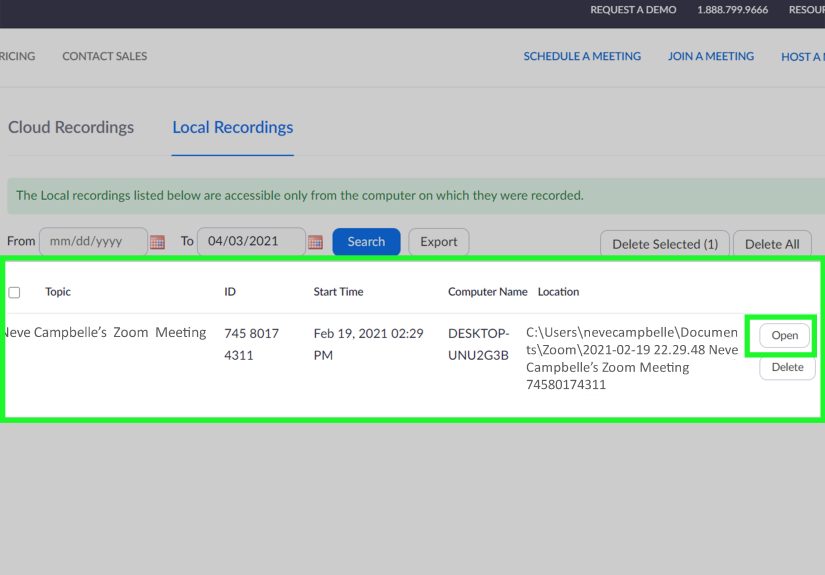
Step 5) For Local Recordings: Find the File on the Recorder’s Computer
Local recordings are stored on the device that recorded them. If you’re the person who recorded it, your fastest path is usually:
- Open the Zoom desktop app.
- Go to Meetings (or the equivalent tab).
- Open Recorded (or “Recordings”).
- Click Open (or “Open File Location”) to jump to the folder.
Typical file types you may see include MP4 for video and M4A for audio, plus optional text or caption files. If someone says, “I only have audio,” they might be looking at the M4A file and ignoring the MP4.
Sharing local recordings: If you need to send it to others, you’ll usually upload the MP4 to a company-approved storage tool (Google Drive, OneDrive, Dropbox, Panopto, etc.) and share access there.
Step 6) Troubleshoot Missing Recordings: Processing, Permissions, Storage Limits, and Retention
If you can’t find the recording, the answer is usually one of these:
- It’s still processing: Cloud recordings can take time after the meeting ends.
- Wrong account: You might have multiple Zoom logins (work, personal, school). Recordings live where they were recorded.
- Not the host: If someone else hosted, the recording is in their portal unless shared.
- Permission restrictions: Some orgs limit who can edit/delete/share recordings or allow downloads.
- Retention policies: Some accounts auto-delete cloud recordings after a set number of days.
- Trash/Deleted: Depending on settings, recordings may be moved to a trash area before permanent deletion.
Fix-it approach: Start with the simplest: confirm host + date + account. Then check processing and filters. If you’re in a managed organization (school/company), ask your Zoom admin whether recordings are auto-deleted or stored elsewhere.
Step 7) Prevent Future Chaos: Set a “Recording Routine” (So This Is Easy Next Time)
The easiest way to access recorded Zoom meetings is to make recordings predictable. Here’s a simple routine that works for teams:
- Name meetings clearly (e.g., “Client Onboarding – ACME – 03/02” beats “Weekly Sync”).
- Decide where recordings live: Cloud for fast sharing, local for long-term controlor export cloud recordings to long-term storage right after.
- Turn on transcripts for searchable notes, then download or store them with the video.
- Use passcodes and expiration for sensitive content.
- Write down the link in the meeting notes immediately after the call.
If your org records a lot, consider creating a shared “Recordings Index” document: meeting name, date, link, owner, and retention date. Future-you will act like you invented fire.
Bonus Tips: Access Faster, Share Smarter, Stay Secure
Use Searchable Transcripts Like a Superpower
If the host enabled transcription, you can often jump to key moments faster than scrubbing a 60-minute video. Look for transcript options and downloadable text/caption files. Great for: “What did we agree on?” and “Who volunteered me for this?”
Know the Difference Between “Can View” and “Can Download”
Zoom sharing settings can allow viewing in-browser while blocking downloads. If you need an offline copy, ask the host to enable downloads for viewersor to download it themselves and upload it to a controlled location with the right permissions.
Remember: Participants Usually Can’t Start Cloud Recording
Participants can sometimes be granted permission to record locally, but cloud recording is typically controlled by the host/co-host and account settings. If you’re a participant and you need a recording, the cleanest method is asking the host for the cloud link.
Conclusion: Accessing Zoom Recordings Can Be Simple (Yes, Really)
Accessing recorded Zoom meetings comes down to a few predictable questions: Was it recorded to the cloud or locally? Who hosted? And what permissions are in place? Once you answer those, the recording stops being a mythical object and becomes… a file. A normal file. Like nature intended.
Use the 7 steps above as your go-to checklist. And if you take only one thing from this guide, let it be this: recordings are easiest to find when meetings are named well and shared intentionally.
: Experiences section
Real Experiences: What Actually Happens When People Try to Find Zoom Recordings
Here are a few true-to-life scenarios (with names changed to protect the innocent and the chronically disorganized) that show why these steps matter in the real world.
1) “It’s recorded” (but nobody knows who hosted)
A project team wrapped a sprint review and everyone relaxed because, yes, it was recorded. Two days later, someone asked for the link. Chaos followed. Three people checked their Zoom portals, two people checked Slack, and one person suggested “maybe it’s on YouTube,” which is how you know a meeting has truly gone off the rails.
The fix was hilariously simple: they identified the actual host (the person who scheduled it) and found it immediately in that host’s cloud recordings. Lesson learned: if you don’t know the host, you’re searching the wrong house for the keys.
2) The recording “disappeared” (aka retention policies happened)
A manager finally had time to watch an important training sessionsix weeks after it happened. They searched and searched. Nothing. Turns out their organization had an auto-delete policy for cloud recordings to manage storage. The recording wasn’t “missing,” it was “gone,” like leftovers in an office fridge after Friday.
The team updated their routine: every important recording gets downloaded within a week and stored in a shared folder with access controls. New lesson: if something matters, don’t let it live forever in temporary storage.
3) The local recording was real… and it lived on a laptop that went on vacation
Someone recorded locally to “save cloud space,” which is a reasonable idea until the recorder is out sick, traveling, or locked out of their machine. Suddenly the recording is technically real but practically unavailable. It’s like storing the only copy of your family photos on a camera you lost in 2012.
The team switched to cloud recording for meetings that needed quick access, then exported to long-term storage after processing. Lesson: choose recording type based on who needs access, not just convenience in the moment.
4) “I can watch it but I can’t download it” (and that’s on purpose)
A new hire tried to download onboarding recordings to watch offline on a commute. The download button wasn’t there. They assumed Zoom was broken. It wasn’t. The host had intentionally disabled downloads to prevent sensitive internal info from leaving the system.
The compromise: the team provided a “travel-friendly” versionan approved summary doc plus a transcript excerptwhile keeping the full video restricted. Lesson: access controls are not the enemy; they’re just boundaries wearing a security badge.
5) The transcript saved the day (and 45 minutes of scrubbing)
In a tense stakeholder meeting, a decision was madethen immediately debated the next day. Instead of rewatching the whole recording, the team searched the transcript for the keyword (“timeline”), jumped to the exact moment, and settled it in minutes.
The team started enabling transcripts for meetings where decisions mattered. Lesson: video is great, but searchable text is what makes recordings truly useful.
If you’ve ever felt like accessing Zoom recordings shouldn’t require detective work: you’re right. Use the steps, build a recording routine, and you’ll spend less time hunting filesand more time doing literally anything else.
SEO tags in JSON format at the very end